Forensic Toxicology & Chemistry
Digestive System
Nervous System/ Types of Tissues
Cause of Death & Body Systems
Time of Death
100
The difference between a remedy and a poison is what?
The dosage, the delivery method, the duration of exposition.
100
What's the difference between chemical & physical digestion?
Physical digestion: This involves the mechanical breakdown of food into smaller pieces without changing its chemical composition. Examples include chewing in the mouth and churning in the stomach.
Chemical digestion: This involves breaking down food molecules into simpler molecules through enzymatic or chemical reactions. Examples include the breakdown of carbohydrates by saliva enzymes in the mouth or proteins by stomach acids.
100
What are the structure(s) that make up the central nervous system?
brain and spinal cord
100
What is the name for a systematic examination of a body after death used to determine how and why a person died?
Autopsy
100
Investigators find a body at 10:00 a.m. The death certificate lists 10:15 a.m. as the official time of death. What type of time of death is this?
Legal time of death
200
Describe the difference between a presumptive test and a confirmatory test.
A confirmatory test identifies and determines the exact composition of substances, while a presumptive test provides a quick indication of the presence of a substance.
200
What is the correct pathway of food as it moves through the digestive system?
Oral cavity → Esophagus → Stomach → Small intestine → Large intestine
200
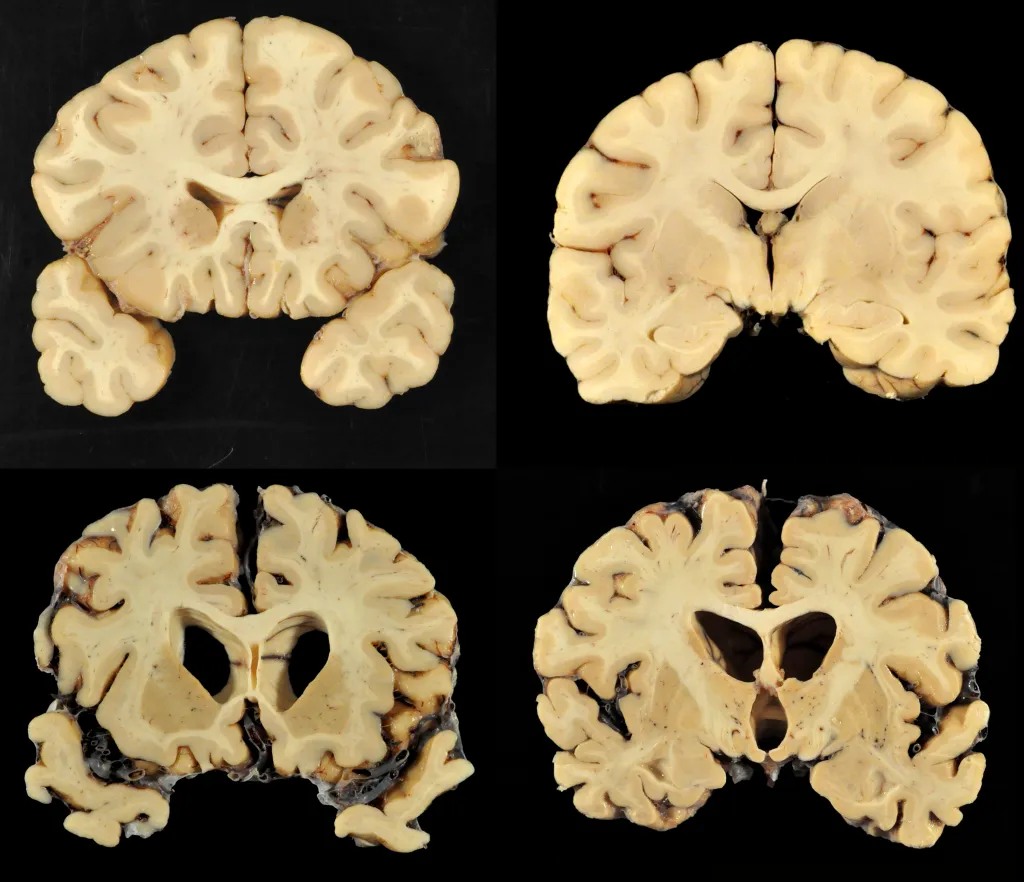
What type of brain injury do we see above?
Chronic traumatic encephalopathy
200
Who performs autopsies and records official information about death?
A medical examiner or coroner
200
A body feels warm and shows no rigor mortis. Based on postmortem changes, what can you infer about when death occurred?
Death occurred within the last 3 hours.
300
What is the primary role of a forensic chemist in an investigation?
Examine nonbiological samples to determine their identity, components, and concentration
300
Which term is defined as the process of breaking substances down and converting them into new molecules?
Metabolism
300
Which lobe is the last to develop and affects the actions and behaviors of those not yet in their 20s?
Frontal
300
Name three components of an autopsy.
Brain Exam, External Exam, Internal Exam, Documentation, etc.
300
A man is found face-up, but lividity is seen on his chest and face instead of his back. What does this suggest about what happened after death?
The body was moved after death.
400
A forensic chemist is investigating a pill found at a crime scene. First, they perform a pH test on the powdered contents of the pill. The solution turns acidic, suggesting that the substance might be an opioid. Later, the chemist conducts a blood test on a sample from the victim to confirm the presence of hydrocodone, which is found in the pill.
Which is the presumptive test, and which is the confirmatory test?
The pH test is a presumptive test, and the blood test is a confirmatory test.
400
During an investigation, a forensic scientist examines two digestive processes:
Stomach muscles contract to churn food into smaller fragments.
Gastric juices in the stomach break down proteins into smaller peptides.
Correctly identify the type of digestion occurring in each process.
1. Physical
2. Chemical
400
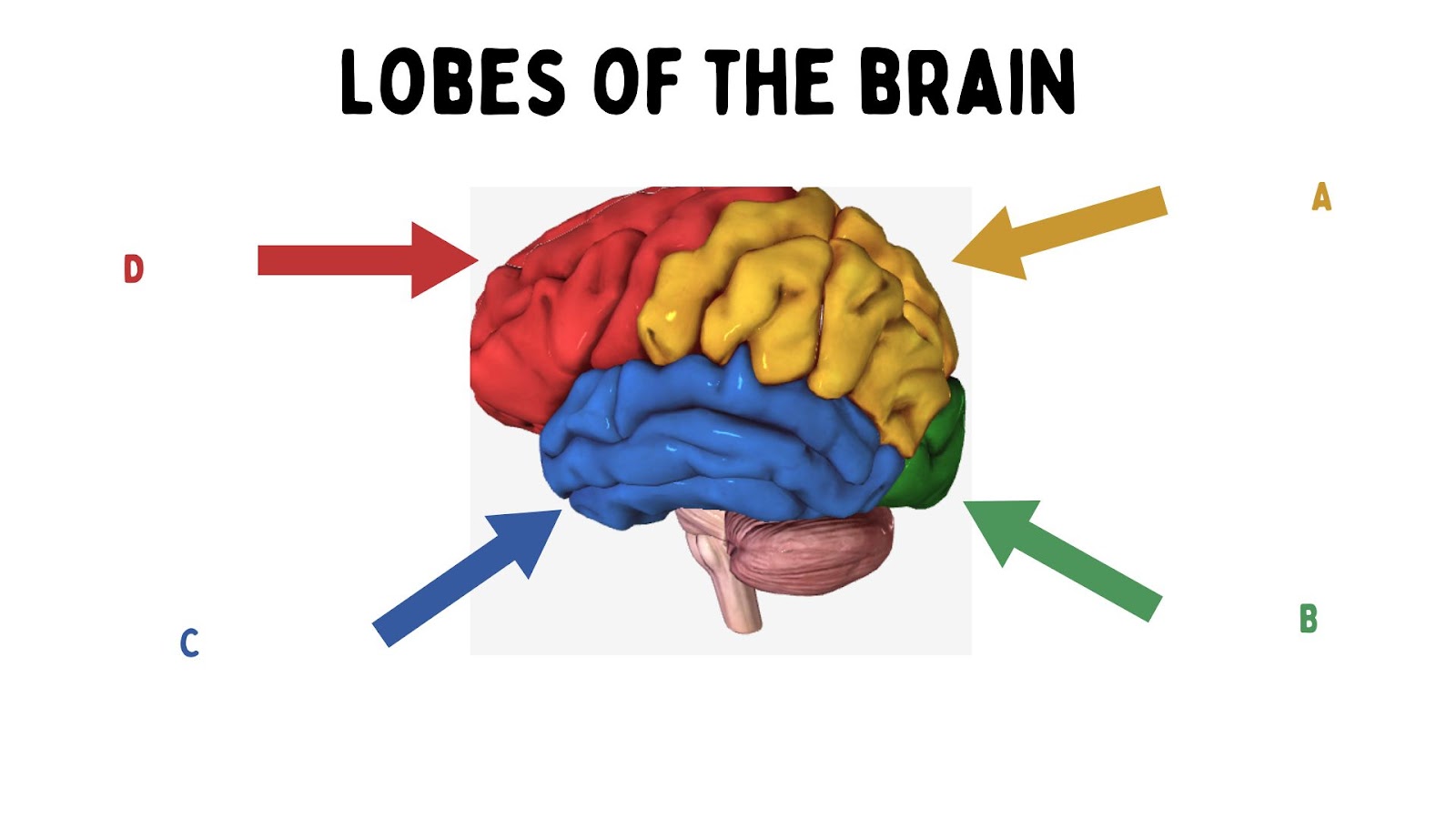
Label each lobe of the brain.
A- parietal, B- occipital, C - temporal, D - frontal
400
A toxicologist finds high levels of a drug in the bloodstream and liver. Which two systems are key to analyzing how that drug led to death?
The circulatory and digestive (or excretory) systems.
400
During a lab simulation, one group’s “body” in 0°C water cools much faster than the one at room temperature. What real-world factor does this model demonstrate?
Ambient temperature affects the rate of algor mortis (body cooling).
500
A forensic toxicologist is called to investigate a case where a college student was found unresponsive at a party. On the scene, empty bottles of prescription medication, an over-the-counter pain reliever, and several alcoholic beverages were discovered. During the autopsy, the medical examiner collects blood and stomach content samples from the decedent for analysis.
What steps should the forensic toxicologist take to determine if any substances contributed to the death, and what factors must be considered when interpreting the results?
Analyze the presence of toxic substances in blood and tissues, considering dosage, interactions, and the individual's body weight.
500
What is the function of the stomach?
Muscle contractions and digestive enzymes/acids further break down food.
500
During a forensic investigation, a medical examiner observes the following tissue types performing specific functions:
The skin's surface is formed by a tightly packed layer of cells.
The biceps muscle is contracting to lift an object.
Nerve cells in the arm are transmitting signals to control muscle movement.
Tendons are attaching muscles to the bones.
Correctly identify the types of tissue involved in each scenario.
Epithelial tissue, Muscle tissue, Connective tissue, Nervous tissue
500
A body shows a stab wound to the chest that caused an air embolism and is classified as a homicide. Identify the cause, mechanism, and manner of death.
Cause: stab wound to the chest; Mechanism: air embolism; Manner: homicide
500
An autopsy reveals full rigor mortis and a body temperature of 80°F. The ambient temperature is 70°F. Using the typical cooling rate of 1.5°F per hour, estimate how long ago death occurred.
About 12 hours ago.(37°C ≈ 98°F; 98–80 = 18°F drop ÷ 1.5°F/hour ≈ 12 hours)