Life Science 1
Life Science 3
Life Science 4
Life Science 5
Life Science 6
Life science 7
1
Where the food is made in a plant
Leaves
1
Which of the following is an inherited trait ? (a) a broken feather (b) hurt foot (c) the shape of the bird's beak (d) ability to fly over trees
What is (c)?
1
Learned behavior where animals move during the winter to find food?
Migration
1
Where does all the energy in a food chain come from?
The sun
1
What type of adaptation does a polar bear have?

Camouflage
blubber for warmth
1
What is the difference between trophic levels and consumer levels?
trophic levels start with producers - simply the number in the chain
consumer levels start with primary (1st) consumer - has to EAT something. producers do not count
2
If a small rodent eats a piece of corn, which one is the producer? (a) the rodent is the producer (b) the corn is the producer
What is b? the corn is the producer
2
Hunting skills are what type of behavioral adaptation?
learned behavior
2
What type of adaptation is this?

Mimicry
2
What stage of the life Cycle is this?

Pupa
2
Why would a plant evolve to have very large leaves?
To collect as much sunlight as possible
2
How do plants, animals, and decomposers "work together" in an ecosystem?
plants convert sunlight into usable energy, animals eat plants and other animals to move energy though ecosystem (and help redistribute plants) and decomposers break down dead waste and recycle carbon.
3
What adaptation does this animal have?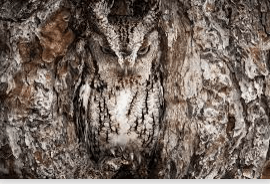
Camouflage
3
What type of metamorphosis is this ?
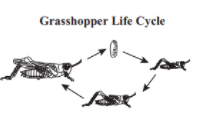
Incomplete
3
Gives the a plant support (like a skeleton)
Stem
3
What type of metamorphosis is this ?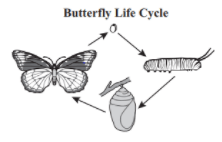
Complete
3
How do you decide how related something is?
Classification level most in common; characteristics they share, evolution line (common ancestor); adaptations, ability to mate with each other; location (or if they were close to each other in the past) genetics
3
What does Eukaryotic vs Prokaryotic mean?
euk = have nucleus, domain that has 4 kingdoms under it (plants, animals, protist, fungi)
pro = no nucleus = bacteria and archae.
4
Cross a homozygous dominant parent to a heterozygous. What will the offspring's phenotype be?
100% dominant
4
Masi learned here alphabet and her addition facts in first grade. This is an example of (a) an inherited trait (b) an instinct (c) a gene pool (d) a learned behavior
What is (d)? a learned behavior
4
What is the difference between mutualism and cooperation?
choosing to work together (coop) - same species generally vs accidentally helping each other by doing its job (mut) diff species generally
4
What adaptations helps to protect the cactus?

The sharp needles
4
Why do animals hibernate?
To save energy when there is not a lot of food available.
4
What is a scientific name made of?
Genus AND species name (Genus capitalized, species lowercase).
5
What would happen to the population of hawks and mice if the snakes disappeared?
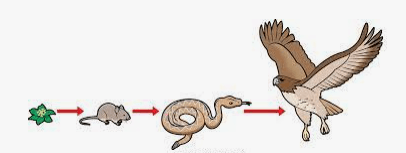
Hawks would have less to eat (some might die), mice would have one less predator so their would be more of them.
5
How does energy in this food chain travel?

From the sun to the king fisher (bird)
5
Determine what is the IV, DV, constant, controls in this experiement:
I want to test a new mouse food. I use genetically identical mice in the same size pens using the same water bottles, food bowls, and bedding. I test mouse food 1 in pen 1-5 and mouse food 2 in pens 6-10 and the industry standard mouse food in pens 11-15. I measure each day for 30 days the weight of the mice in each pen.
IV - mouse food
DV - mouse weight
constants - pen size, mouse Genetics, food bowl, water bottle, bedding
control - mice in pens 11-15 with industry standard food.
5
What adaptation allows the sea turtle to survive in the ocean?

It's limbs (flippers)
5
What factors could help increase a population?
more food, less predators, more shelter/space/water; increased birth rates; new genetic pool
5
What is DNA made of?
Sugar, Phosphate, nitrogen bases (nucleotide = 1 sugar, 1 phosphate, 1 of the 4 bases = lego piece to build).