Fossil Record
Evolution
Energy Flow and Mater Recycling
Energy and Ecosystems
Pathogens
Epidemics and Pandemics
100

Which layer is the oldest?
A. 1
B. 2
C. 3
D. 4
D. 4
100

Changes in inherited characteristics can cause a species to change into a new one. This change over time is called?
A. Graduation
B. Selective Breeding
C. Revolution
D. Evolution
D. Evolution
100
In a food web, approximately what percentage of energy is transferred from one trophic level to the next?
A. 100%
B. 50%
C. 10%
D. 1%
C. 10%
100
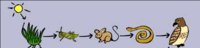
What is this called?
A. Food Web
B. Food Chain
C. Abiotic Factors
D. Natural Selection
B. Food Chain
100
Some bacteria is known as ________________ and cause disease.
A. pathogens
B. flagella
C. influenza
D. ebola
A. pathogens
100

Why do antibiotics destroy bacterial cells but have no effect on viruses?
A. Viruses are made up of organic molecules that are too small to be targeted by antibiotics.
B. Viruses are not alive and do not carry out the life functions that are stopped by antibiotics
C. Viruses do not possess the protein coat that is targeted by all antibiotics
D. Viruses are too strong for antibiotics
B. Viruses are not alive and do not carry out the life functions that are stopped by antibiotics
200

The diagram shows fossils in different rock layers. Which of these statements about the age of these fossils is most likely correct?
A. Fossil A and C are the same age
B. Fossil B is older than fossil C
C. Fossils A is older than fossil B
D. Fossil D is older than fossil C
D. Fossil D is older than fossil C
200
What must be true about a trait for natural selection to act upon it?
A. The trait must be learned during the organism's lifetime
B. The trait must be visible to predators
C. The trait must be heritable, meaning it can be passed from parents to offspring
D. The trait must appear in every individual in the population
C. The trait must be heritable, meaning it can be passed from parents to offspring
200
Which of the following is an example of coexistence and cooperation in an ecosystem?
A. A lion hunting a zebra
B. A clownfish living among sea anemone tentacles, where both organisms benefit
C. A tapeworm living inside a dog's intestines
D. Two deer competing for the same patch of grass
B. A clownfish living among sea anemone tentacles, where both organisms benefit
200
 Which organism do the owl and the weasel compete for in the food web?
A. Hawk
B. Spider
C. Grasshopper
D. Shrew
D. Shrew
200
Why are antibiotics ineffective against viral infections?
A. Antibiotics are too large to enter the bloodstream
B. Viruses do not have cell walls or cellular structures that antibiotics target
C. Viruses produce enzymes that immediately destroy antibiotics
D. Antibiotics only work in the digestive system
B. Viruses do not have cell walls or cellular structures that antibiotics target
200
A student is analyzing data showing that a new respiratory illness has infected 10,000 people across 45 different countries within two months. Based on this data, how should this illness be classified?
A. Endemic
B. Sporadic
C. Epidemic
D. Pandemic
D. Pandemic
300
Which of the following best describes analogous structures?
A. Structures that are similar in function but have different evolutionary origins
B. Structures that are identical in both form and function across all species
C. Structures that are inherited from a common ancestor
D. Structures that are only found in extinct species
A. Structures that are similar in function but have different evolutionary origins
300
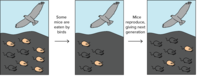
Why is the mouse population changing over time?
A. The light mice can reproduce more successfully than the dark mice
B. The hawks eat more dark mice than light mice because the dark mice taste better
C. The hawks eat more light mice than dark mice because they can see the light mice more easily
D. The hawks eat more dark mice than light mice because they can see the dark mice more easily
C. The hawks eat more light mice than dark mice because they can see the light mice more easily
300
Which process in the water cycle directly provides the water molecules needed for photosynthesis in plants?
A. Evaporation from the ocean surface
B. Transpiration from plant leaves
C. Absorption of water from the soil through plant roots
D. Condensation forming clouds
C. Absorption of water from the soil through plant roots
300
 Where does the energy start in this food chain?
A. Plant
B. Sun
C. Deer
D. Wolf
B. Sun
300
Which of the following correctly identifies a basic characteristic of fungi?
A. Fungi are prokaryotes that lack a nucleus
B. Fungi are eukaryotes that obtain nutrients by absorbing them from their environment
C. Fungi are non-living particles that require a host cell to reproduce
D. Fungi are multicellular organisms that produce their own food through photosynthesis
B. Fungi are eukaryotes that obtain nutrients by absorbing them from their environment
300
Which of the following prevention strategies would be most effective at the global level during a pandemic compared to a local epidemic?
A. Closing one school in a single district
B. Issuing travel bans, international vaccine distribution, and global health organization coordination
C. Treating only the patients in one hospital
D. Sending warning letters to residents of one neighborhood
B. Issuing travel bans, international vaccine distribution, and global health organization coordination
400

If scientists find fossils of a type of mosquito on the bottom layer and find fossils of beetles towards the top layer, what can scientists infer?
A. Mosquitos ate the beetles
B. Mosquitos are older fossils than beetles
C. Beetles are older fossils than mosquitos
D. Both mosquitos and Beetles must have lived at the same time.
B. Mosquitos are older fossils than beetles
400

The image shows light and dark colored moths that live on a tree. Which result is most likely to occur to the moth population over time due to predation?
A. The number of light colored moths in the population will increase
B. There will be more dark colored moths than light colored moths
C. The number of light colored moths will decrease
D. The dark colored moths will move to a different type of tree
B. There will be more dark colored moths than light colored moths
400

How do atoms like oxygen, carbon, and nitrogen move through an ecosystem's living and nonliving parts?
A. They are only found in living things such as plants, animals and fungi.
B. They are only found in nonliving things such as air and water.
C. They cycle through the ecosystem through living and nonliving things over and over.
D. They are used only once then lost.
C. They cycle through the ecosystem through living and nonliving things over and over.
400
Which of the following scenarios best demonstrates how a change in shelter availability affects a population?
A. A decrease in rainfall causes plants to wilt and die
B. An increase in temperature causes a lake to evaporate
C. The removal of old trees eliminates nesting sites, causing the local owl population to decline
D. An increase in sunlight causes algae to grow faster in a pond
C. The removal of old trees eliminates nesting sites, causing the local owl population to decline
400
What is the role of a vaccine in preventing viral diseases?
A. It kills the virus directly inside the body
B. It stimulates the immune system to recognize and fight a specific virus before infection occurs
C. It acts as an antibiotic to destroy the virus's cell wall
D. It prevents the virus from entering the body by creating a physical barrier
B. It stimulates the immune system to recognize and fight a specific virus before infection occurs
400
A health department notices that the number of flu cases in one city has tripled compared to the same time last year. Which concept does this data best support?
A. The flu has become a pandemic
B. The flu outbreak in the city may be classified as an epidemic
C. The flu has been eradicated from the region
D. The flu is now considered an endemic disease worldwide
B. The flu outbreak in the city may be classified as an epidemic
500

According to this cladogram, primates are most closely related to
A. Amphibians
B. Rodents and rabbits
C. Crocodiles
D. Birds
B. Rodents and rabbits
500
Which of the following statements correctly describes the role of genetic variation in natural selection?
A. Genetic variation ensures that all individuals in a population survive equally
B. Genetic variation provides the raw material upon which natural selection acts, allowing some individuals to be better suited to their environment
C. Genetic variation only occurs when the environment changes dramatically
D. Genetic variation causes all individuals in a population to evolve at the same rate
B. Genetic variation provides the raw material upon which natural selection acts, allowing some individuals to be better suited to their environment
500

The diagram shows the cycling of nitrogen through an ecosystem. If the number of denitrifying bacterial decreased, what direct effect would this have on the ecosystem?
A. More nitrogen would be available for leguminous plants.
B. Less nitrate ions would be available for assimilation in plants.
C. Less nitrogen would be available for fixation by nitrogen-fixing soil bacteria.
D. More ammonium ions would be available for nitrification by nitrifying bacteria.
C. Less nitrogen would be available for fixation by nitrogen-fixing soil bacteria.
500
An organism consumes 2000 calories of food per day. Approximately 1/10 of the energy consumed is transferred to the next trophic level. If a secondary consumer eats the primary consumer, how many calories are available to the secondary consumer from the primary consumer's energy?
A. 2000 calories
B. 200 calories
C. 20 calories
D. 1000 calories
C. 20 calories
500

HIV is
A. a bacteria that attacks humans
B. a virus that attacks the immune system
C. a bacteria that attacks the immune system
D. a virus that attacks the integumentary system
C. a bacteria that attacks the immune system
500
Which of the following explains why treatment strategies may differ between an epidemic and a pandemic?
A. Pandemics only affect elderly people, so treatments are different
B. Epidemics require no treatment because they resolve on their own
C. Pandemics require coordinated global responses and resources, while epidemics may be managed at a regional or national level
D. Epidemics are always caused by bacteria, while pandemics are always caused by viruses
C. Pandemics require coordinated global responses and resources, while epidemics may be managed at a regional or national level