Refraction/Snell's Law
Lenses
Mirrors
The mirror/lens equations
Electromagnetic Spectrum
Properties of light waves
100
The bending of light when it travels to another object.
What is refraction?
100
The type of lens pictured here:
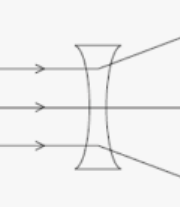
What is a diverging lens?
100
These are the 3 types of mirrors.
What is Plane, Convex, and Concave?
100
The focal length of a convex (diverging) mirror when the object is placed at 35 cm away and the image is 11 cm inside the mirror.
What is 16 cm?
100
This is the colors of the rainbow in order from least energy to most energy.
What are Red, orange, yellow, green, blue, indigo, violet?
100
This property of light filters waves to reduce glare (sunglasses) or enable 3D cinema.
What is polarization?
200
The angle of refraction when light passes from air into glass (n=1.50) when the angle of incidence is 37.0 degrees.
What is 23.7 degrees?
200
This type of lens can have real images.
What is a converging lens?
200
This is the only type of mirror that is capable of producing magnified images.
What is concave (converging)?
200
A diverging lens shows a image 5.75 cm behind the lens when an object is placed 10.8 cm behind the lens. This is the focal length of the lens.
What is (-)12.3 cm?
200
This is the relationship between frequency and energy of light.
What is directly proportional?
200
When light enters a transparent block, the speed of light slows to 2.65 x 10⁸ m/s. This is the substance's index of refraction.
What is 1.13?
300
If a ray travels from a fast medium into a slow medium, this is the way the refracted angle will bend.
What is towards the normal? (smaller angle of refraction)
300
When one uses a magnifying glass to read fine print, one uses this type of lens to make this type of image.
What is a converging lens to make a virtual image?
300
This type of mirror is used to provide a wide-angle reduced-size image, making them ideal for increasing visibility in blind spots and traffic.
What is a convex (diverging) mirror?
300
When an object is placed 10.0 cm in front of a converging lens, a real image is formed 4.30 cm behind the lens. This is the focal length of the lens.
What is 3.01 cm?
300
This is the order of the following EMS waves from longest to shortest wavelengths: x-rays, green light, ultraviolet, microwaves, and orange light
What is: microwaves, orange light, green light, ultraviolet, and x-rays?
300
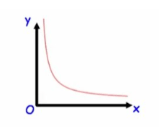
Of the graphs below, the one that would graph the frequency and wavelength of light:

What is graph #2?
400
The index of refraction for a substance that has an angle of refraction of 72.5 degrees when light travels from ice (n=1.308) with an angle of incidence of 57.0 degrees.
What is 1.15?
400
The sign of the focal length and the image distance is this in a diverging lens.
What is negative?
400
A concave mirror has a center of curvature located at 10.0 cm. This is the distance where no image would be formed in the mirror.
What is 5.00 cm? (or at the focal point)
400
This is the magnification of an image placed 24.0 cm in front of a diverging lens with a focal length of 17.0 cm.
What is 0.415?
400
This is the wavelength of a radio wave with a frequency of 103.5 MHz.
What is 2.90 m?
400
When light travels from one medium to another, this characteristic of light remains the same in both medium.
What is frequency?
500
The critical angle when light travels from glass (n=1.50) to air.
What is 41.8 degrees?
500
The attitude of the image formed by the following lens when the object is located beyond the focal point.
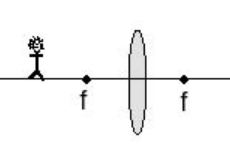
What is inverted (up-side down)?
500
These are the type, attitude, and size of the image formed of the arrow below in the concave mirror shown.
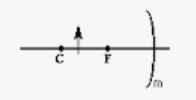
What are: real, inverted, and magnified?
500
This is the image height of a 7.50 cm object placed 8.25 cm in front of a concave mirror with a focal length of 5.00 cm.
What is -11.5 cm?
500
This is the frequency of a 227 nm ultraviolet wave.
What is 1.32 x 10¹⁵ Hz?
500
On the picture below, as light travels from glass to air, these letters show the correct refraction and reflection.
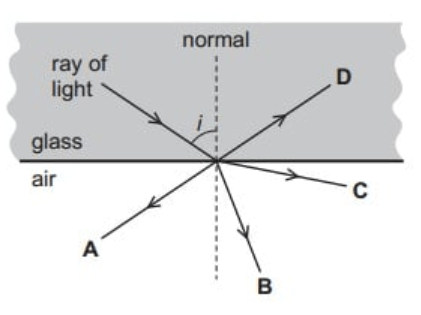
What are C for refraction and D for reflection?