Living/Non living things 1
Living/Non Living things 2
Living/Non living things 3
Living/Non living things 4
Living/Non living things 5
100
Fill in the blanks
Yeast and bacteria are.....................organisms;
what is
single-celled
100
What is growth?
what is:
a permanent increase in size due to an increase in the number of cells.
100
Define Movement
What is
The ability to change position or travel over a distance
100
Yeast is a kind of
a. bacteria
b. virus
c. fungus
d. amoeba
c. fungus
100
Mosses, pine trees and Conifers are__________
a. flowering
b. non-flowering
what is
non-flowering
200
How many characteristics do living things display or have?
Seven.
Movement, Metabolism, Respiration, Growth, Reproduction, Responding to Stimuli, Excretion
200
Name the features that makes living things different from Non-living things
Movement, Metabolism, Respiration, Growth, Reproduction, Responding to Stimuli, Excretion
200
Give two examples of responding to stimuli
e.g.
- when an animal shivers when it is cold
- when a plant grows towards the light
200
All of the following are living things except
a. cow
B. snail
c. mushroom
d. diamond
diamond
200
All flowering plants produce___________ and ______.
flowers and seeds
300
How do plants respire?
It involves using the sugars produced during photosynthesis plus oxygen to produce energy for plant growth
300
What is Biology?
What is the study of living things
300
How do plants respond to changes in light intensity?
Most plants release hormones that cause them to grow in the direction of a light source.
300
What is Reproduction?
What is
The process of making the next generation
300
what type of plants are mango, akee and ornamental flowers;
a. flowering
b. non flowering
flowering plants
400
Name the characteristics of living things
Movement, Metabolism, Respiration, Growth, Reproduction, Responding to Stimuli, Excretion
400
What type of respiration involves the breakdown of glucose in the absence of oxygen?
A: Anaerobic respiration.
400
How do hammerhead sharks locate prey?
Hammerhead sharks use specialised receptors and organs to detect electrical signals emitted by living things in the environment.
400
Plants and animals are ..................... organisms.
a. single-celled
b. multicellular
multicellular
400
Pine trees/Conifers do not have flowers but they produce pine cones. Do pine cones have seeds?
Yes
500
Fill in the blanks
Living organisms can be either many celled_________ or single celled___________
what is
multicellular and unicellular
500
define respiration
what is
It is a process in which living things release the energy they need from food (ATP) and oxygen and release carbon dioxide.
500
Define Excretion?
what is
the process by which animals rid themselves of waste products and of the nitrogenous by-products of metabolism or toxic substances from the cells and tissues of a plant or animal.
500
What is yeast?
Yeast is a microscopic, unicellular mushroom of ovoid or spherical shape.
500
Plants and animals are multicellular organisms.
What is Multicellular?
Having or consisting of many cells.
600
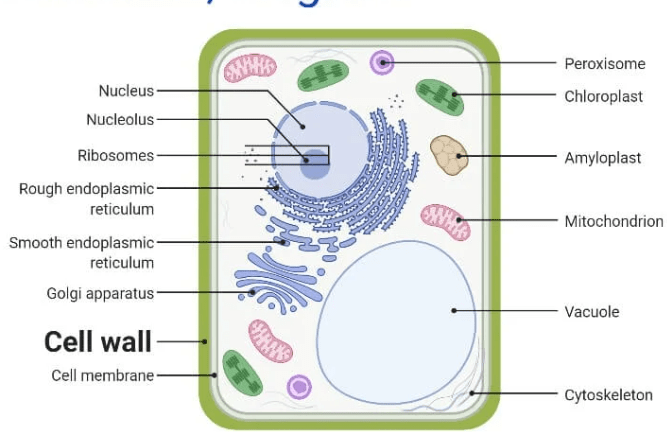
What is made of cellulose and is only found in plant cells
Cell Wall
600
A place in a cell where nutrients, water and dissolved gasses are stored V
Vacuole
600
A place where photosynthesis occurs in plant cells
Chloroplasts
600
A semi-permeable membrane or barrier in both plant and animal cells C----M____
Cell Membrane
600
Which type of cell was the first to appear on the planet?
Prokaryote
700
P_________ are organisms whose cells lack a nucleus and other organelles.
Prokaryote
700
E________ organisms whose cells have a membrane-bound nucleus
Eukaryotes
700
Organisms that contain only one Cell U___
Unicellular
700
Organism that contain Many cell M_____
Multicellular
700
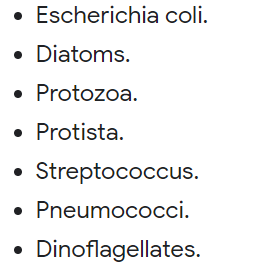
Examples of Unicellular organisms
Bacteria, Protozoa, Yeast,
800
Where DNA is found
Nucleus
800
The Centre for energy, where respiration occurs MI____
Mitochondria
800
The process by which a cell replicates its chromosomes and then segregates them, producing two identical nuclei in preparation for cell division
MI_____
MITOSIS
800
M_______is a type of cell division in sexually reproducing organisms that reduces the number of chromosomes in gametes
Meiosis
800
Pigment that makes leaves green
Chlorophyll
900
Examples of multicellular eukaryotes
animals
plants
protozoa
fungi
900
Organisms that have both Respiration and photosynthesis happening in their cell
Plants
900
Cells that can only do Respiration and not Photosynthesis
Animal Cells
900
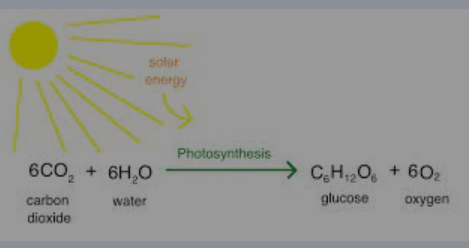
Chemical equation for photosynthesis
900
Structures responsible for controlling all cell functions and also contains DNA
Nucleus