Abiotic v. Biotic
Food Chains/ Food Webs
Community Interactions
Community Interactions
Human Impact on Ecosystem
Biogeochemical cycles
Wild Card (Random Topic)
100
What is an abiotic factor?
Non-Living factors in an ecosystem
100
All the different populations that live and interact in an environment.
A. Community
B. Population
C. Niche
D. Biosphere
A. Community
100
Recent evidence indicates that lakes in large areas of New York State are being affected by acid rain. The major effect of acid rain in the lakes is _______.
(1) an increase in game fish population levels
(2) the stimulation of a rapid rate of evolution
(3) the elimination of many species of aquatic life
(4) an increase in agricultural productivity
(3) the elimination of many species of aquatic life
100
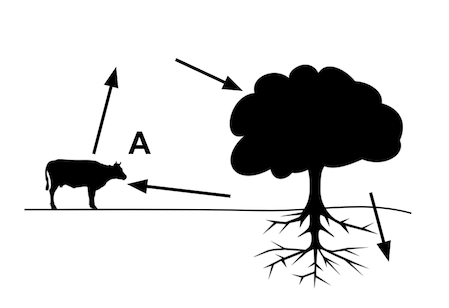
Which of the following steps of the carbon cycle is occurring at point A?
A Respiration
B Combustion
C Photosynthesis
D Decomposition
A Respiration
100
Removal of a __________________ from a community affects community structure significantly.
A) keystone species
B) niche
C) competitor
D) predator
A) keystone species
200
Nonliving parts of the environment such as soil, water, sunlight are ...
A. Decomposers
B. Biotic
C. Abiotic
D. Scavenger
C. Abiotic
200
How are autotrophs different from heterotrophs? Also, where do autotrophs get their energy?
autotrophs make energy from the sun, heterotrophs must eat other organisms for energy
200
Which human activity has probably contributed most to the acidification of lakes in the Adirondack region?
1) passing environmental protection laws
(2) establishing reforestation projects in lumbered areas
(3) burning fossil fuels that produce air pollutants containing sulfur and nitrogen
(4) using pesticides for the control of insects that feed on trees
(3) burning fossil fuels that produce air pollutants containing sulfur and nitrogen
200
Why must nutrients go through biogeochemical cycles? (ex: why must nitrogen go through the nitrogen cycle)
To be continuously replaced and maintain homeostasis within ecosystems
200

Gel electrophoresis
300
Which are the four most abundant elements in living cells?
1. carbon, oxygen, nitrogen, sulfur
2. carbon, oxygen, hydrogen, nitrogen
3. carbon, oxygen, sulfur, phosphorus
4. carbon, sulfur, hydrogen, magnesium
2. carbon, oxygen, hydrogen, nitrogen
300
An organism that survives by eating only animals.
Carnivore
300
An activity that would help to ensure a suitable environment for future generations is the increased use of__________.
1) fossil fuels
(2) pesticides
(3) biological controls
(4) chemical dumps
(3) biological controls
300
Which of the following best describes the importance of biogeochemical cycles?
A They explain how energy moves through trophic levels of an ecosystem.
B They chart how biotic changes destroy unstable ecosystems.
C They describe how the adaptations of organisms change based on environmental pressures.
D They show how certain elements and compounds move through the environment and are continually used and recycled.
D They show how certain elements and compounds move through the environment and are continually used and recycled.
300
Which sequence shows increasing complexity of levels of ecological organization?
(1) biosphere, ecosystem, community
(2) biosphere, community, ecosystem
(3) community, ecosystem, biosphere
(4) ecosystem, biosphere, community
(3) community, ecosystem, biosphere
400
Give at least 5 examples of abiotic factors in an ecosystem.
light intensity
temperature range
type of soil or rock
pH level (acidity or alkalinity)
water availability
dissolved gases
level of pollutant
400
In an energy pyramid, how much energy is passed from one trophic level to the next?
10%
400
Toxic chemicals called PCBs, produced as a result of manufacturing processes were dumped into the Hudson River. What was most likely a result of this action on fish in the Hudson River?
(1) Some fish became unfit to eat due to bioaccumulation.
(2) The fish populations increased.
(3) Thermal pollution of the river increased, decreasing the fish population.
(4) The carrying capacity for fish increased in the river.
(1) Some fish became unfit to eat due to bioaccumulation.
400
Atmospheric nitrogen (N2 gas) is easily taken up and used by plants and animals.
True or False
False
Correct! Although the majority of the air we breathe is N2, most of the nitrogen in the atmosphere is unavailable for use by organisms. In order for plants and animals to be able to use nitrogen, N2 gas must first be converted to a different form, such as ammonium (NH4+), nitrate (NO3-), or organic nitrogen.
400
Cutting down a rainforest and planting agricultural crops, such as coffee plants, would most likely result in __________.
(1) a decrease in biodiversity
(2) an increase in the amount of energy recycled
(3) a decrease in erosion
(4) an increase in the amount of photosynthesis
(1) a decrease in biodiversity
500
Name 3 processes that a living thing can do that non-living things cannot.
Examples: respiration, reproduction, digestion, metabolism, synthesis, etc.
500
Food and or home for a parasite.
A. Scavenger
B. Decomposer
C. Host
D. Consumer
C. Host
500
Name four human activities that are detrimental to the environment.
Pollution, deforestation, burning of fossil fuels, littering, habitat destruction, etc.
500
What is the most common way that nitrogen fixation occurs?
A. lightning
B. nitrogen-fixing bacteria
C. fossil fuel combustion
D. forest fires
B. Nitrogen-fixing bacteria
Correct! Microorganisms, particularly bacteria, play major roles in all of the principal nitrogen transformations. Nitrogen-fixing bacteria often form symbiotic relationships with host plants. In fact, most nitrogen-fixing is carried out by bacteria.
500
The Galapagos finches evolved partly due to:
1. Migration and selective breeding
2. mutation and asexual reproduction
3. variation and competition
4. cloning and recombination
3. variation and competition