What the Cell?
Humans Rule the World
Mitosis, Meiosis
Pot-ay-to, Pot-ah-to
Pot-ay-to, Pot-ah-to
Darwin FTW!
Miscellaneous
100
Small but mighty, this is where proteins are made.
What is a ribosome?
100
The name for what happens to an ecosystem if nature is allowed to just run its course, uninterrupted by man or natural disasters, where large stable trees eventually outcompete grasses and shrubs.
What is ecological succession?
100
This process, important in growth and repair, produces identical copies of the original cell.
What is mitosis?
100
A major public health issue, when bacteria are no longer killed by antibiotics that used to kill them.
What is antibiotic resistance?
100
These two systems are critical in maintaining a balanced equilibrium while running.
What are the respiratory and circulatory systems?
200
This important organelle is the place where glucose and oxygen are converted to ATP in cellular respiration.
What is the mitochondria?
200
A variety of living organisms that is essential for a stable ecosystem.
What is biodiversity?
200
The driver of genetic diversity - this is the reason your (non-identical twin) siblings are similar but ultimately different to you.
What is meiosis?
200
Two drivers of evolution.
What are mutations and sexual reproduction?
200
It's a change to this feature of an enzyme that causes it to no longer work well (denature) when the conditions of its environment (like pH or temperature) change.
What is its shape?
300
The function of this organelle is to give the cell shape and regulate what enters and exits the cell.
What is the cell membrane?
300
Only 10% of the food energy available at a level of the food pyramid makes it up to the next trophic level - the 90% that is lost is lost as which form of energy?
What is heat?
300
If the original cell has 30 chromosomes, after meiosis this is how many "daughter" cells will have been produced with this many chromosomes.
What is 4 and 15?
300
Nature/the environment causing an increase in the number of times a gene appears in a population, because the trait associated with that gene helps organisms survive and reproduce.
What is natural selection?
300
An immune response to something that is not a pathogen.
What is an allergy?
400
Only present in certain cells, this is where autotrophs make their own glucose.
What are the chloroplasts?
400
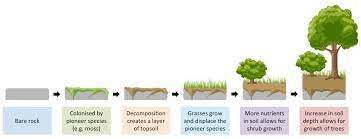
What is primary succession?
400
The correct order of mitosis, meiosis and differentiation.
What is meiosis, mitosis and differentiation?
400
Unlike natural selection, this process is the result of humans intentionally choosing certain genes over others to produce offspring with specific traits.
What is selective breeding?
400
Fertilization occurs here while the baby grows there.
What is the Fallopian Tubes (fertilization) and the Uterus (baby grows)?
500
Often analogized to the brains of the cellular operation, this important organelle is home to DNA (and only DNA).
What is the nucleus?
500
A phrase used to describe that decisions should consider both the PROS and CONS of anything with an environmental impact.
What is trade-off?
500
This process, when occurring out of control, leads to cancerous growth.
What is mitosis?
500
A random change to the genetic sequence that causes a change to the protein made from those instructions.
What is a mutation?
500
These are the blood cells that make antibodies.
What are the white blood cells?
1000
The part of the leaf that allows carbon dioxide in and oxygen and water vapor out.
What are the stomata?
1000
The necessary beginning of any food chain or web.
What are plants/autotrophs/producers?
1000
If a strand of DNA has 14% A, this is the percentage of C.
What is 36%?
1000
The delivery of weakened pathogens or the instructions to make a pathogen's antigens, stimulating the body to make antibodies to protect against future disease.
What is vaccination?
1000
The type of organism that must do both photosynthesis and cellular respiration to survive.
What are autotrophs?