Vocabulary
Materials, Substances and Particles
How Solids and Liquids Behave
Melting and Solidifying
Chemical Reactions
50
Use your vocabulary paper to find and match the following descriptions:
a. all materials are made of this
b. all matter is made of this
a. matter
b. particles
50
Decide if each of the statements below describes a solid or a liquid.
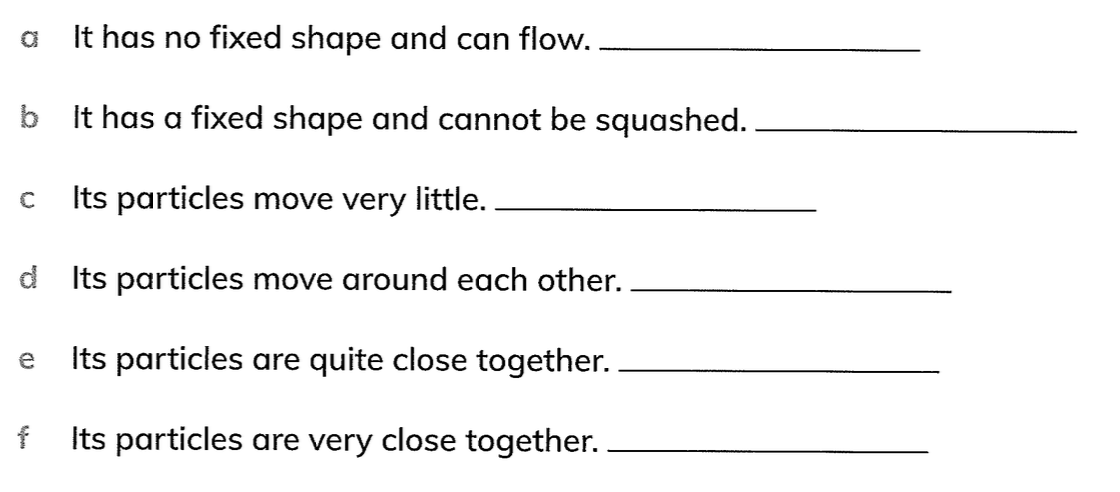
a. liquid
b. solid
c. solid
d. liquid
e. liquid
f. solid
50
Complete these sentences to explain why water changes shape when poured into different containers. Use the words in the box.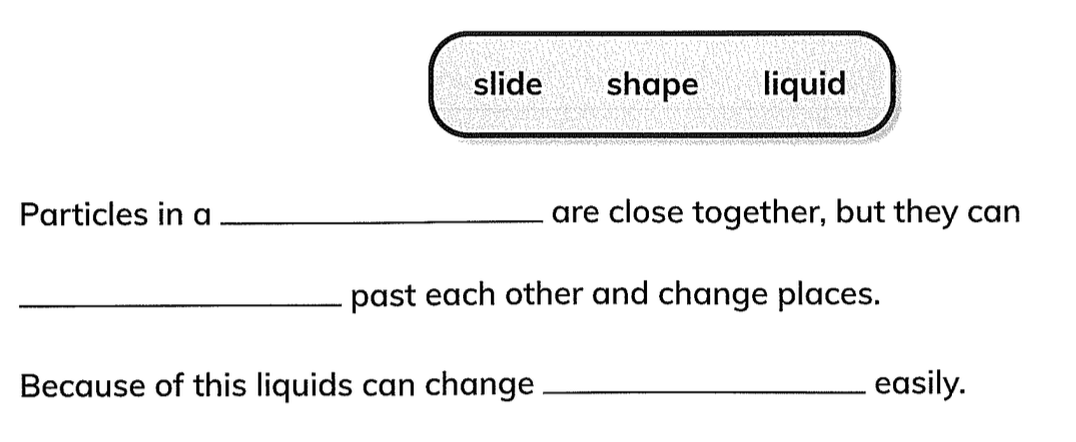
liquid
slide
shape
50
Choose the correct answer to each of the questions.
1. When ice cream becomes liquid on a hot day it is ...
A. freezing B. melting
C. soldifying D. cooling
2. We can show the process of melting like this:
A. liquid + heat → solid
B. gas - heat → liquid
C. solid + heat → liquid
D. solid - heat → liquid
1. B. melting
2. C. solid + heat → liquid
50
Decide which of the statement about chemical reactions are true and which are false.
a. A chemical reaction can happen with only one substance.
b. We need heat for chemical reactions to happen.
c. Rust is a chemical reaction.
d. Cake can be changed back into the substances it was made from.
e. When we mix sand with water, it is a chemical reaction.
f. Chemical reactions make new substances form.
a. false
b. false
c. true
d. false
e. false
f. true
100
Use your vocabulary paper to find and match the following descriptions:
a. when a substance changes form, but the type of substance does not change
b. when we mix together two substances and they both change to make a new substance
a. physical process
b. chemical reaction
100
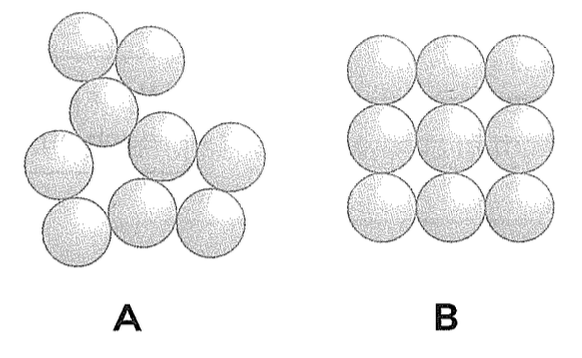
Imagine that you have 9 particles of matter. Draw the arrangement of the particles in:
A. a liquid
B. a solid
100
Read the descriptions of how materials behave and decide if it is a 'solid' or a 'liquid'.
a. the shape does not change on its own
b. can flow and take the shape of its container
c. can change shape by spreading out over a surface
d. sometimes we can make it change shape if we squeeze or push hard enough
a. solid
b. liquid
c. liquid
d. solid
100
Choose the correct answer to each of the questions.
3. We can show the process of freezing like this:
A. liquid - heat → solid
B. gas + heat → liquid
C. solid + heat → liquid
D. gas - heat → solid
4. Solids melt because ...
A. their particles gain energy and break away from the solid
B. their particles are not moving fast enough to stay in the solid
C. new liquid particles form when the solid is heated
D. solids cannot keep their shape when heated
3. A. liquid - heat → solid
4. A. their particles gain energy and break away from the solid
100
Sofia put a metal nail into a saucer of water. After three days she observed that the nail was covered in a reddish-brown substance.
a. What is the reddish-brown substance?
b. What three substances are needed for it to form?
c. What do we call the kind of process that forms new substances?
a. rust
b. metal, water and air
c. chemical reaction
150
Use your vocabulary paper to find and match the following descriptions:
a. when a liquid changes state to become a solid
b. when a solid changes state to become a liquid
a. solidifying
b. melting
150
Read the descriptions of how particles behave below. Write 'solid', 'liquid' or 'both' for each description.
a. particles are always moving
b. its particles move around each other
c. the space between the particles is very small
d. particles are packed tightly together in a regular pattern
a. both
b. liquid
c. solid
d. solid
150
Name four types of solids that act like liquids. We sometimes call them powders.
sand, flour, salt and sugar
150
Sofia pours water into an ice tray. She puts the ice tray in the freezer.
a. In which state of matter was the water when she started to put the ice tray into the freezer?
b. In which state of matter will the water be when she takes the ice tray out of the freezer?
a. It was a liquid.
b. It will be a solid.
150
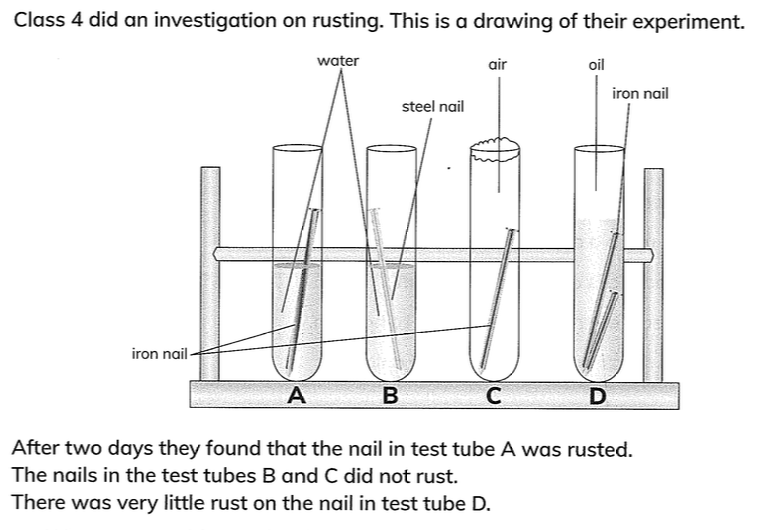
Why was there very little rust on the nail in the test tube of oil?
There wasn't any water in the test tube and the oil kept the air out.
200
Use your vocabulary paper to find and match the following descriptions:
a. kinds of matter that we use, such as glass and plastic
b. pure water and salt are examples
c. a reddish-brown powder that forms on some metals
d. a solid with small grains that have air and space between them
a. materials
b. substances
c. rust
d. powder
200
Read the descriptions of how particles behave below. Write 'solid', 'liquid' or 'both' for each description.
e. particles cannot move around very much
f. particles are close together but not in a regular pattern
g. there are bigger spaces between particles
h. it is made of particles
e. solid
f. liquid
g. liquid
h. both
200
Sand is a solid.
a. In what way does sand behave like a liquid?
a. We can pour sand.
200
Sofia pours water into an ice tray. She puts the ice tray in the freezer.
c. Why did the water change from the one state to the other?
d. Name the process that took place to make the water change state. It is a type of physical process.
c. It lost heat in the freezer. It got cold in the freezer.
d. Solidifying or freezing
200
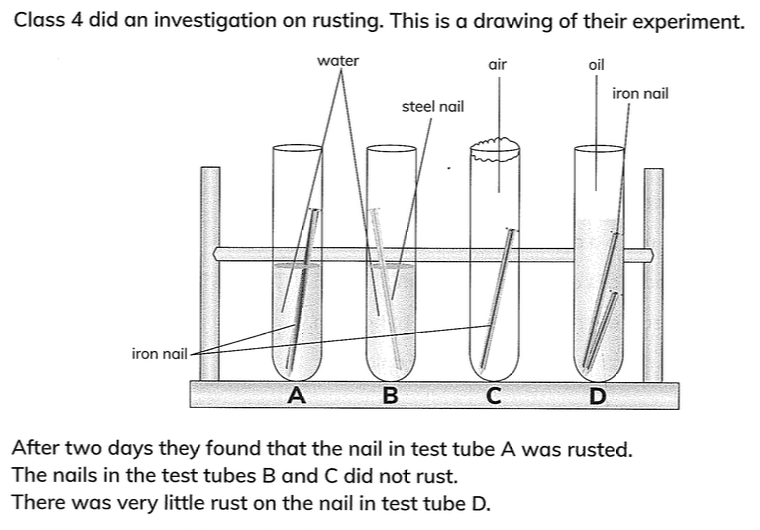
This was NOT a fair test. Say why.
To make this a fair test, you must use the same type of metal nails; for example, only use iron nails in all four test tubes.
250
Use your vocabulary paper to complete the sentences.
a. Cooling causes a liquid to _______________. For example, water changes into ice.
b. Heating causes a solid to _______________ and change state from solid to _______________.
c. If the _______________ are more loosely packed so that they can slide over each other, the substance is a ______________.
d. If the _______________ are closely packed, so that they can only move a little bit, the substance is a _______________.
a. solidify
b. melt, liquid
c. particles, liquid
d. particles, solid
250
1. Explain the difference between a material and a substance.
2. Is glass a material or a substance? Say why.
3a. How are sand and pure water similar?
b. How are they different?
1. A material is a mixture of substances, like plastic or rubber. A substance is a pure type of solid, liquid or gas; it is not a mixture.
2. Glass is a material because it is made of different substances.
3a. They are both made of matter and particles.
b. Pure water is a substance. Sand is not a
substance: it is a mixture or a material.
250
Why is sand able to behave like a liquid? Use the words: grains, air, space, move, flow, liquid.
Sand is made of lots of tiny grains. There is air between the grains which means that the grains have space to move into. This lets the grains flow past one another like the particles in a liquid.
250
e. Why could Sofia pour the water into the ice tray before she put it in the freezer? Use the word 'flow' OR 'pour' in your answer.
e. The water was a liquid and liquids can flow or be poured.
250
Rusting is a chemical reaction. Say why this is so and use the word 'react'.
Metal reacts with water and air to form rust, which is a new substance.