Trigonometry Basics
Factors and Factoring
Irrational Numbers and Radicals
Rational Exponents
Exponent Laws
Potpourri
100
This ratio compares the side opposite an acute angle to the side adjacent to that angle in a right triangle.
Tangent
100
This is the largest factor that two or more numbers have in common.
Greatest common factor (GCF)
100
This is a number that cannot be written as a fraction m/n (where m and n are integers and n ≠ 0); its decimal form neither terminates nor repeats.
Irrational Number
100
This is an exponent that is a fraction, where the numerator represents a power and the denominator represents a root.
Rational (fractional) exponent
100
An exponent that indicates the reciprocal of the base raised to the corresponding positive exponent
Negative exponent
100
The small number outside the radical symbol that indicates the root (e.g., 3 in ∛x).
Index
200
This is the angle between the horizontal and the line of sight when looking downward at an object.
Angle of depression
200
Factor completely: (6n+9)
3(2n+3)
200
Tell whether each number is rational or irrational: √25, √26, 1.21, ∛(−30).
In order: Rational, irrational, rational, irrational
200
Evaluate:
a) 27^(1/3)
b)
(0.49)^(1/2)
a) 3
b) 0.7
200
Evaluate:
a) 3^-2
b) (-64)^(-2/3)
a) 1/9
b) 1/16
200
Method of calculating the hypotenuse if both legs of a right angle triangle are known.
Pythagorean Theorem
300
A guy wire makes a 56° angle with the level ground and is anchored 15.4 m from the base of a tower. How high up the tower does the wire reach, to the nearest tenth of a metre?
22.8m
300
Determine the square root of 1296 using prime factoring.
36
300
Write √675 in simplest form.
15√3
300
Evaluate 81^0.75 without a calculator.
27
300
Simplify by writing as a single power: 0.3⁻³ · 0.3⁵
0.3²
300
Area of the blue area in terms of x.
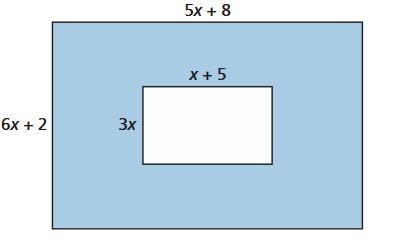
27x^2+43x+16
400
A fire truck ladder extends 30.5 m and makes a 77° angle of inclination with the ground. How far up the wall can the ladder reach, to the nearest tenth of a metre? Identify which ratio you used and why.
29.7m. Use sine because hypotenuse and angle are given and opposite side is unknown.
400
For the polynomial 5x⁴ − 80y⁴
a) Factor completely
b) What kind of special polynomial is this?a)5(x² + 4y²)(x + 2y)(x − 2y)
b) Difference of squares
400
a) Simplify the radical √(49/16).
b) Explain how you can tell — without a calculator — whether √14 is rational or irrational.
a) 7/4
b) Irrational, 14 is not a perfect square so √14's decimal form will neither terminate nor repeat and so cannon be expressed as a fraction (m/n, n =/=0).
400
A student claims that
(-729)^(1/3)
is undefined because you cannot take the square root of a negative number. Explain the error in this reasoning and evaluate
(-729)^(1/3)
Student is confusing index of 3 with index of 2. Only even indexed roots for negative numbers are undefined.
(-729)^(1/3) = -9
400
Simplify and explain your reasoning: (x³y²)(x²y⁻⁴)
x⁵/y² (Product of powers: add exponents for like bases: x³⁺² = x⁵ and y²⁺⁽⁻⁴⁾ = y⁻² = 1/y²)
400
a) Paleontologists use the formula v = 0.155 s^(5/3) f^(7/6) where v is the speed in metres per
second, s is the distance between successive
footprints of the same foot, and f is the
foot length in metres to estimate dinosaur speed. Estimate the speed when s = 1m and f = 0.25m. Round to two decimal places.
b) Explain why a negative exponent does not necessarily make a value less than 1.
a) 0.03m/s
b) If the original value is is a value less than 1 taking the reciprocal of that value will result in a value greater than 1 (e.g. (1/4)^-1 = 4 )
500
A zip-line cable is 150 ft long and anchored at a platform 45 ft above the ground.
a)Calculate the angle of elevation of the cable from the ground stake to the platform, to the nearest degree.
b) Explain how you would solve the triangle completely.
a) 17°
b) To solve completely: the third angle is 90° − 17° = 73°, and the horizontal distance is √(150² − 45²) ≈ 143.1 ft (or use cos 17° × 150)
500
Factor by decomposition: 6k² − 11k − 35. Verify your answer.
(2k-7)(3k+5)
500
A cube has a volume of 2187 cubic centimetres. What is the perimeter of one face of the cube? Give your answer as a mixed radical in simplest form.
36∛3cm
500
a) Evaluate (9/16)^-(3/2) , showing each step.
b) Why can you evaluate the root and the power in a fractional exponent in either order?
a) 64/27
b) They can be evaluated in either order because x^(m/n) = (ⁿ√x)^m = ⁿ√(x^m) - the operations of root taking and power raising are commutative (i.e. order doesn't matter).
500
Simplify: (−2x²y)³ · (3xy⁻²)². State which exponent laws you used and verify your answer by evaluating the original and simplified expressions when x = 1 and y = 2.
−72x⁸/y
500
A rectangular prism has a volume of 2400 cm³, with length 3x cm, width 2x cm, and height x cm. Write an equation in terms of x, solve for the exact value of x as a radical in simplest form and explain how exponent laws and roots are connected in your solution.
2∛50 cm
To get x by itself, need to raise both sides to the 1/3 power (3 x 1/3 = 1), which is the same as taking the cube root of both sides.