Unit 5
Unit 6
Unit 7
Unit 8
Wildcard
100
What function describes the graph shown below?
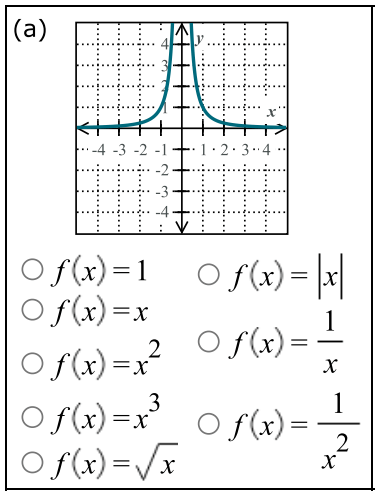
f(x)=1/x^2
100
The functions r and s are defined as follows:
r(x)=4x^2
s(x)=3x
evaluate (s+r)(2)
(s+r)(2)=22
100
What is the Vertex of Function 1?
What is the Vertex of Function 2?
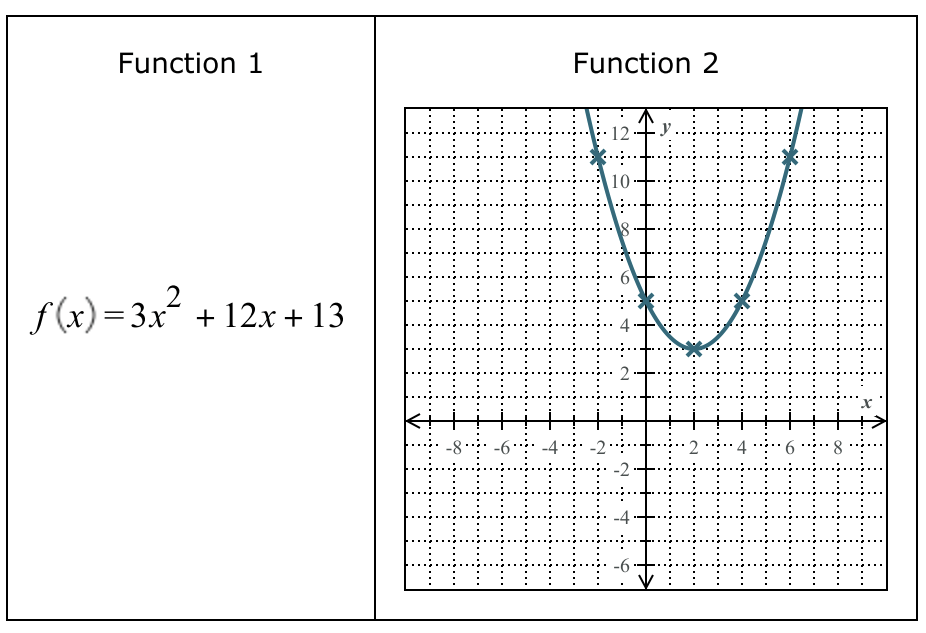
Vertex of function 1: (-2,1)
Vertex of function 2: (2,3)
100
Find a polynomial that has the following zeros. Leave it in factored form.
6, 0, 5, -7
x(x-6)(x-5)(x-7)
100
What intervals on the graph below are strictly increasing?
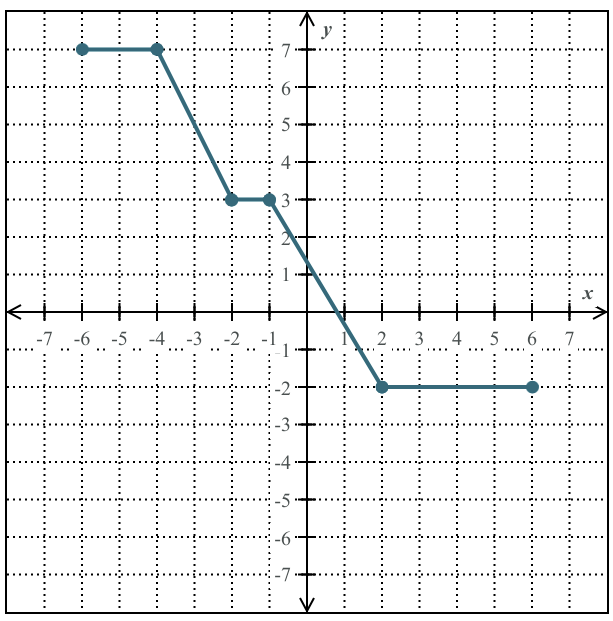
None
200
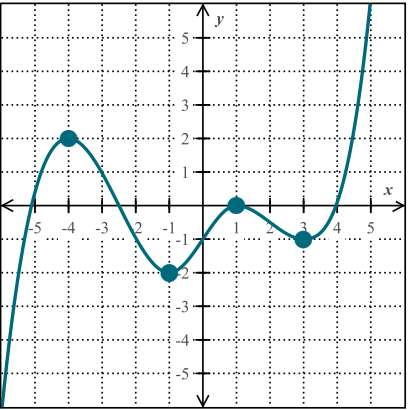
a) What are all the local minimum values of f?
b) What are the values at which f has a local minimum?
a) -2, -1
b) -1, 3
200
The functions of f and of g are defined as follows:
f(x) =−5x + 3
g(x)=sqrt(2x-1)
Find (f*g)(x) and write the domain of (f*g)(x) in interval notation.
(f*g)(x)=(-5x+3)(sqrt(2x-1))
The domain of (f*g)(x) is
[1/2,∞)
200
What is the domain and range of the graph below? Use interval notation.
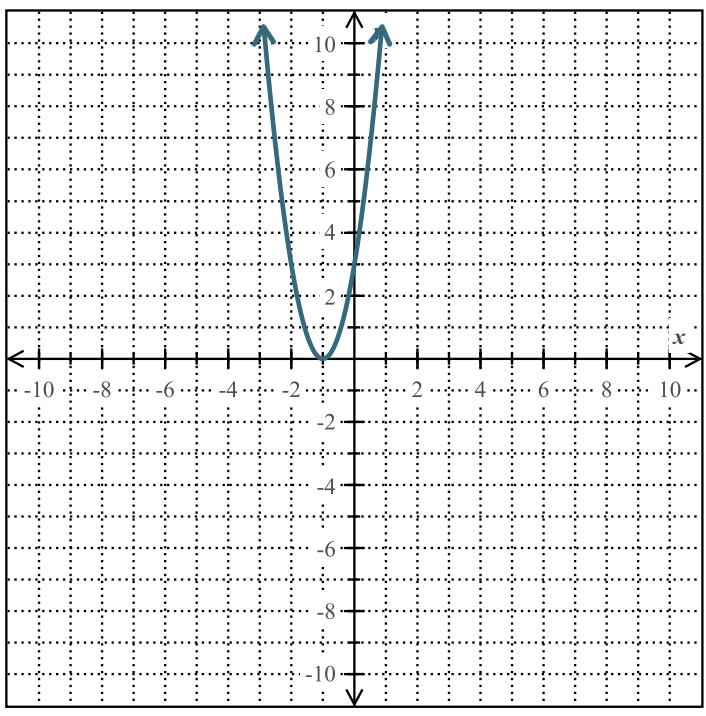
Domain: (-∞, ∞)
Range: [0,∞)
200
At what zeros does the graph touch or cross for the following polynomial?
f(x)=-4x(x-4)(x+2)
The graph crosses at x=0, x=4, x=-2
200
Manuel is cooking a roast. Below is a table of the temperature of the roast R(t) a few times t after he removed it from the oven.
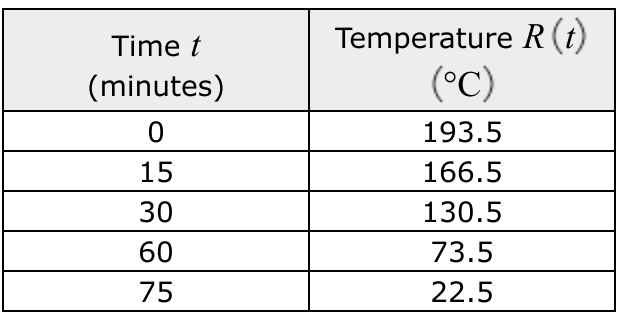
What is the average rate of change for the temperature from 0 to 15 minutes?
-1.8 Celsius per minute
300
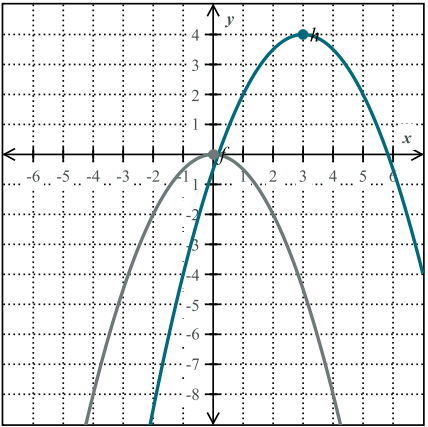
The graph of f(x) has been translated to obtain the graph of h(x).
f(x)=-1/2x^2
What is h(x)?
h(x)=1/2(x-3)^2+4
300
Find the average rate of change of f(x)=-3x^2-2 from x=4 to x=8
The rate of change is -38
300
What is the equation of the graph shown below?
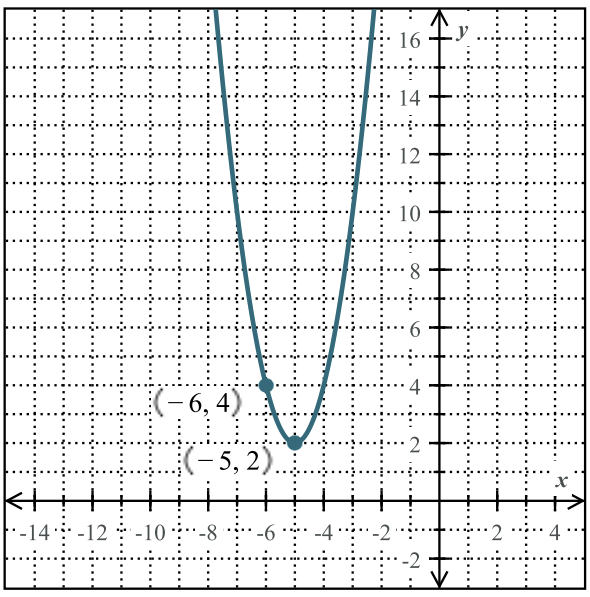
y=2(x+5)^2+2
300
Find the x and y intercepts for the following function
y=x^3-4x^2-x+4
x-intercepts: -1, 1, 4
y-intercepts: 4
300
Solve the following inequality. Use interval notation.
x^3+x^2≤12x
(-∞,-4]uu[0,3]
400
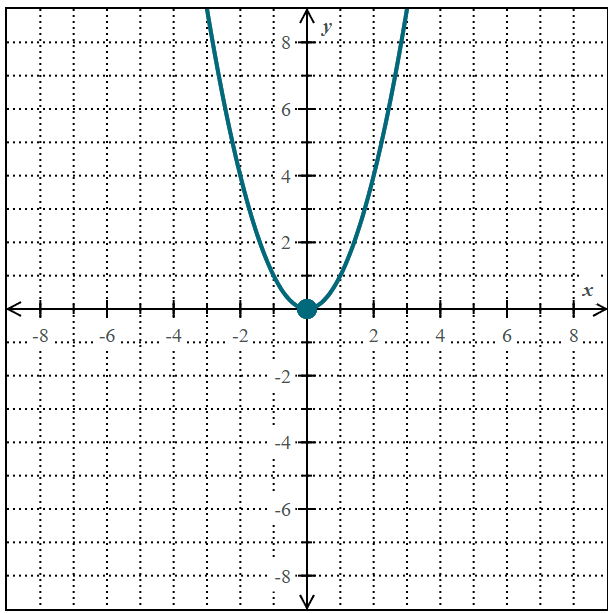
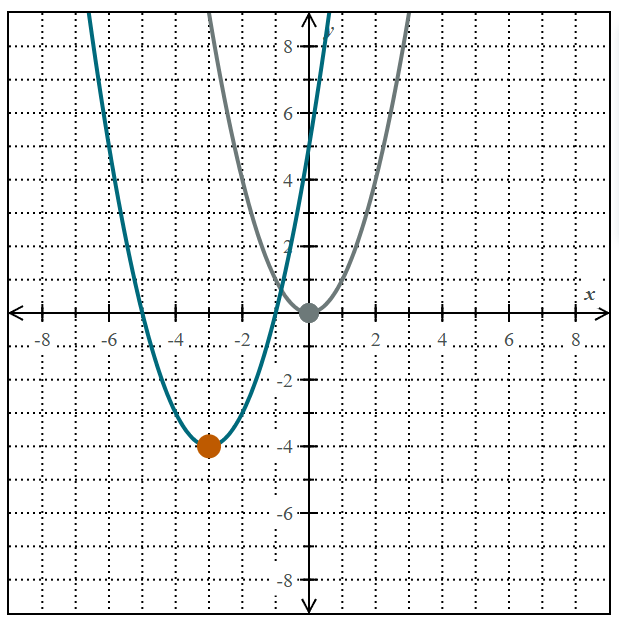
Below is the graph of f(x)=x^2
Translate it to make it the graph of f(x)=(x+3)^2-4
400
The functions f and g are defined as follows:
f(x)=4x^2-5
g(x)=8x-3
Find (f/g)(-2)
Find what value(s) are NOT in the domain of (f/g).
(f/g)(-2)=-11/19
values of x not included in the domain of (f/g): 3/8
400
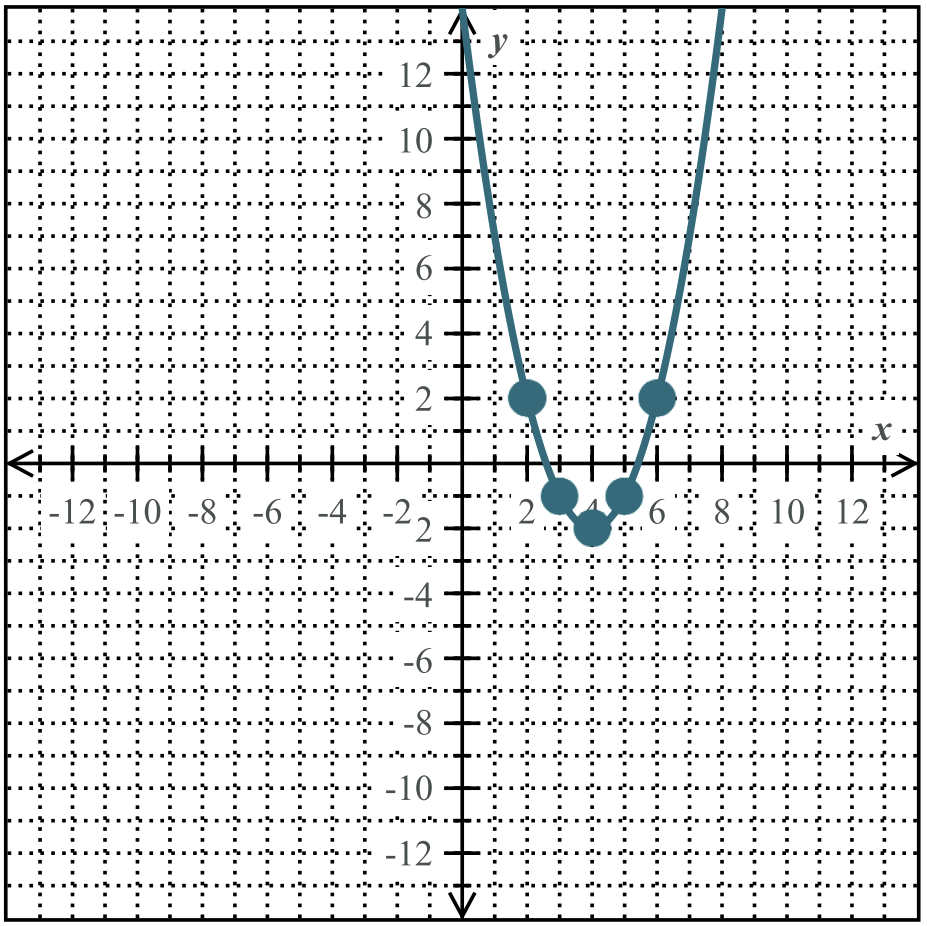
Graph the parabola
y=x^2-8x+14
400
What is the end behavior of the graph for the following polynomial?
f(x)=-4x(x-4)(x+2)
Rises/falls to the left and Rises/falls to the right?
Rises to the left and falls to the right
400
Divide.
(x^2+10x+19)div(x+7)
What is the quotient and remainder?
Quotient: x+3
Remainder: -2
500
Suppose that the function of f is defined as follows.
f(x)={(-3x-1 if x<-1),(-x+1 if x≥-1):}
Graph the function f & then determine if it is continuous.
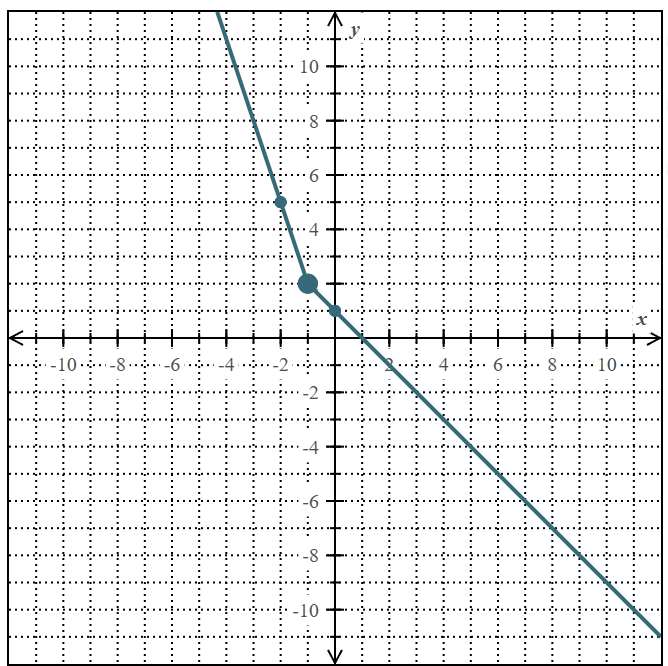
The function is continuous
500
Find the difference quotient (f(x+h)-f(x))/h for the function below
f(x)=-2x^2+2x-2
Simplify your answer as much as possible
-4x-2h+2
500
A wire that is 16cm long is shown below. A wire is cut into two pieces and each piece is bent and shaped into a square. Suppose that the side lengths of one square (shown below) is x.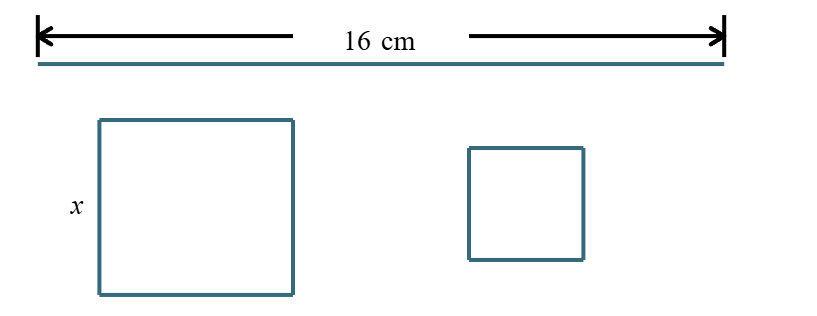
a) Find a function that gives the total area A(x) enclosed by the two squares
b) Find the side length x that minimized the total area of the two squares
c) What is the minimum area enclosed by the two squares
a) A(x)=2x^2-8x+16
b) x=2cm
c) 8cm^2
500
Use the Remainder Theorem to find P(-2) for
P(x)=-x^3-2x^2-4 . Give the quotient and remainder for the final value of P(-2).
Quotient: -x^2
Remainder: -4
P(-2): -4
500
Suppose the functions f and g are defined as follows.
f(x)=-2x^2+3
g(x)=1/(5x^2+2)
Find (f-g)(x) . What is the domain of (f-g)(x)
(f-g)(x)=(-2x^2+3)-(1/(5x^2+2))
Domain of (f-g)(x) :(-∞,∞)