Limits
Difference Quotient
Derivatives
Derivative Applications
100
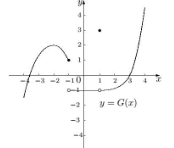
Determine
G(-1)
If it does not exist, then use DNE to state that.
1
100
True or False
The formula for the difference quotient is
(f(x-h)-f(x))/h
False should be
(f(x+h)-f(x))/h
100
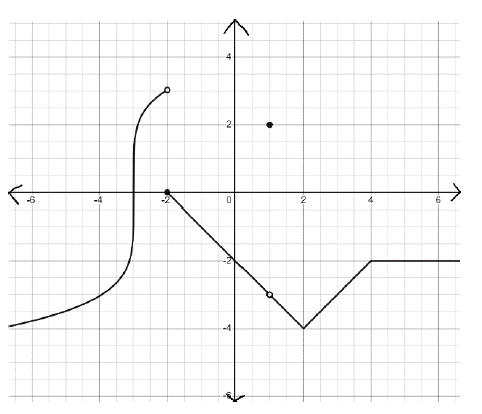
Give two x-values where the function is nondifferentiable and state the reason why each one is nondifferentiable.
Possible answers
x=-3 vertical tangent line
x=-2 discontinuous
x=1 discontinuous
x=2 sharp corner
x=4 sharp corner
100
True or False
Taking the derivative of the position function will give you the velocity function.
True
200

Determine
lim_(x->1) G(x)
If it does not exist, then use DNE to state that.
-1
200
True or False
Finding the simplified difference quotient and finding the derivative are the same thing.
False
To find the derivative you take the limit of the simplified difference quotient as h approaches 0.
200
Find
d^4/dx^4(3x^4)
72
200
Find the equation of the tangent line to the following graph at x=1
f(x)=x^3-3x^2+1
Write your answer in slope-intercept form.
y=-3x+2
300
Determine
lim_(x->1) (x^2+x-2)/(x-1)
If it does not exist, then use DNE to state that.
3
300
Find the derivative of the following function
f(x)=(-3x)/4+3sqrtx-2/root(3)(x)+ln(2x)-32
f'(x)=-3/4+3/2x^(-1/2)+2/3x^(-4/3)+1/x
300
If a rock is dropped from the top of a 196 ft tall building, then the height of the rock, in feet, at t seconds can be modeled by
s(t)=196-16t^2
Find v(2) and interpret it in the context of the problem.
v(2)=-64 (ft)/sec
At 2 seconds, after the rock is dropped, it is falling with a speed/velocity of 64 feet per second.
400
G(x)={(2x,+,3,if x<=2,),(x,-,1,if x>2,):}
Find
lim_(x->2) G(x)
If it does not exist, then use DNE to state that.
DNE
400
Find the derivative of the following function and simplify your answer
y=4xe^(8x+1)
y'=4e^(8x+1)(8x+1)
400
Find the point(s) on the curve where the tangent line is horizontal.
f(x)=6x-3x^2
(1, 3)
500
f(x)={(x,+,2,if x<=1,),(x^2,-,3,if x>1,):}
Is f continuous at x=1? Why or why not?
f is not continuous at x=1 because the limit does not exist.
500
Given the function, find the simplified difference quotient.
f(x)=2x^2 +3x
4x+2h+3
500
Find the derivative of the following function
f(x)=root(3)(x^5-3x^3+2
f'(x)=1/3(x^5-3x^3+2)^(-2/3)(5x^4-9x^2)