indefinite integrals
FTC pt 1 and 2
Differential Equations
2 dimensional DEs
miscellaneous
100
Evaluate the integral:
int (6x^8 -20x^4+x^2+9)dx
2/3x^9-4x^5+1/3x^3+9x+c
100
Find:
int_-1^0x^3(1-2x^4)^3dx
0
100
Find and give the stability of the equilibria of:
y' = (y^2-4)(y+1)^2
2 = unstable, -2 = stable, -1 = semi-stable
100
How do you pass X nullclines? Y nullclines?
X nullclines: Vertical
Y nullclines: Horizontal
200
Evaluate the integral:
int sin^2(x)cos(x)dx
1/3sin^3(x)+c
200
Evaluate:
(d/dx)int_4^(x^2)e^(x^2)dx
2xe^(x^4)
200
In a city having a fixed population M, the time rate of change of the number N of those persons who have heard a certain rumor is proportional to the number of those who have not yet heard the rumor. Write the differential equation.
(dN)/dt=k(M-N)
200
Describe what is happening in each quadrant for a sample predator-prey model assuming y axis is predator
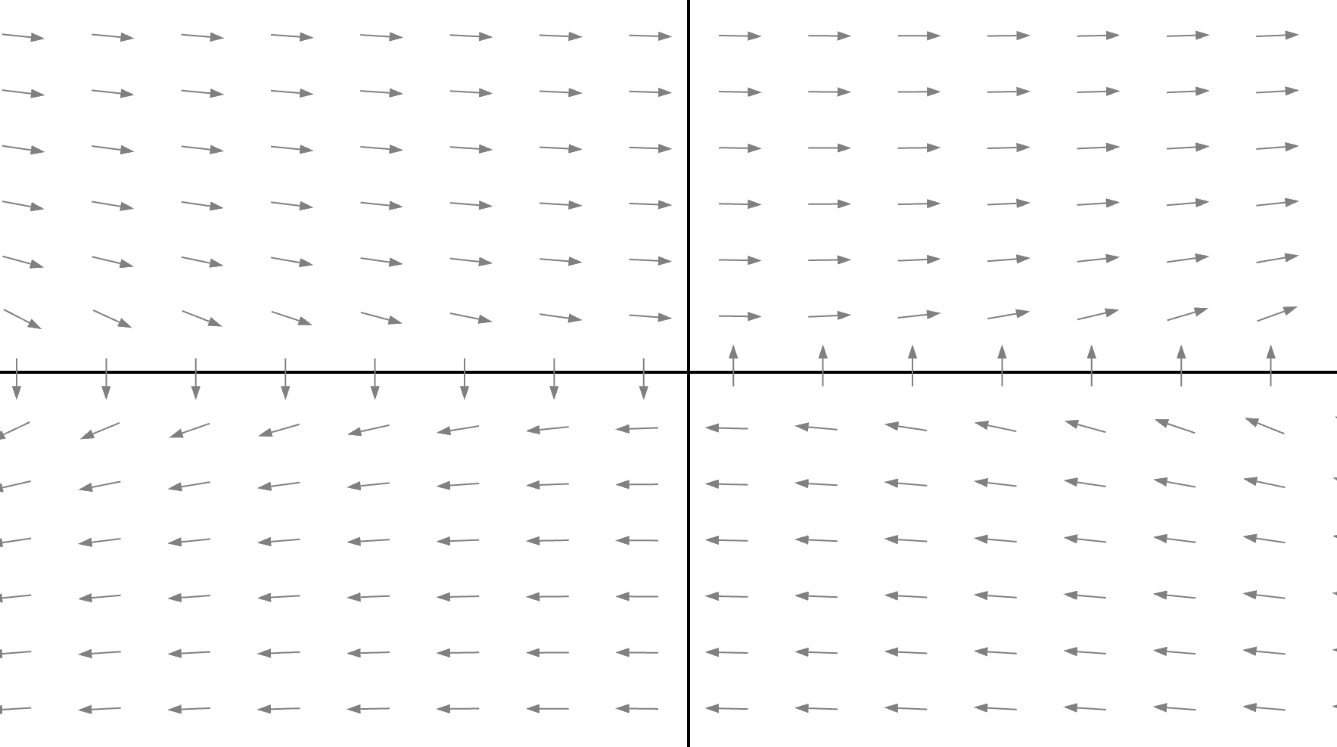
I: Both predator and prey populations are decreasing
II: more prey, fewer predators
III: more prey, more predators
IV: more prey, less predators
300
Evaluate the integral:
int 4(1/x-e^-x)cos(e^-x+lnx)dx
4sin(e^-x+lnx)+c
300
Find:
int_(1/e)^e (lnx)^3/x dx
0
300
Use Euler's method to approximate p(2), using a step size of 1.
(dp)/dx=0.5x(1-x),p(0)=2
2
300
Use Euler's method to approximate t(0.2), using a step size of 0.1.
y'+2y=2-e^(-4t)
y(0)=1
0.853
300
Given a function
y=x^2
, find the Left Riemann Sum of the function on the interval [0,6] divided into three sub-intervals.
40
400
Evaluate the integral:
int (3x)/(x^2+2x-8)dx
2lnabs(x+4)+lnabs(x-2)+c
400
Does the following converge or diverge?
Find:
int_1^oo dx/(x^2-1)
Diverges aka
oo
400
Find the general solution:
dy/dt=2y(t^2+1)
y=Ae^(2/3t^3+2t)
500
Evaluate the integral:
int x^7sin(2x^4)dx
-1/8x^4cos(2x^4)+1/16sin(2x^4)+c
500
Evaluate:
int_1^oo (lnx)/x^2 dx
1
500
Solve given the conditions.
(dy)/dx=(x+x^3)/y^2 , y(1)=1
y = ((6x^2+3x^4-5)/4)^(1/3)
500
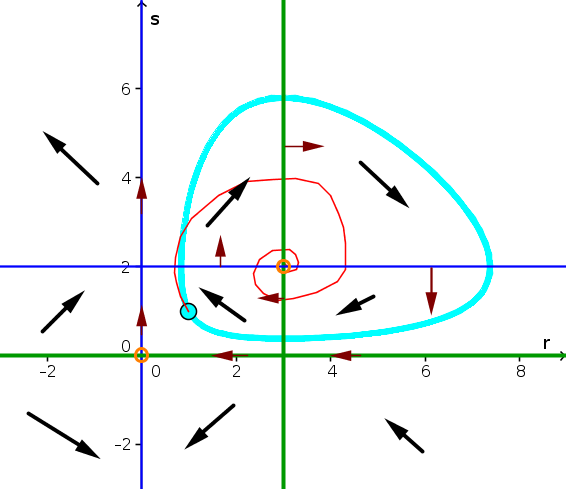
For the following system of differential equations, plot the nullclines and find the equilibria.
(dr)/dt=-r(2-s), (ds)/dt=s(3-r)
Plot direction arrows and a plausible solution in the phase plane for the initial conditions r(0)=1 and s(0)=1.