Adding/Subtracting Expressions
CLT, Equivalent Expressions, Factoring
Solution Sets for Equations and Inequalities
Inverse Operations
Equations from Tables and Stories
100
Add the expressions together.
(10b + 10) + (b + 2)
11b + 12
100
Combine like terms.
n - 10 + 9n - 3
10n - 13
100
Determine the solution from the set.
x = {8, 9, 10, 11, 12}
-3(x + 4) = -36
x = 8
100
Solve. What inverse operation do you have to use?
4.5x = 9
x = 2
Divide by 4.5 on both sides.
100
Determine the pattern in the table, then write an equation for the table.
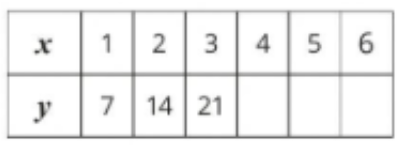
Pattern: multiply by 7
7x = y
200
Subtract the expressions.
(n - 10) - (9n - 3)
-8n - 7
200
Combine like terms.
12r + 5.5 + 3r − 5 + (-5) + 9.5r + 6
24.5r + 1.5
200
Determine the solution from the set.
x = {8, 9, 10, 11, 12}
4(x - 8) = 16
x = 12
200
Solve. What inverse operation do you have to use?
17.55 + x = 81.95
x = 64.40
Subtract by 17.55 on both sides.
200
Determine the pattern in the table, then write an equation for the table.
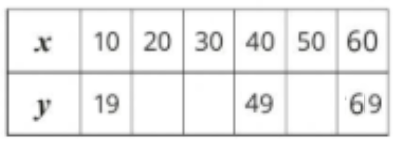
Pattern: add 9
Equation: x + 9 = y
300
Add the expressions together.
(−2n + 4) + (n + 3)
-n + 7
300
Factor the expression.
4x - 10y
2(2x - 5y)
300
Determine the solution(s) from the set.
x = {8, 9, 10, 11, 12}
− 2(x − 4) > −10
x = 8
300
Solve. What inverse operation do you have to use?
x/7.1=19.6
x = 139.16
Multiply by 7.1 on both sides.
300
At a restaurant, Mike and his three friends decided to divide the bill evenly. If each person paid $13 then what was the total bill? Write an equation, then solve.
x/4=13
x=52
400
Add the expressions together.
(9 − 10n) + (-6 + 7n)
3 - 3n
400
Simplify completely.
−7(-n - 3) − 8(1 + 8n) + 10(6n − 1)
7n + 21 - 8 - 64n + 60n - 10
3n + 3
400
Determine the solution(s) from the set.
x = {8, 9, 10, 11, 12}
2(1 − 4x) < −2
x = 8, 9, 10, 11, 12
400
Solve. What inverse operation do you have to use?
x - 8.88 = 2.22
x = 11.1
Add 8.88 on both sides.
500
Subtract the expressions.
(6m − 3) - (-1 + 4m)
2m - 2
500
Distribute both expressions.
7(1 - 3m)
1.5(h + 9)
7 - 21m
1.5h + 13.5
500
Solve. What inverse operation do you have to use?
3/4x=1 1/2
x = 2
Divide by 3/4 or multiply by reciprocal on both sides.