Triple Treat
INT INT INT INT INT INT INT INT
Hmmm...Which Theorem to use?
Potpourri
100
Evaluate the triple integral
intintint_B xyz^2 dx
where B is the rectangular box given by:
{(x,y,z)|0<=x<=1,-1<=y<=2,0<=z<=3}
27/4
100
Evaluate the line integral
int_C xy^4ds
where C is the right half of the circle
x^2+y^2=16
int_(-pi/2)^(pi/2) 4^6 cost sin^4tdt=8192/5
100
Find the line integral
int_Cye^xdx+2e^xdy
where C is the positively oriented rectangle with vertices (0,0), (3,0), (3,4), and (0,4).
int_0^3 int_0^4 e^x dydx=4(e^3-1)
100
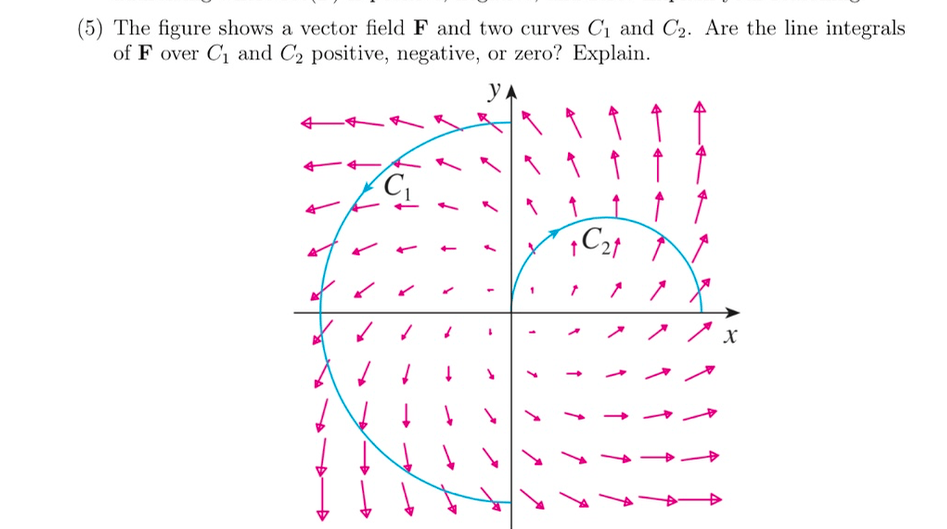
The line integral of F over C1 is positive and the line integral of F over C2 is negative.
200
Set-up a triple integral for ,
intintint_E 6xydV
where E lies below the plane z = x and above the region in the xy-plane bounded by the curves
y=sqrtx,
y= 0,
and x = 1.
int_0^1int_0^sqrtx int_0^x 6xy dzdydx
200
Evaluate the line integral
int_C y^2zds
where C is the line segment from (3,1,2) to (1,2,5).
int_0^1 (1+t)^2(2+3t)sqrt(14)dt=(107sqrt14)/12
200
Evaluate the line integral
int_CvecFcdotdvecr
, where C is the curve given by
vecr(t)=<<e^tsint,e^tcost>>,0<=t<=pi
and
vecF=<3+2xy,x^2-3y^2>
Using the Fundamental Theorem of Line Integrals
e^(3pi)+1
200
Find the divergence and curl of the vector field
vecF=<<sin(yz), sin(xz),sin(xy)>>
curl vecF=<<xcos(xy)-xcos(xz),ycos(yz) - ycos(xy),zcos(xz) - z cos (yz)>>
Div vecF = 0
300
A solid E lies within the cylinder
x^2+y^2=1
, below the plane z = 4, and above the paraboloid
z=1-x^2-y^2
Set up an integral to find the volume of the region.
V=int_0^(2pi)int_0^1int_(1-r^2)^4rdzdrd theta
300
Evaluate the line integral
int_C vecF cdot dvecr
, where
vecF=<<x,y,xy>>
and C is given by the vector function
vecr(t)=<<cost, sint,t>>, 0<=t<=pi
int_0^pi sint cost dt=0
300
Setup an integral to find the work done by the force
vecF=<x^2+y^2,x^2-y^2>
in moving a particle from the origin along the boundary of a triangle with vertices (0,0), (2,1), and (0,1) in the counter-clockwise direction.
Using Green's Theorem:
W=int_0^2 int_(1/2x)^1(2x-2y)dydx
300
Find the area of the surface with parametric equations
x=u^2,y=uv,z=1/2v^2, 0<=u<=1,0<=v<=2
4
400
Setup an integral to find the volume of the solid that lies with both the cylinder
x^2+y^2=1
and the sphere
x^2+y^2+z^2 = 4.
int_0^(2pi)int_0^1 int_-sqrt(4-r^2)^sqrt(4-r^2) r dz dr d theta
400
Find the flux of the vector field
vecF=<<z,y,x>>
over the unit sphere
x^2+y^2+z^2=1
(4pi)/3
400
Find the mass of the region with a density function
rho(x,y)=2x^2
that is bounded by
y=x+2
and
y=x^2
63/10
500
Evaluate
intintint_E y^2z^2dV
where E lies above the cone
phi=pi/3
and below the sphere
rho=1
(47pi)/3360
500
A particle moves along line segments from the origin to the points (1,0,0), (1,2,1), (0,2,1), and back to the origin under the influence of the force field
vecF=<<z^2,2xy,4y^2>>
Suppose that the plane passing through these points is given by -y + 2z = 0.
Find the work done.
3 using Stoke's Theorem.