ROC & Limits
Derivative Rules
Derivative/Antiderivative
Applications
Applications
Related Rates
Antiderivatives
100
Define the formal mathematical definition of a derivative.
1. Give the formal equation.
2. Draw a picture of the derivative of f(x) = x^2 at x = 2 .
The derivative is defined as the instantaneous rate of change of a function at a specific point. So, the derivative of f at x = a is the limit of the average rate of change as x -> a aka the INSTANTANEOUS rate of change.
f'(a) = lim_(x -> a) \frac{f(x) - f(a)}{x - a}
The derivative is represented by the slope of the tangent line -- a line that touches the function only at that x-value. Example shown on board.
100
Evaluate each of the following and give me the name of the rule. These are all of the basic derivative rules, you SHOULD know these by heart for the exam and they will be directly tested on this exam!
1. d/dx (a) =
2. d/dx (x^n) =
3. d/dx (e^x) =
4. d/dx (sin(x)) =
5. d/dx (cos(x)) =
6. d/dx (ln(x)) =
7. d/dx (af + bg) =
8. d/dx (f(x)g(x)) =
9. d/dx (\frac{f(x)}{g(x)}) =
10. d/dx (tan(x)) =
11. d/dx (f(g(x)) =
1. 0
2. nx^(n-1)
3. e^x
4. cos(x)
5. -sin(x)
6. 1/x
7. a \frac{df}{dx} + b \frac{dg}{dx}
8. f'g + fg'
9. \frac{f'g - fg'}{g^2}
10. sec^2 (x)
11. f'(g(x)) cdot g'(x)
100
A particle moves along a straight line. Its position s(t) (in meters) is recorded at various times t in seconds.

1. Estimate the velocity of the particle at t = 3 seconds. Round to two decimal places as needed and include units!
2. Is the particle slowing down or speeding up near t = 3 seconds? Explain.
1. s'(3) approx 3.35 m/s
2. By computing estimate velocities around t = 3, we see that the particle is speeding up.
100
Find the derivatives of the following functions. Assume that f is an unknown function.
1. d/dt(t^2f) =
2. d/dx(f^4) =
1. (2t)f + t^2f'
2. 4f^3f'
100
Suppose (df)/dx = ae^(ax + b) where a and b are constants.
Find any antiderivative.
F(x) = e^(ax+b)
200
Evaluate the following:
lim_(x -> 2) \frac{3x^3 - 5x^2 + 4}{x^2 + 1}
lim_(x -> 4) \frac{sqrt(x+5) - 3}{x - 4}
lim_(x -> 3) \frac{x^2 - 5x + 6}{x - 3}
1. frac{8}{5}
2. 1/6
3. 1
200
Evaluate the derivative of the following functions.
1. f(x) = (4x^3 - 2x + 5)^5
2. g(x) = sin(3x^2 - 4x)
3. h(x) = sqrt(2x^2 + 1/x)
1. f'(x) = 5(4x^3-2x+5)^4 cdot (12x^2 - 2)
2. (6x - 4) cdot cos(3x^2 - 4x)
3. \frac{4x - \frac{1}{x^2}}{2sqrt(2x^2 + \frac{1}{x}}
200
An object is launched straight upward from a platform. Its height above ground is:
h(t) = 3 + v_0t - 4.9t^2
where h is in meters and t is in seconds. v_0 is an unknown constant.
The velocity of the object is 0 at the instant when t = 2 seconds. What is v_0 ? Round to one decimal place with correct units.
v_0 approx 19.6 m/s
200
Suppose 9x^2 + 4y^2 = 36 , where x and y are functions of t.
1. If (dy)/dt = 2 , find (dx)/dt when x = 2 and y = 3.
2. If dx/dt = -1 , find dx/dt when x = -2 and y = 3.
Give exact answers for both.
1. dx/dt = -4/3
2. dy/dt = -3/2
200
Find the general antiderivative. Use proper notation.
f(x) = 6x^2 - 4x + 5/x - 3sin(x)
F(x) = 2x^3 - 2x^2 + 5ln(x) + 3cos(x) + C
300
An object is thrown straight up. Its height is given by y(t) = 100t - 16t^2 with y in feet and t in seconds. Write a formula for the average velocity on the interval [1.7, x] . Enter your answer as an algebraic expression with any decimals rounded to 2 places. No simplification is needed.
\frac{/_\ y}{/_\ t} = \frac{123.76 - 100x + 16x^2}{1.7 - x}
300
Water is draining from a tank. The volume of water remaining in liters after t minutes is given by the following function:
V(t) = 18 - 4sqrt(2t + 1)
1. Find the flow rate at t = 4 minutes. Include proper units and round to three decimal places!
2. At what time is the flow rate exactly -2 liters per minute?
1. V'(4) = -1.333 L/min
2. t = 1.5 minutes
300
The velocity of an object is given by (dh)/(dt) = 20sin(t) cm/sec. h is the height of the object in cm and t is time in seconds. The initial height of the object is 30 cm.
1. Find a formula for the height of this object.
2. Find the maximum height of this object and round your answer to one decimal place.
1. h(t) = 50 - 20cos(t)
2. 70 cm
300
A 10 ft ladder leans against a wall. The bottom slides away from the wall at 3 ft/s. How fast is the top sliding down the wall when the bottom is 6 ft from the wall? Round to two decimal places and use proper units.
Hint: Draw a picture first!
dy/dt = -2.25 ft/s (depending on what you use as x and y!)
300
Find the function F(x) such that:
F'(x) = 4x^3 - 6/x^2 + 2cos(x)
where F(1) = 5.
F(x) = x^4 + 6/x + 2sin(x) - 2 - 2sin(1)
400
A stone is tossed in the air from ground level with initial velocity of 25 m/s. Its height at time t is h(t) = 25t - 4.9t^2 m. Compute the stone's average velocity over the time interval [0.5, 2.5]. Include units!
About 10.3 m/s
400
Take the derivative of the following functions.
1. f(x) = (2x^2 - 3x + 4)e^(3x)
2. g(x) = \frac{x^3 - 4x}{x^2 + 1}
1. f'(x) = (4x - 3)e^(3x) + (2x^2 - 3x + 4)(3e^(3x))
2. g'(x) = \frac{(3x^2 - 4)(x^2 + 1) - (x^3 - 4x)(2x)}{(x^2 + 1)^2}
400
An object is launched straight up from a platform. Its height above ground is given by: h(t) = h_0 + v_0t - 1.50t^2 , which is plotted below.
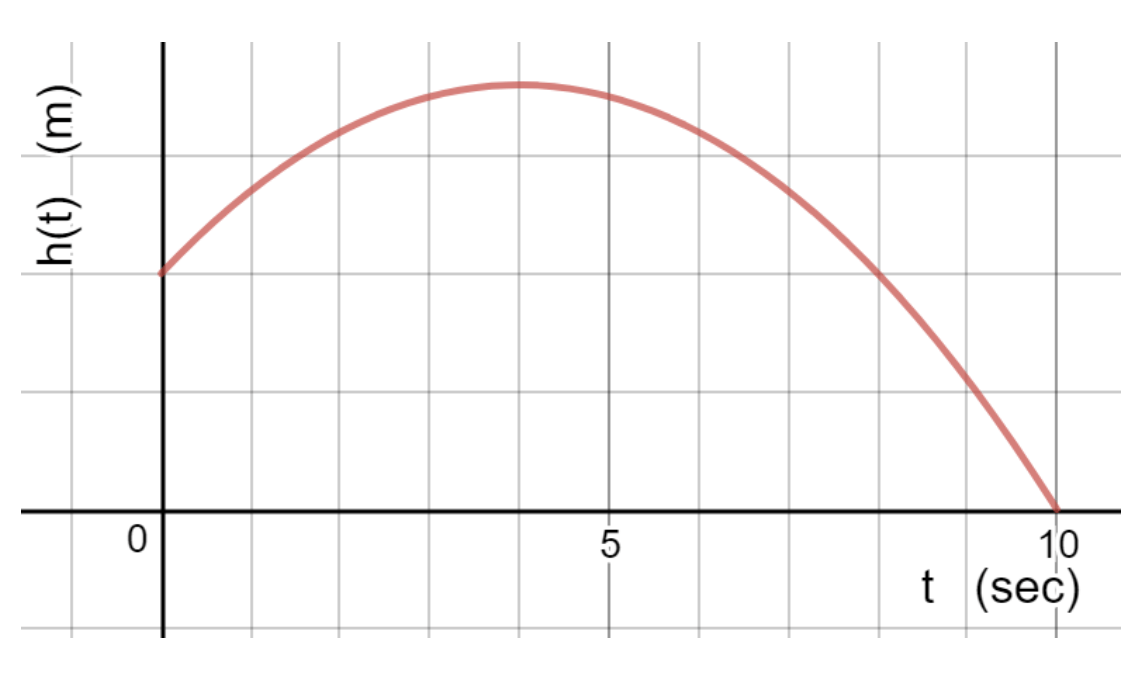
Find h_0 and v_0 . Use proper units.
h_0 = 30 m
v_0 = 12 m/s
400
Water is being poured into an inverted conical tank, where the volume of the cone is given by:
V = 1/3 pir^2h
The tank has a fixed shape with height of 12 cm and radius of 6 cm. Water is being added so that the height of the water is increasing at a rate of 2 cm/s. How fast is the volume increasing when the water is 8 cm deep?
(dV)/(dt) approx 100.53 cm^3/s
400
Find the general antiderivatives of the following functions.
1. f(x) = 4x(2x^2 + 3)^5
2. g(x) = 6xcos(3x^2)
1. F(x) = \frac{(2x^2 + 3)^6}{6} + C
2. G(x) = sin(3x^2) + C
500
Find the slope, m, of the tangent to the curve y = 2sqrtx at the point where x = a .
Using the definition of the limit, m = lim_(x -> a) \frac{2sqrtx - 2sqrta}{x - a} . Simplifying and then plugging in a gives us m = 1/sqrta.
500
1. Given:
f(x) = xcos(2x)
Evaluation the function at f'(pi/4).
2. Take the derivative of the following function.
f(x) = sin^2(x) + cos^2(x)
1. f'(pi/4) = -pi/2
2. f'(x) = 0
500
An object is heating up. Its temperature, T, is a function of time, t, with T in kelvin and t in minutes. Suppose you know that:
(d^2T)/(dt^2) = -1.17e^(-0.15t) K/min^2
(dT)/dt = 7.80 K/min at t = 0
T(0) = 298 K.
1. Find a formula for (dT)/dt .
2. What is the temperature of the object at the instant t = 20 minutes? Be accurate to two decimal places and use proper units.
3. When does the temperature reach 345 K? Be accurate to two decimal places and use proper units.
1. (dT)/dt = 7.8e^(-0.15t)
2. 347.41 K
3. 15.61 minutes
500
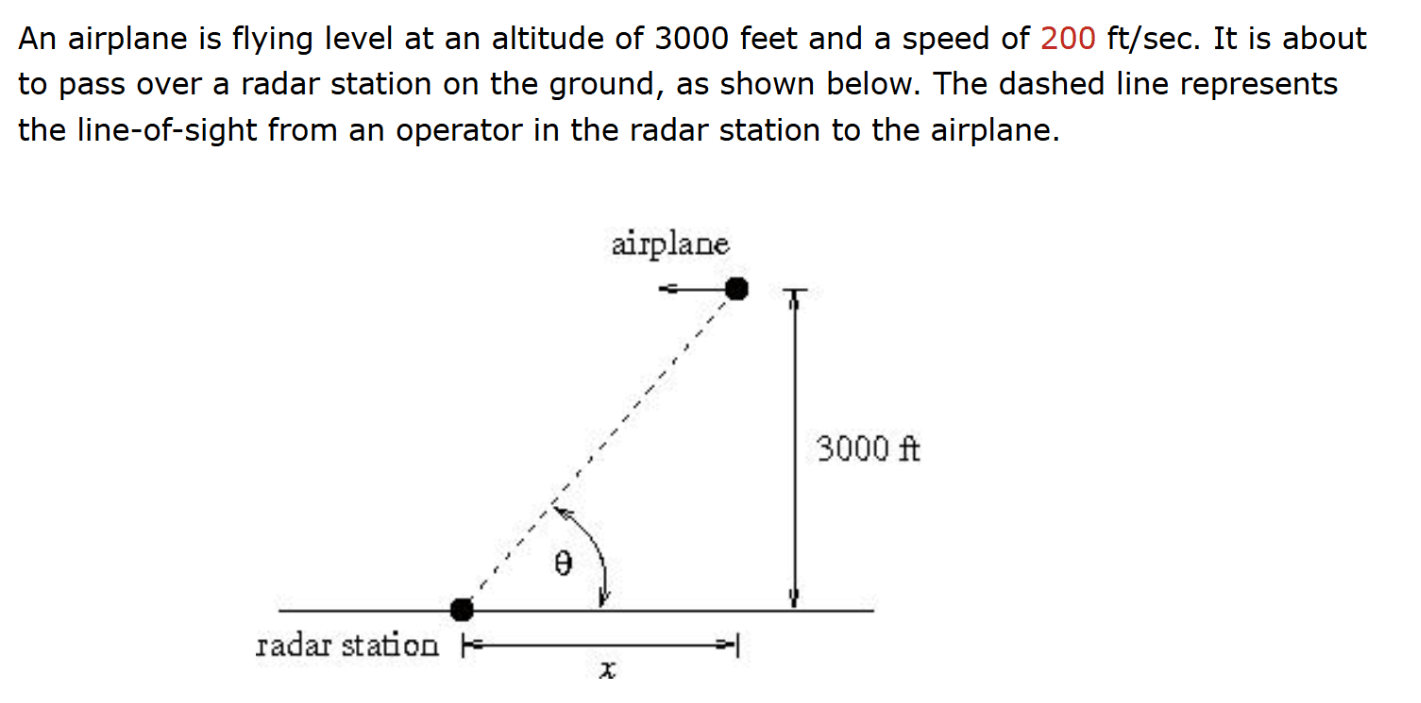
How fast is the distance between the station and the airplane changing at the instant when x = 2000 feet? Round to one decimal place and use proper units!
-110.9 ft/s
500
Surprise! Please make sure you review the unit circle before Exam 1. Here are some must-know unit circle equations:
1. sin(pi/2)
2. cos(pi)
3. tan(pi/4)
4. sin((3pi)/2)
1. 1
2. 0
3. 1
4. -1