General Macro
Fiscal
Monetary
External
Medium-term stability
100
In what year were Tenzing Norgay and Sir Edmund Hillary the first to summit Mt. Everest?
A) 1948
B) 1951
C) 1953
D) 1956
C) 1953
100
Which of the following would you NOT adjust for when calculating the Structural Budget Balance?
A) Asset Prices
B) Commodity Prices
C) Discretionary policy measures
D) Business Cycle
C) Discretionary policy measures
100
Which of the following statements about policies to address persistent macroeconomic imbalances is correct?
A) A fiscal contraction and an exchange rate depreciation can both help reduce inflationary pressures
B) A fiscal contraction and an exchange rate depreciation can both help reduce an external deficit
C) A fiscal expansion and an exchange rate depreciation can both help reduce an external deficit
D) A fiscal expansion and an exchange rate depreciation can both help reduce inflationary pressures
B) A fiscal contraction and an exchange rate depreciation can both help reduce an external deficit
100
If the government deficit is 3% of GDP and the private savings-investment gap is 2% of GDP, what is the current account balance?
A) -5% of GDP
B) +5% of GDP
C) -1% of GDP
D) +1% of GDP
C) -1% of GDP
100
As of March 2025, how many moons does Saturn have?
A) 274
B) 247
C) 168
D) 186
A) 274
200
In the Cobb-Douglas production function 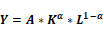 , what does the α parameter represent under the assumption of perfect competition?
A) The total factor productivity (TFP) growth rate
B) The elasticity of output with respect to labor
C) The share of national income that accrues to capital
D) The rate of net capital accumulation over time
C) The share of national income that accrues to capital
200
Which fiscal policy pattern is most likely to generate a persistent deficit bias over time?
A) Pro cyclical in “good times” and in “bad times”
B) Counter cyclical in “good times” and in “bad times”
C) Pro cyclical in “good times” and counter cyclical in “bad times”
D) Counter cyclical in “good times” and pro cyclical in “bad times”
C) Pro cyclical in “good times” and counter cyclical in “bad times”
200
What is a key challenge that high and volatile inflation poses for monetary policy??
A) It makes central bank communication clearer, leading to more stable capital flows.
B) It reduces the effectiveness of monetary policy, as inflation becomes harder to control and expectations may become unanchored.
C) It lowers borrowing costs by pushing nominal interest rates toward the zero lower bound.
D) It prevents wage–price spirals by forcing wages to adjust downward quickly
B) It reduces the effectiveness of monetary policy, as inflation becomes harder to control and expectations may become unanchored.
200
What happens when net capital inflows exceed the current account deficit?
A) Foreign reserves increase
B) The local currency depreciates
C) The government needs to borrow abroad
D) Domestic prices increase
A) Foreign reserves increase
200
High and increasing inflation is likely to have the following effect on debt (Assume everything else remains constant – ceteris paribus):
A) Debt/GDP will decrease in the long run as higher supply driven inflation leads to higher real growth
B) Debt/GDP will increase in the long run due to tighter financing conditions
C) Debt/GDP will increase in the long run due to the “dilution” effect
D) Debt/GDP will increase in the short run as expectations adjust to actual inflation
B) Debt/GDP will increase in the long run due to tighter financing conditions
300
According to the Phillips Curve, which three factors are the primary determinants of current inflation?
A) Money supply growth, velocity of money, and total output
B) Past inflation, expected future inflation, and real marginal costs (economic slack)
C) Unemployment rates, interest rates, and trade balances
D) Exchange rate movements, commodity prices, and fiscal dominance
B) Past inflation, expected future inflation, and real marginal costs (economic slack)
300
Which of the following public expenditure items is not discretionary?
A) Interest payments
B) Public sector wage bill
C) Telecommunication services
D) Transport and travel
A) Interest payments
300
According to the "Impossible Trinity" (or Trilemma) framework, which two objectives can a country achieve simultaneously if it chooses to maintain a fixed exchange rate?
A) Independent monetary policy and full capital mobility.
B) Full capital mobility and an inflation-targeting regime.
C) Full capital mobility or independent monetary policy, but not both at the same time.
D) A flexible exchange rate and a currency board arrangement.
C) Full capital mobility or independent monetary policy, but not both at the same time.
300
How many elements are in the periodic table?
A) 105
B) 112
C) 118
D) 121
C) 118
300
Assume: initial public debt/GDP ratio of 60%, a real interest rate of 6% and real GDP growth of 5%; and a primary fiscal balance of –4% (of GDP). What will happen to the debt/GDP ratio over time?
A) It will increase without bound
B) It will remain stable at 60 percent of GDP
C) It will stabilize at some value higher than 60% of GDP
D) It will eventually converge to zero
A) It will increase without bound
400
If an economy is characterized by a negative output gap, weak labor market conditions, and inflation that is concentrated specifically in the energy and food sectors, it is most likely experiencing:
A) Cost-push inflation driven by external supply shocks.
B) Demand-pull inflation resulting from an overheated domestic economy.
C) A wage-price spiral anchored by high inflation expectations.
D) Monetarist inflation caused by excessive growth in the money supply
A) Cost-push inflation driven by external supply shocks.
400
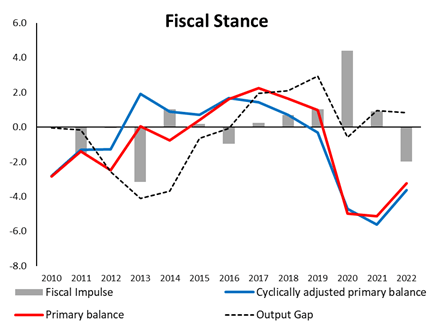
In which of these years was fiscal policy NOT counter cyclical?
A) 2013
B) 2016
C) 2020
D) 2022
A) 2013
400
Which country has the most time zones:
A) Russia
B) China
C) Canada
D) France
D) France
400
What is the approximate movement in the REER if foreign inflation is higher than domestic inflation by 3% and the nominal exchange rate depreciates by 4%?
A) appreciate by 1%
B) depreciate by 1%
C) appreciate by 7%
D) depreciate by 7%
D) depreciate by 7%
400
Which of the following is NOT an element in the definition of public debt sustainability: Government can service debt over the short, medium and long run…
A) with low rollover risk
B) with no implausible policy adjustments.
C) with no increase in the debt to GDP ratio
D) without restructuring
C) with no increase in the debt to GDP ratio
500
What could explain the difference in the Consumer Price Index (CPI) and the GDP Deflator?
A) CPI includes only domestically produced goods, while the GDP deflator includes imports
B) CPI and the GDP deflator use identical baskets but different base years
C) CPI includes imported goods and uses a fixed basket, while the GDP deflator reflects prices of all domestically produced goods and services with a changing basket
D) The GDP deflator only measures services, while CPI only measures goods
C) CPI includes imported goods and uses a fixed basket, while the GDP deflator reflects prices of all domestically produced goods and services with a changing basket
500
The first African movie to win an Oscar was from which country?
A) Egypt
B) Morocco
C) Tunisia
D) Algeria
D) Algeria
500
Under the modified Uncovered Interest Parity (UIP) condition, why might domestic interest rates exceed foreign interest rates even when the exchange rate is expected to remain stable?
A) Because capital flows are fully restricted, preventing arbitrage across countries
B) Because investors require a country risk premium to compensate for the perceived risk of holding domestic assets
C) Because the exchange rate is legally fixed under a currency union arrangement
D) Because money velocity is constant in the long run
B) Because investors require a country risk premium to compensate for the perceived risk of holding domestic assets
500
External balance means that the current account:
A) Can be sustained by capital flows
B) Has to be zero over business cycle
C) Has to be positive most of the time
D) Can only be financed by reserves
A) Can be sustained by capital flows
500
What is the external debt stabilizing primary current account balance (% of GDP) assuming: initial external debt-to-GDP ratio of 55%, real interest rate on foreign debt of 9%, real domestic growth rate of 5%?
A) -3.2%
B) -1.9%
C) 2.1%
D) 5.4%
C) 2.1%