Geography
Religion
Achievements
Japan Politics
Medieval China Politics
Mongol Politics
Economics
Social Structure
200
The largest contiguous land empire in history.
Mongol Empire
200
The religion that many Mongol leaders converted to while ruling in the western portions of the empire.
Islam
200
The dynasty in which gunpowder was invented.
Tang
200
The political/economic system of lords pledging loyalty and military support to an emperor in exchange for land.
Feudalism
200
The period of instability after the collapse of the Han Dynasty.
Three Kingdoms Period
200
Temujin was declared this after uniting the Mongol tribes.
Genghis Khan
200
This Japanese policy restricted trade and interaction with foreign communities.
Isolationism
200
The true leader of Japanese feudal society.
Shogun
400
The geographic feature that Japan is composed of that caused its isolation from the rest of Asia.
Islands
400
The philosophy that puts women in domestic roles.
Confucianism
400
The relay system that enabled fast communication across the Mongol Empire.
Yam Postal System
400
The prince who introduced Confucianism and the rank system to Japan.
Shotoku Taishi
400
The golden age dynasty and its golden age emperor. (name both)
Emperor Taizong (Li Shimin) of Tang
400
The dynasty founded by Kublai Khan in China.
Yuan
400
The Chinese dynasty in which paper money was first used.
Song
400
The Song dynasty practice that limited women by reconstructing certain body parts.
Foot-binding
600
The agricultural crop that supported populations in China and Japan.
Rice
600
A polytheistic and animistic faith native to Japan that included the belief in kami (nature spirits).
Shinto/Shintoism
600
This invention of the Tang Dynasty enabled the spreading of Confucian texts.
Woodblock printing
600
The first shogun of Japan.
Minamoto no Yoritomo
600
The large-scale rebellion that led to the decline of the Tang Dynasty.
An Lushan Rebellion
600
The Persian conqueror who defeated three khanates and founded his own empire.
Timur
600
The Japanese period in which rice agriculture was introduced.
Yayoi
600
The Chinese dynasty in which women saw the greatest rights and the philosophy that is responsible. (name both)
Daoism in the Tang Dynasty
800
The geographic origin of the Xiongnu, Huns, and Mongols.
Eurasian Steppe
800
The blending of Confucianism with Daoism and Buddhism.
Neo-Confucianism
800
The 1,100+ mile-long waterway constructed during the Sui dynasty.
Grand Canal
800
The shogun who began the Edo period and isolationism in Japan.
Tokugawa Ieyasu
800
The dynasty that united China after the Five Dynasties and Ten Kingdoms Period.
Song
800
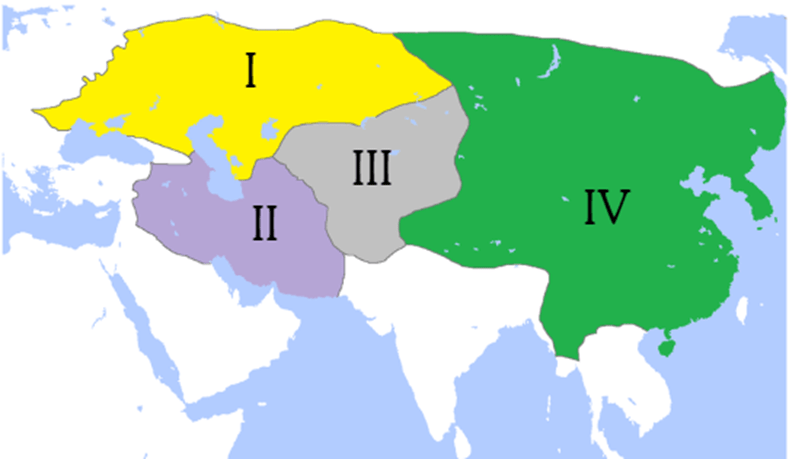 The division of the Mongol Empire shown as II on the map.
Ilkhanate
800
The large and poor group that had higher social status in Chinese and Japanese societies than other civilizations due to their importance to society.
Farmers
800
A system in which individuals are granted military or political positions based on their capability and aptitude.
Meritocracy
1000
The regions that the Khwarazmian Empire encompassed before being conquered by Genghis Khan. (name both)
Persia & Central Asia
1000
The religion of the Xiongnu, Huns, and Mongols.
Tengrism
1000
The oldest novel in the world.
The Tale of Genji
1000
The policies enacted during the Asuka Period that strengthened the power of the emperor through patrimonial rule and decreased the nobility's power.
Taika Reforms
1000
The dynasty founded by Wei general, Sima Yan (Emperor Wudi).
Jin
1000
The Mongol leader who conquered the Abbasid Caliphate and added the Middle East to the Mongol Empire.
Hulagu Khan
1000
The period that saw an increase in safety and stability along the Silk Road.
Pax Mongolica
1000
The feudal lords in Japan.
Daimyo