Ch 1 - Data and Decision Making
Ch 2 - Data Visualization
Ch 3 - Numerical Descriptive Measures
Ch 4 - Probability
Ch 5 - Discrete Probability Distributions
Ch 6 - Continuous Probability Distributions
100
A company wants to estimate the average annual spending of its 12,000 customers. It randomly selects 300 customers and calculates their average spending.
Identify the population and the sample.
Population: All 12,000 customers
Sample: The 300 selected customers
Explanation:
The population is the entire group of interest. The sample is the subset used to estimate characteristics of the population.
100
A company records customer type as Retail, Wholesale, or Corporate.
Which graph is most appropriate to display this data?
Bar chart
Explanation:
Customer type is categorical data. Bar charts are used for categorical variables.
100
Data: 6, 8, 10, 12
Find the sample mean.
Mean = (6 + 8 + 10 + 12) / 4 = 36 / 4 = 9
Explanation:
The mean is the average of the observations.
100
If P(A) = 0.72, find P(Aᶜ).
P(Aᶜ) = 1 − 0.72 = 0.28
Explanation:
Complement rule: P(Aᶜ) = 1 − P(A).
100
What are the two key properties of a discrete probability distribution?
0 ≤ P(X = x) ≤ 1
The sum of all probabilities equals 1
Explanation:
All probabilities must be between 0 and 1, and the total probability across all outcomes must equal 1.
100
Which of the following is true for a continuous random variable?
A) P(X = 5) > 0
B) P(X = 5) = 0
C) P(X = 5) = 1
B) P(X = 5) = 0
Explanation:
For continuous variables, probability exists over intervals, not exact values.
200
The true average annual spending of all 12,000 customers is $4,850.
Is this value a parameter or a statistic?
Parameter
Explanation:
A parameter describes a population. Since it refers to all 12,000 customers, it is a population value.
200
A dataset contains employee salaries grouped into intervals ($30k–40k, $40k–50k, etc.).
Which graph is most appropriate?
Histogram
Explanation:
Salaries are quantitative data grouped into numeric intervals. Histograms show distributions of quantitative variables.
200
Data: 6, 8, 10, 12
Find the median .
Median = (8 + 10) / 2 = 9
Explanation:
For an even number of observations, average the two middle values.
200
If events A and B are mutually exclusive,
what is P(A ∩ B)?
0
Explanation:
Mutually exclusive events cannot occur at the same time.
200
A discrete random variable has the following distribution:
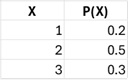
Find the expected value.
E(X) = (1)(0.20) + (2)(0.50) + (3)(0.30)
= 0.20 + 1.00 + 0.90
= 2.10
Explanation:
Expected value equals Σ x·P(x).
200
What does the area under a probability density curve represent?
Probability
Explanation:
The area between two values equals the probability the variable falls in that interval.
300
The average spending of the 300 selected customers is $4,720.
Is this value a parameter or a statistic?
Statistic
Explanation:
A statistic describes a sample. The value was calculated from only 300 customers.
300
A histogram shows a long tail extending to the right.
Is the distribution left-skewed, right-skewed, or symmetric?
Right-skewed
Explanation:
Skewness direction follows the tail.
300
Data: 6, 8, 10, 12
Calculate the sample variance .
6.67
Explanation:
Excel =VAR.S()
Sample variance divides by n − 1.
300
If P(A) = 0.40 and P(B) = 0.50 and the events are independent, find P(A ∩ B).
0.40 × 0.50 = 0.20
Explanation:
For independent events: P(A ∩ B) = P(A)P(B).
300
A discrete random variable has the following distribution:
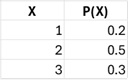
The mean is 2.10, find the variance.
Compute squared deviations:
(1 − 2.1)² = 1.21
(2 − 2.1)² = 0.01
(3 − 2.1)² = 0.81
Variance = (1.21)(0.20) + (0.01)(0.50) + (0.81)(0.30)
= 0.242 + 0.005 + 0.243
= 0.49
Explanation:
Variance = Σ (x − μ)² P(x).
300
The time of a call is uniformly distributed between 2 and 10 minutes.
Find the mean.
Formula:
Mean = (a + b) / 2
Mean = (2 + 10) / 2 = 6
Explanation:
The mean of a continuous uniform distribution is the midpoint.
400
A manager calculates the average, median, and standard deviation of monthly sales data.
Is this descriptive or inferential statistics?
Descriptive statistics
Explanation:
Descriptive statistics summarize observed data without making generalizations beyond the data.
400
If a distribution is right-skewed, how do the mean and median compare?
Mean > Median
Explanation:
The long right tail pulls the mean upward more than the median.
400
Using the variance 6.67, find the sample standard deviation.
Standard deviation = √6.67 ≈ 2.58
Explanation:
Standard deviation is the square root of variance.
400
State the addition rule for non-mutually exclusive events.
P(A ∪ B) = P(A) + P(B) − P(A ∩ B)
Explanation:
We subtract the overlap to avoid double counting.
400
What four conditions must be satisfied for a binomial experiment?
Fixed number of trials
Independent trials
Two possible outcomes per trial
Constant probability of success
Explanation:
If any of these fail, it is not binomial.
400
The time of a call is uniformly distributed between 2 and 10 minutes.
Find the variance.
Formula:
Variance = (b − a)² / 12
Variance = (10 − 2)² / 12
= 64 / 12
= 5.33
Explanation:
Standard Deviation is the square root of Variance. So Variance uses the same formula, without the square root.
500
A manager uses data from 300 customers to estimate the average spending of all 12,000 customers.
Is this descriptive or inferential statistics?
Inferential statistics
Explanation:
Inferential statistics use sample data to make conclusions about a population.
500
If a distribution is left-skewed, how do the mean and median compare?
Mean < Median
Explanation:
The long left tail pulls the mean downward.
500
When calculating sample variance, why do we divide by n − 1 instead of n?
To correct bias when estimating population variance.
Explanation:
Dividing by n − 1 adjusts for the fact that the sample mean is an estimate.
500
If P(A) = 0.60, P(B) = 0.50, and P(A ∩ B) = 0.30, find P(A ∪ B).
0.60 + 0.50 − 0.30 = 0.80
Explanation:
Apply the addition rule.
500
A production process produces non-defective parts 90% of the time.
If 5 parts are selected, what distribution applies?
Binomial distribution
Explanation:
Fixed trials, independent, two outcomes, constant probability.
500
Net income is uniformly distributed between $200,000 and $300,000.
Find P(X ≥ 275,000).
Formula:
(d − c) / (b − a)
= (300,000 − 275,000) / (300,000 − 200,000)
= 25,000 / 100,000
= 0.25
Explanation:
Uniform probability equals length of subinterval divided by total interval.
600
Sales revenue recorded each month for the past 24 months is what type of data?
Time-series data
Explanation:
Time-series data track the same variable over multiple time periods.
600
Given the following summary statistics:
Q1 = 30
Q3 = 50
Calculate the interquartile range.
IQR = 50 − 30 = 20
Explanation:
The interquartile range measures the spread of the middle 50% of the data.
600
A dataset has mean = 50 and standard deviation = 8.
Find the z-score for X = 66.
z = (X − μ) / σ
z = (66 − 50) / 8
= 16 / 8
= 2
600
Define conditional probability.
The probability of an event occurring given that another event has occurred.
Explanation:
Conditional probability adjusts probabilities based on new information.
600
If n = 10 and p = 0.30, find the mean and variance of the binomial distribution.
Mean = np = 10(0.30) = 3
Variance = np(1 − p) = 10(0.30)(0.70) = 2.1
Explanation:
These are standard binomial formulas.
600
A normal distribution has mean = 50 and standard deviation = 5.
Find the z-score for X = 60.
Formula:
z = (X − μ) / σ
z = (60 − 50) / 5 = 2
Explanation:
The value is 2 standard deviations above the mean.
700
Customer income levels collected from 500 customers on March 1 is what type of data?
Cross-sectional data
Explanation:
Cross-sectional data are collected at a single point in time.
700
Given the following summary statistics:
Q1 = 30
Q3 = 50
Calculate the lower outlier boundary.
Lower boundary = Q1 − 1.5(IQR)
= 30 − 1.5(20)
= 30 − 30
= 0
Explanation:
Values below this boundary are considered potential outliers.
700
A value has a z-score of 1.8. What does this mean?
The value is 1.8 standard deviations above the mean.
Explanation:
Positive z-scores indicate values above the mean.
700
If P(A ∩ B) = 0.24 and P(B) = 0.60, find P(A | B).
P(A | B) = 0.24 / 0.60 = 0.40
Explanation:
Conditional probability formula:
P(A | B) = P(A ∩ B) / P(B).
700
A company averages 4 customer complaints per day.
What distribution should be used to model the number of complaints per day?
Poisson distribution
Explanation:
Poisson models number of events in a fixed time interval.
700
For a standard normal distribution, what are:
a) Mean
b) Standard deviation
a) 0
b) 1
Explanation:
The standard normal distribution is centered at 0 with SD = 1.
800
Classify each variable as qualitative or quantitative:
a) Customer satisfaction rating (Excellent, Good, Fair, Poor)
b) Annual revenue in dollars
a) Qualitative
b) Quantitative
Explanation:
Qualitative data describe categories. Quantitative data are numerical and measurable.
800
Given the following summary statistics:
Q1 = 30
Q3 = 50
Calculate the upper outlier boundary.
Upper boundary = Q3 + 1.5(IQR)
= 50 + 1.5(20)
= 50 + 30
= 80
Explanation:
Values above this boundary are potential outliers.
800
A value has a z-score of −2.5. Interpret this.
The value is 2.5 standard deviations below the mean.
Explanation:
Negative z-scores indicate values below the mean.
800
If P(A | B) = 0.30 and P(B) = 0.50, find P(A ∩ B).
0.30 × 0.50 = 0.15
Explanation:
Rearranging conditional probability:
P(A ∩ B) = P(A | B)P(B).
800
If λ = 3, what is the probability of exactly 0 events?
Use the formula:
P(X = 0) = e⁻³ (3⁰ / 0!)
P(X = 0) = e⁻³ ≈ 0.0498
Explanation:
For Poisson, P(X = 0) = e⁻λ.
800
If Z = −1.28, what is P(Z < −1.28) approximately?
0.10
Explanation:
From standard normal tables or Excel:
NORM.DIST(−1.28,0,1,TRUE) ≈ 0.1003.
900
Classify each of the following variables as nominal, ordinal, interval, or ratio.
a) Temperature measured in degrees Fahrenheit
b) Customer satisfaction rating (1 = Very Unsatisfied to 5 = Very Satisfied)
c) Marital status (Single, Married, Divorced)
d) Annual salary in dollars
a) Interval
b) Ordinal
c) Nominal
d) Ratio
Explanation
Temperature (Fahrenheit) is interval because differences are meaningful, but zero does not represent the absence of temperature.
Customer satisfaction ratings are ordinal because there is order, but the difference between 1 and 2 is not guaranteed to equal the difference between 4 and 5.
Marital status is nominal because categories have no ranking.
Annual salary is ratio because it has equal intervals and a meaningful zero.
900
A boxplot shows a long upper whisker and several high-value points beyond it.
What does this suggest about the distribution?
The distribution is right-skewed with high outliers
Explanation:
A longer upper tail indicates skewness toward higher values.
900
If every observation in a dataset increases by 10, what happens to:
a) The mean
b) The standard deviation
a) Mean increases by 10
b) Standard deviation stays the same
Explanation:
Adding a constant shifts the center but does not change spread.
900
What is prior probability?
The probability of an event before new evidence is considered.
Explanation:
It is the initial belief or probability estimate.
900
When drawing 5 cards from a deck without replacement and calculating the probability of getting 2 aces, which distribution applies?
Hypergeometric distribution
Explanation:
Sampling without replacement from a finite population.
900
Which Excel function finds cumulative probability for a normal distribution?
NORM.DIST with TRUE
Explanation:
TRUE returns cumulative probability.
1000
Which level of measurement allows meaningful ratios to be computed?
A) Nominal
B) Ordinal
C) Interval
D) Ratio
D) Ratio
Why:
Ratio data have a true zero and equal intervals.
1000
A scatterplot of advertising spending vs. sales shows points rising from left to right.
What does this suggest?
A positive association
Explanation:
As advertising spending increases, sales tend to increase.
1000
Two investments have the following:
Investment A: Mean = 8%, Standard Deviation = 4%
Investment B: Mean = 12%, Standard Deviation = 6%
Which measure should you use to compare relative risk?
Coefficient of variation
Explanation:
The coefficient of variation compares variability relative to the mean, making it appropriate when means differ.
1000
What is posterior probability?
The updated probability of an event after considering new evidence.
Explanation:
Bayes’ Theorem converts prior probability into posterior probability using additional information.
1000
Which Excel functions correspond to:
a) Binomial probability
b) Poisson probability
c) Hypergeometric probability
a) BINOM.DIST
b) POISSON.DIST
c) HYPGEOM.DIST
1000
A machine fails on average once every 4 years.
Assuming exponential distribution, find the probability it lasts at least 6 years.
Step 1:
λ = 1 / mean = 1 / 4
Step 2:
=EXPON.DIST(6,1/4,TRUE)
≈ 0.2231
Explanation:
Exponential survival probability equals e^(−λx).