Argument Analysis
Philosophy Phundamentals
What is There? - Metaphysics
What am I? -
Philosophy of Mind
Philosophy of Mind
What Can I Know? -
Epistemology
Epistemology
100
These are the propositions used to defend an argument.
What are premises?
100
This is the field that concerns the study of the fundamental nature of reality - the study of existence, space, time, causality, etc.
What is metaphysics?
100
Ontology
What is the study of what things exist?
100
This thinker believed that, since he could be mistaken about his body, but could not be mistaken that he existed, that therefore the mind/soul must be distinct from the body.
Who is Descartes?
100
This phrase (not actually said in Descartes' Meditations) means "I think, therefore I am".
What is cogito ergo sum?
200
This is when a conclusion would necessarily follow from the premises - if it turns out the premises were true.
What is validity?
200
This is the doctrine that suggests that all of our knowledge is derived from sense-experience (and derivations on that experience)
What is empiricism?
200
This Presocratic thinker believed that the language of "Non-Being" was fundamentally misguided, and any trace of it needed to be removed from our ontology.
Who is Parmenides?
200
This view, in contrast to Dualism, suggests that the mind is ultimately explained by means of physical properties and events in the brain.
What is Physicalism?
200
This is what Locke proposes as the original state of our mind, prior to receiving any sense perceptions.
What is the tabula rasa?
300
This argumentative fallacy is sometimes called "begging the question", or "circular reasoning.
What is it called when the conclusion is assumed, explicitly or implicitly, in the premises of an argument?
300
This is a Latin phrase meaning "from the earlier" or "before the fact", often referring to sense-experience.
What is a priori?
300
This view suggests that all moments in time are equally real; past, present, and future.
What is eternalism?
300
This is Aristotle's view that primary substances are a composite of Matter and Form.
What is hylomorphism?
300
These are the two primary categories of things that can be known, according to Hume.
What are "Matters of Fact" and "Relations of Ideas"?
400
[60 seconds]
This is a sound argument.
[Argument Analysis here]
400
This is a error or reasoning where one assumes that two things share the same kind of existence or nature - that a "college" exists in the same way as a "library" or "cafeteria".
What is a category error?
400
Ontological state of species like "human", "horse", "chairs", for Aristotle.
What are secondary substances?
400
This thinker argued that, because the soul was incorruptable and had two "non-physical functions" - the capacity to reason and the capacity to will - it must therefore be immortal.
Who is Thomas Aquinas?
400
This is the fundamental distinction between primary and secondary qualities, according to Locke.
What is the fact that primary qualities are the ones that correspond directly to the ideas they cause in us, while secondary qualities correspond to the collective primary qualities of tiny pieces of the substance?
500
[60 seconds]
This is a valid, but unsound argument.
[Argument Analysis]
500
Picture Question!
Name the thinkers in the picture, and describe what the are disagreeing about.
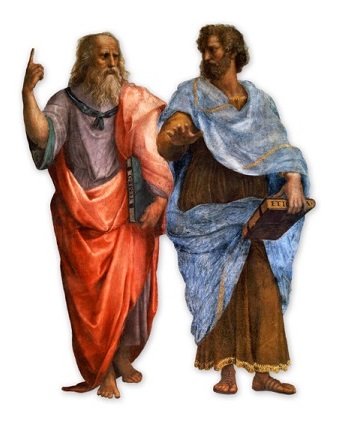
Who are Plato and Aristotle?
[Describe the disagreement]
500
Picture time!
Draw and label the different sections of Plato's Divided Line.

500
This thinker, an advocate for Physicalism, challenged Descartes by proposing something called the "Mind-Body problem", asking how a non-spatial and acausal mind could cause a physical body to move and act.
Who was Princess Elisabeth of Bohemia?
500
Picture time!
Draw a box which represents the analytic/synthetic and a priori/a posteriori categories, and list a proposition that belongs in each box (with the exception of one) - which box cannot contain a proposition, and why?[Analysis]