Trauma Assessment + Kinematics
Soft Tissue + Burns
Burns + Airway Emergencies
My head, My Neck, My Face or something like that
Chest Trauma
Abdominal + Extremity Trauma
Mixed Bag
Last one...
100
This trauma triad is associated with increased mortality in severely injured patients.
What is hypothermia, acidosis, and coagulopathy?
100
This type of bite occurs when a person punches another person in the mouth
What is a fight bite?
100
The most common burn associated with inhalation injury
What is a steam burn?
100
The facial fracture that causes flattening of one side of the face.
What is a zygomatic fracture?
100
The treatment that saves patients with commotio cordis.
What is early defibrillation?
100
This sign indicates possible splenic injury and presents as left shoulder pain.
What is Kehr's sign?
100
What is the correct order of scene safety priorities?
Yourself → Partner → Other Responders → Patient → Bystanders
100
Identify the blank spots: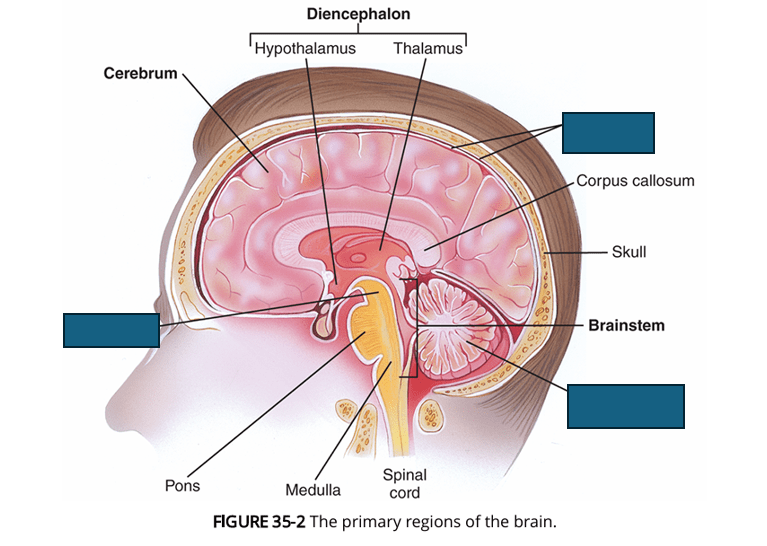
What is: Midbrain, Meninges, and Cerebellum
200
The three factors that determine the amount of energy transferred during trauma.
What are mass, speed, and force?
200
The most common organism responsible for necrotizing fasciitis.
What is Group A Streptococcus?
200
Three signs suggesting airway involvement in a burn patient.
What are hoarseness, stridor, singed nasal hair, facial burns, carbon in sputum, or enclosed-space fire history? (Any 3)
200
The first priority in a patient with severe oral trauma and bleeding.
What is airway protection and suctioning?
200
This chest injury presents with paradoxical chest wall movement.
What is flail chest?
200
What is the proper way to manage eviscerated organs?
Apply normal saline- soaked sterile dressing over the top of the evisceration and cover the injured area to keep warm.
** do not place organs back inside the body**
***ABCDE***
200
Which retroperitoneal organ is most commonly injured with lower rib fractures on the left?
Spleen
200
Fill in the blank spaces: 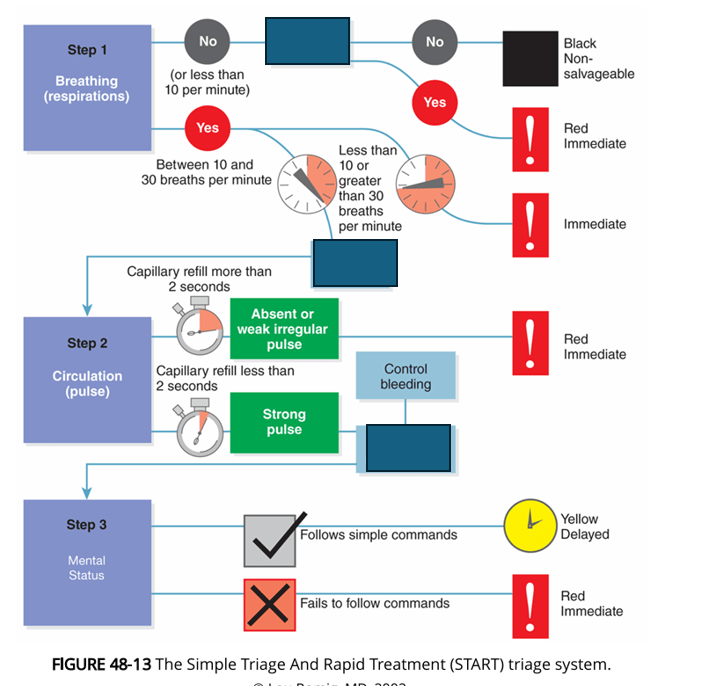
What is: Reposition the airway, Access circulation, and Assess mental status
300
In an MVC, this pathway causes the patient's head to strike the windshield, roof, or dashboard.
What is the up-and-over pathway?
300
The only two situations in which EMS should remove an impaled object.
What are airway obstruction through the cheek and interference with chest compressions?
300
he two major systemic complications of large body surface area burns.
What are hypovolemia and hypothermia?
300
Three classic findings of a basilar skull fracture.
What are Battle's sign, raccoon eyes, and CSF leakage from ears or nose?
300
Three findings associated with tension pneumothorax.
What are absent breath sounds, JVD, tracheal deviation, unequal chest rise, tachycardia, or narrowing pulse pressure? (Any 3)
300
The major complication resulting from hollow organ rupture.
What is peritonitis?
300
Which type of blast injury is caused directly by the blast wave?
Primary Blast Injury
300
What triage category is described:
Patients whose treatment and transport can be temporarily delayed.
----------------------------------------
. Burns without airway problems
· Major or multiple bone or joint injuries
. Back injuries with or without spinal cord damage
Delayed: Yellow tag (second priority)
400
Windshield damage should make you suspicious for these four injuries.
What are brain injury, facial/scalp lacerations, cervical spine injury, and tracheal injury?
400
This burn should be covered with oil rather than water.
What is a sodium burn?
400
Fluid resuscitation should be considered for burns involving greater than this percentage of TBSA.
What is 20% TBSA?
400
This intracranial bleed is characterized by a lucid interval can also be described as arterial
What is an epidural hematoma?
400
Unlike tension pneumothorax, this injury typically produces dullness to percussion and may have bloody sputum.
What is a massive hemothorax?
400
The major life-threatening complication of crush syndrome.
What is acute renal failure caused by rhabdomyolysis?
400
Complications of humerus Fx?
Nerve injury (inability to extend wrist= wrist drop
400
What Triage category is described:
Patients who require minimal or no treatment and transportation can be delayed until last.
--------------------------------------
. Minor fractures
· Minor soft-tissue injuries
Minimal: Green tag (third priority; walking wounded)
500
Victims of rollover crashes may be repeatedly struck against the interior due to this mechanism.
What is multiple directional changes causing repeated impacts inside the vehicle?
500
The formula used to estimate fluid requirements in major burn patients.
What is the Parkland (Consensus) Formula?
The amount of fluids administered in the first 24 hours after injury is typically 2-4mL of lactated ringer solution multiplied by the pts body weight in kg multiplied by the percentage of TBSA burned (2 to 4 mL × Body weight (in kg) × Percentage of body surface area burned)
500
Giving too much fluid too quickly to a burn patient can cause these complications.
What are pulmonary edema, ARDS, compartment syndrome, and airway edema?
500
Hyperventilation in TBI should only be performed when this condition exists.
What is cerebral herniation?
500
This traumatic chest injury often causes tearing pain behind the sternum or between the scapulae.
What is an aortic injury?
500
SHALLOW BREATHING, ANXIETY, “SPLINTING” are signs of?
Flail Chest
500
Operations Sector Responsibilities:
Triage Unit Leader Responsibilities:
Primary VS Secondary Triage:
Operations sector responsibilities: managing the tactical operations including standard triage, treatment and transport of the pts
-Triage unit leader responsibilities: to ensure every pt receives an initial assessment of their conditions page 2697
-Primary vs Secondary Triage: Primary: secondary triage is a type of sorting within the treatment group that involves retriaging of the pts in the treatment area
500
What triage category is described:
Patients, including injured rescuers, who need immediate care and transport.
Treat these patients first, and transport as soon as possible.
----------------------------------------------------------------------------
- Airway and breathing difficulties
- Uncontrolled or severe bleeding
- Severe medical conditions
- Decreased mental status
- Signs of shock (hypoperfusion)
- Severe burns
- Open chest or abdominal injuries
What is: Immediate: Red tag (first priority)
600
Fill in the blanks for the Trauma center criteria:
GCS < ___
_ Long bone fxs
Amputation ___ to Wrist/Ankle
Falls > ___ Feet
Pregnancy > ___ Weeks
What is:
GCS <6
2+ Long bone Fxs
Amputation PROXIMAL to wrist/ankle
Falls> 10 feet
Pregnancy > 20 weeks
600
What classification of burn do these describe:
- Full-thickness burns covering less than 2% of TBSA
- Partial-thickness burns covering:
- Less than 15% of TBSA if age 10–50 years
- Less than 10% of TBSA if age younger than 10 years or older than 50 years
- Superficial burns covering less than 50% of TBSA
- Major burn characteristics absent
What is minor burns
600
What do these injuries get classified as:
- Burns involving hands, feet, face, major joints, or genitalia, or circumferential burns of other areas
- Full-thickness burns covering more than 10% of TBSA
- Partial-thickness burns covering more than:
- 25% of TBSA if age 10–50 years
- 20% of TBSA if age younger than 10 years or older than 50 years
- Burns associated with respiratory injury (smoke inhalation or inhalation injury)
- Burns complicated by fractures or trauma
- High-voltage electrical burns
- Chemical burns
- Burns on patients younger than 5 y/o or older than 55 yrs that would be classified as “moderate” on young adults
What is Major Burns
600
What kind of triage is a type of sorting within the treatment group that involves retriaging of the pts in the treatment area
What is secondary triage
600
What is the proper steps/management to dealing with an impaled object?
Do not try to remove an impaled object unless it is through the cheek and interferes with the airway or is impaled in the chest and interferes with chest compressions.
Control hemorrhage by direct compression, but do not apply pressure on the impaled object itself or on immediately adjacent tissues.
Do not try to shorten an impaled object unless it is extremely cumbersome (eg, a fence post impaled in the chest); any motion of the object may damage surrounding tissues.
Stabilize the object in place with a bulky dressing, and immobilize the extremity (if the object is impaled in an extremity) with a splint to prevent motion.
600
Who's responsibility is it to ensure every pt receives an initial assessment of their conditions?
What is the triage unit leaders responsibility page 2697
600
Who's responsibility is managing the tactical operations including standard triage, treatment and transport of the pts
What is Operations sector responsibilities
600
What was designed to include all types of agencies who respond to disasters and with effective implementation of helped local government agencies work with regional, state and federal agencies during all phases of major emergency incidents?
What is the National Incident Management System.