Matter
Thermochemistry
Gases
Atomic Theory
Periodic Table
Bonding
100
This form of matter has a fixed composition and can be broken down chemically.
What is a compound?
100
Which sample of water has particles with the greatest average kinetic energy?
A) 50.g at 10°C
B) 80. g at 25°C
C) 5.0 g at 60°C
D) 200.g at 0°C
What is C, 5.0g at 60°C?
100
At STP, this gas sample contains the same number of molecules as 1.5 L of O₂(g).
A) 0.75 L N₂
B) 3.0 L H₂
C) 1.5 L CO₂
D) 2.0 L Ne
What is C, 1.5 L of CO2
100
Formed when electrons are lost or gained.
What are ions?
100
The ability of an atom to attract electrons.
What is electronegativity?
100
Given the equation representing a reaction: I₂ → I + I. What changes happen to the bond and energy?
Bonds are broken and energy is absorbed.
200
This property of a substance can be observed without changing the identity of the substance.
What is a physical property?
200
Convert 428oC to Kelvin.
What is 701 K?
200
Draw the relationship between volume and temperature.
[Direct Relationship]
200
Name one conclusion about the structure of the atom as a result of the gold foil experiment.
The atom has a small, positive, dense nucleus
OR
The atom is mostly empty space
200
Different forms of the same element. They have different structures and different properties.
What are allotropes?
200
This substance has metallic bonding.
A) Cu
B) Br2
C) CO
D) H₂O
What is A), Cu or Copper.
300
A student separates sand from saltwater by pouring the mixture through filter paper. This laboratory technique separates substances based on differences in particle size.
What is filtration?
300
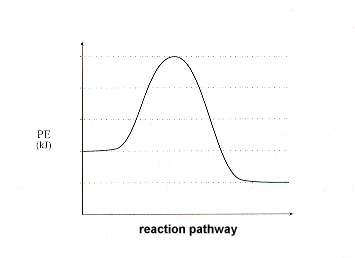 Label the heat of reaction with a double headed arrow.
Arrow between the products and reactants.
300
The kinetic molecular theory of gases includes several statements that explains how ideal gases behave. Name one of these statements.
1) Gases have negligible volumes
2) Gases move in constant, random, straight-line motion
3) Gases do not experience intermolecular forces
4) Gases move proportional to temperature
5)All collisions are elastic (bouncy) and no energy is lost
300
The net charge of an atom that has 13 protons, 10 electrons, and 14 neutrons.
What is +3?
300
As atomic number increases across Period 3, atomic radius generally does this.
What is decrease.
300
The Lewis Dot Diagram for NH3.
[Teacher Check, pyramidal shape]
400
In this sample, the ratio of components can vary:
A) KBr(s)
B) CO₂(g)
C) NH₃(g)
D) NaCl (aq)
What is D, NaCl(aq)?
400
A student holds a glass of water at 55°C in a room where the air temperature is 20°C, and the student’s hand temperature is 37°C. Identify two directions of heat flow that occur in this system.
What is from the water to the hand, and from the water to the air?
400
Convert 152 kPa to atmospheres.
What is 1.50 atm?
400
Compare the energy of an electron in the 1st shell vs the 3rd shell.
An electron in the 3rd shell has more energy than an electron in the 1st shell.
400
This element is a metalloid:
A) Al
B) Si
C) Na
D) S
What is B), Si?
400
The bond polarity and molecular polarity of CO2.
What is polar bond and non-polar molecule?
500
Explain, in terms of particle distribution, why NaCl(aq) is a homogenous mixture?
The particles are distributed evenly or uniformly.
500
This amount of heat is required to completely vaporize 25.0 g of water at 100°C.
What is 56,500 J ?
500
A sealed container holds helium gas at 530. K and 104 kPa. If the temperature decreases to 450. K, calculate the new pressure.
What is 88.3 kPa?
500
Write an electron configuration for K in the excited state.
2-8-7-2
[other answers are possible and subject to approval]
500
It's why electronegativity decreases down a group.
What is increased principle energy levels or shells.
500
Explain, in terms of ions, why NaCl(s) is NOT conductive and NaCl(aq) is.
The ions in a solid cannot move, but can move when dissolved.