States of Matter
Changes of States
Random
Atmosphere
Water Cycle
100
When particles are in this state they do not have a definite shape or volume, and expand to fill the container they’re in.
What is a gas?
100
The process of a solid gaining thermal energy (heat) to become a liquid.
What is melting?
100
True of False: All air contains water.
True
100
This atmospheric layer separates the rest of the atmosphere from outer space. It is the largest of the layers of the atmosphere.
What is the exosphere?
100
This process by which energy from the Sun causes water to change from a liquid to a gas.
What is evaporation?
200
When particles are in this state they display a definite shape and definite volume. The particles are also compact (or close together) and vibrate, slowly, back and forth.
What is a solid?
200
The process of a liquid gaining thermal energy (heat) to become a gas.
What is vaporization?
200
What is 39.2F in C?
Waht is 4.
200
This is the middle layer of Earth's atmosphere -- meteors burn up within it, due to friction (caused by collisions between gases and the meteor's particles).
What is the mesosphere?
200
The process by which water vapor, within the atmosphere cools enough to changes back into a liquid.
(Hint: Clouds form because of this)
What is condensation?
300
Particles within this state have a definite volume, but do not have a definite shape—their shape changes, depending on their container.
What is a liquid?
300
The process of a liquid losing thermal energy (heat) to become a solid.
What is freezing?
300
What is the difference between climate and temperature/weather?
Weather reflects short-term conditions of the atmosphere while climate is the average daily weather for an extended period of time at a certain location.
300
The atmospheric layer that consists of 99% of the atmosphere's water, and 75% of the atmosphere's gases. This layer is also the closest to the Earth's surface.
What is the Troposphere?
300
The process of water droplets, within clouds, colliding, forming bigger drops, and falling to Earth.
What is precipitation?
400
List two examples of each state of matter
solid: ice, tables, chairs
Liquid: water, soda melted snow
Gas: water vapor, helium, steam
400
When does a change in state occur?
What is when matter loses or absorbs energy?
400
What would earth be like with no atmosphere?
There would be no sound
We wouldeventually die
The water would boil/freeze
The air would still be too thin to breathe
400
This sub layer consists of electrically charged particles, and extends from the top of the Mesosphere, through the Thermosphere, to the bottom of the Exosphere.
(Hint: Humans can see this sub layer in the arctic regions of the planet)
What is the Ionosphere (or Aurora)?
400
Classification of world climates is commonly based on annual and monthly averages of these two non-living environmental factors.
What are temperature and precipitation?
500
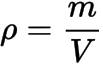
What is density?
And the formula to find density?
Density is a substance's mass per unit of volume.
500
The process of a gas losing an extreme amount of thermal energy (heat) to become a solid, with ever becoming a liquid.
What is deposition?
500
What is an ecological footprint?
the impact of a person or community on the environment, expressed as the amount of land required to sustain their use of natural resources.
500
This sub layer sits within the Stratosphere, and protects the Earth from the Sun's UV radiation.
What is the Ozone Layer?
500
This is the name of a specific amount of water that makes it back to the earth, and underground, at the completion of the water cycle.
What is groundwater?