ch9 climate
vocabulary
vocabulary
vocabulary
other labs
100
Describe factors that result in natural variations in climate….e.g. past glacial and interglacial periods
Ocean currents (distribution of cold and warm water around Earth), ocean-atmospheric oscillations, intensity of the sun, time of year, and volcanic eruptions. Long-term variability can be explained by the 3 Milankovitch cycles. The first involves the elliptical orbit stretching and shortening (100,000 years). The next cycle entails the angle of tilt of Earth’s axis shifting (40,000 years). And lastly, the Earth “wobbles” on its axis (26,000 years) (p. 210-213).
100
These non-native species can cause environmental harm when introduced to a new area, often outcompeting local species.
What are invasive species?
100
What is a closed system?
A closed system is a natural physical system that does not allow transfer of matter in or out of the system
100
What is a bioessential/bioindicator species?
Species whose health, behavior, population numbers, etc. are used to monitor and assess the overall health of an ecosystem
100
What is the system you used to identify trees?
Dichotomous Key
200
which month had the highest precipitation?
March
200
This type of symbiotic relationship benefits both species involved, such as bees pollinating flowers while collecting nectar.
What is Mutualism?
200
What is a dichotomous key?
A tool used to identify organisms or objects in the natural world. The key consists of a series of paired statements or clues about features or characteristics, providing a stepwise guide toward identifying each entity. As the user moves from one step to the next, the clues gradually narrow the list of possible entities until they are all identified.
200
What is point source pollution?
Pollution from a single, identifiable source rather than multiple scattered sources
200
What are the temperatures that the UN/countries are aiming not to go over/limit to in terms of warming? What is one of the big reasons for global warming? Think of your mock UN meeting.
2 degrees Celsius; it is even better to be under 1.5 degrees Celsius
Emmissions: CO2 from fossil fuels
300
Draw a diagram illustrating the greenhouse effect
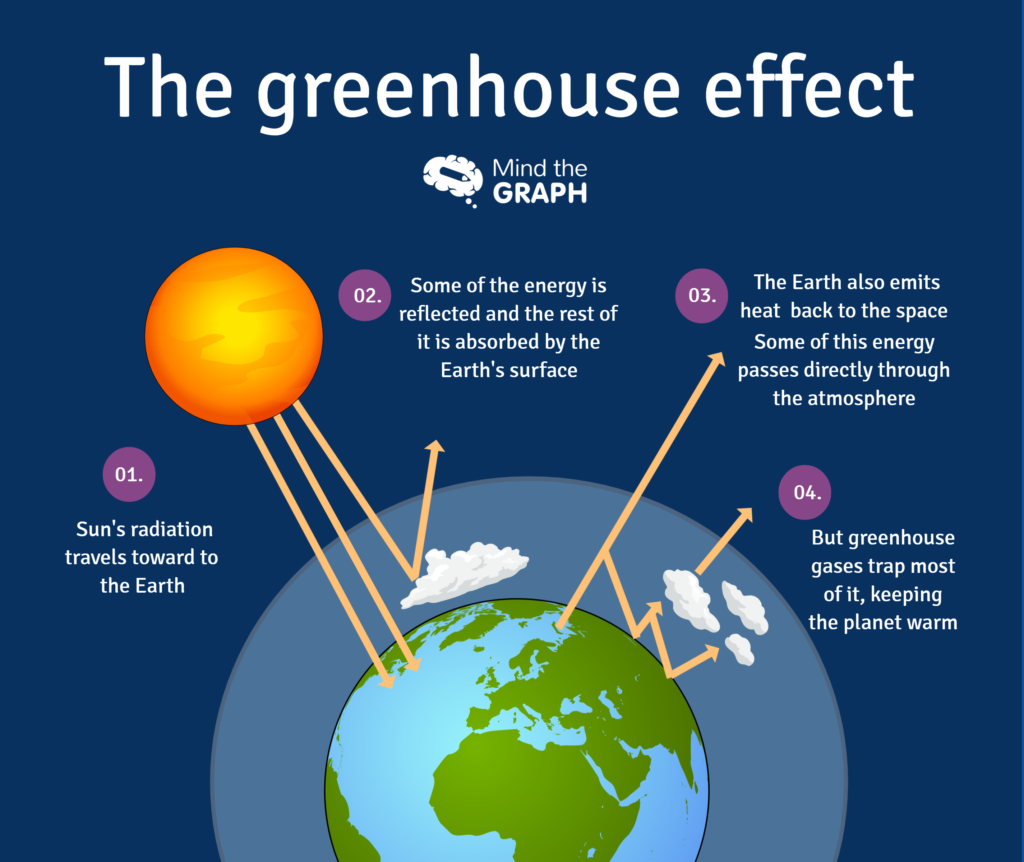
300
This occurs when individuals of different species compete for the same resource in an ecosystem, such as food or space.
What is interspecific competition?
300
What is a primary producer?
Plants, algae, and certain bacteria that capture energy from sunlight or chemicals and convert it into forms that living cells can use.
300
Describe your forceps/spoon lab. What was being simulated in A? What was being simulated in B?
Forceps: Native predator. Spoon: Non-native or invasive predator. Beads: Food/Prey
Sim A: Native predator being out-competed by invasive predator
Sim B: Native predator and non-native predator feeding on the same prey/food, not competition
400
list 5 effects of climate change
5 effects of climate change are (p. 219):
In 50 years there has been an 8 inch rise in global sea level from thermal expansion, melting glaciers, and melting ice sheets.
An increase in the frequency of wildfires as well as pests.
Earlier springs lead to early flowering, migration, and hotter summers from the onset of warm weather.
Heavier storms from the increased energetic atmospheric circulation.
- Cumulative costs for damaged infrastructure, lost property values, and health costs due to climate change.
400
These long-term changes in the Earth’s orbit and tilt are believed to be a significant factor in triggering ice ages.
What are Milankovitch Cycles?
400
What is biotic potential?
the maximum rate at which a species can reproduce under ideal conditions
400
What is the Earth overshoot day, and what does it represent? If your overshoot day is April 24th, what does that mean?
August first; The day when humanity's demand for natural resources exceeds the Earth's capacity to regenerate them
That means you/if everyone used resources the same as you/your resources would be used up by April 24th.
500
What are some conclusions you can draw from this graph?

Keeling curve, increase since industrial revolution from anthropogenic activity
500
This type of factor, such as food or disease, limits population growth more significantly as population density increases.
What is a density dependent factor?
500
What is the tropic level pyramid; draw and label it!
:)
500
Describe biomagnification and bioaccumulation in the context of our dragonfly larvae lab/outing
Biomag: When fish eat contaminated dragonfly larvae, mercury can become more concentrated as it moves up the food chain through this process.
Bioacc: This process occurs when mercury gradually builds up inside an organism; ex: dragonfly larvae.