Signs
Random knowledge
Random knowledge
Random knowledge
Random knowledge
100
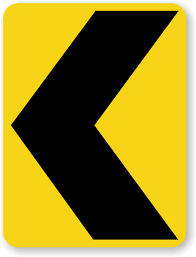
The preceding signs represents:
A.) Caution left turn.
B.) Caution roadwork to the left.
C.) Chevron sign-Left curving turn.
D.) Construction ahead detour to the left.
What is C? Chevron sign-left curving turn.
100
When turning left at an intersection with a green light but no arrow, what must you do:
A.) Turn immediately because you have the right-of-way.
B.) Accelerate to beat oncoming traffic.
C.) Yield to all oncoming traffic and pedestrians before turning.
D.) Yield only to pedestrians before turning.
What is C? Yield to all oncoming traffic and pedestrians before turning.
100
Bicyclists in Massachusetts:
A.) Must always ride on sidewalks.
B.) Must obey all traffic laws, just like motorists.
C.) Have the right of way in all circumstances.
D.) All of the above.
What is B? Must obey all traffic laws, just like motorists.
100
In Massachusetts, if two drivers arrive at an uncontrolled intersection at the same time:
A.) The driver on the left yields to the driver on the right.
B.) The driver on the right yields to the driver on the left.
C.) The first vehicle to stop has the right of way.
D.) Both cars continue with caution as normal.
What is A? The driver on the left yields to the driver on the right.
100
In work fines are:
A.) Stay the same.
B.) Are tripled.
C.) Are halved.
D.) Are doubled.
What is D? Doubled.
200
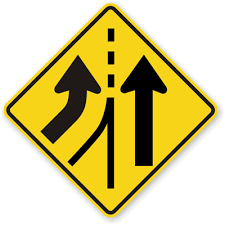 The preceding sign means:
A.) Added Lane ahead.
B.) Merging traffic ahead.
C.) One way road ahead.
D.) Yield to left lane ahead.
What is A.) Added Lane ahead.
200
What should you do if you are driving at night and your headlights suddenly go out:
A.) Turn on your interior lights so you can see the road.
B.) Honk your horn to alert other drivers.
C.) Turn on your hazards lights and reduce speed immediately.
D.) Slow down and pull off the road as quickly as possible.
What is D? Slow down and pull off the road as quickly as possible.
200
In heavy fog, you should:
A.) Turn on your high beams.
B.) Turn on your hazards.
C.) Turn on your low beam headlights.
D.) Reduce speed and use proper hand signals.
What is C? Turn on your low beam headlights.
200
In Massachusetts, parking is prohibited:
A.) In intersections.
B.) With in 10 feet of a fire hydrant.
C.) Neither A or B.
D.) Both A and B.
What is D? Both A and B.
200
If an oncoming vehicle has its high beams on, you should:
A.) Flash your high beams in response.
B.) Look to the right side of the road to avoid being blinded.
C.) Look to the left side of the road to avoid glare.
D.) Turn off your headlights.
What is B? Look to the right side of the road to avoid being blinded.
300
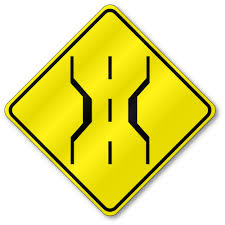
The preceding sign represents:
A.) S-turn ahead.
B.) Dead end ahead.
C.) Narrow bridge ahead.
D.) Narrow highway lanes ahead.
What is C? Narrow bridge ahead.
300
In Massachusetts, driving under the influence of marijuana is:
A.) Allowed as long as capable to do so.
B.) Prohibited and punishable by law.
C.) Allowed if medicinal.
D.) Allowed between the hours of 12:00pm and 5:00am.
What is B? Prohibited and punishable by law.
300
The move over law in Massachusetts requires drivers to:
A.) Change to a non-adjacent lane when approaching an emergency vehicle with flashing lights.
B.) Speed up when passing emergency vehicles.
C.) Only move over for police vehicles.
D.) Move to a different lane and proceed as normal when approaching a school bus with lights flashing.
What is A? Change to a non-adjacent lane when approaching an emergency vehicle with flashing lights.
300
On a road with two or more lanes traveling in the same direction, a driver should stay in the:
A.) Leftmost Lane.
B.) Rightmost lane.
C.) Lane that matches their speed.
D.) Lane that is easiest to turn from.
What is B? The right most lane.
300
The best way to handle a tailgater is to:
A.) Speed up to increase distance.
B.) Brake suddenly.
C.) Allow them to pass by either slowing down or changing lanes.
D.) Allow them to pass and give them the finger.
What is C? Allow them to pass by either slowing down or changing lanes.
400
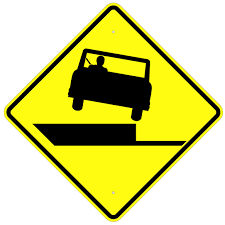 The preceding sign represents:
A.) Speed bump ahead.
B.) Shoulder drop off ahead.
C.) Uneven Road ahead.
D.) This does not represent a valid MA road sign.
What is B? Shoulder drops off ahead.
400
Children under this age must be in a federally approved child passenger restraint.
A.) 2.
B.) 10.
C.) 6.
D.) 8.
What is C? 8.
400
On a road with no sidewalks a pedestrian should walk:
A.) On the left side facing traffic.
B.) On the right side with traffic.
C.) In the middle to be visible.
D.) On the left side with traffic.
What is A? On the left side facing traffic.
400
The safe following distance in ideal condition is:
A.) 2 seconds.
B.) 3 seconds.
C.) 4 seconds.
D.) 6 seconds.
What is B? 3 seconds.
400
Hydroplaning is most likely to occur:
A.) When driving in heavy traffic.
B.) In the first few minutes of rainfall.
C.) In continuous heavy rain.
D.) When a lot of snow melts onto the roadways.
What is B? In the first few minutes of rainfall.
500
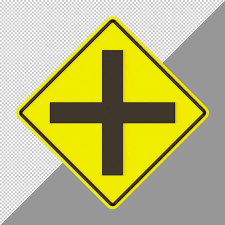 The preceding sign represents:
A.) Intersection ahead.
B.) Four-way stop ahead.
C.) Red cross location ahead.
D.) Hospital ahead.
What is A? Intersection ahead.
500
A yellow painted curb generally means this:
A.) Emergency vehicles parking only.
B.) No parking during business hours.
C.) Disabled persons parking only.
D.) Commercial loading zone- stop only to load or unload.
What is D? Commercial loading zone- stop only to load or unload.
500
When can you drive using only your parking lights:
A.) 30 minutes after sunset and 30 minutes before sunrise.
B.) Under no circumstances.
C.) In foggy conditions.
D.) In icy conditions.
What is B? Under no circumstances.
500
When entering a rotary in Massachusetts:
A.) Vehicles in the rotary have the right of way.
B.) Vehicles entering the rotary have the right of way.
C.) No specific rules, It's first-come, first-serve.
D.) Vehicles approaching the rotary have right of way.
What is A? Vehicles in the rotary have the right of way.
500
When parking uphill on a road with a curb, your front wheels should be:
A.) Turned towards the curb.
B.) Turned away from the curb.
C.) Parrell to the road.
D.) Horizontal to the road.
What is B? Turned away from the curb.