Classify Polynomials
Zeros/Roots and Multiplicity
Long Division and Synthetic Division
Factoring, Factors, and Writing Polynomials
Graphing Polynomails
100
21) Degree:
7
100
How many roots/zeros will a function of degree 5 have?
5
100
22) Divide using long division:

-2n+7-35/(3n+4)
100
4) Write a polynomial in FACTORED form with the following:
zeros = 0, 3i,
sqrt5
f(x) = x(x^2-5)(x^2+9)
100
30) Sketch a graph of:

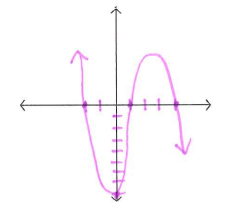
200
21) Coefficient(s):

5, 1/3,-6
200
29) Solve by factoring and list all multiplicities:
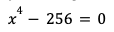
x = +-4i, x =-4, x =4
200
23) Find the missing factor: 
(x - 7)
200
25) Factor:
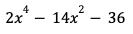
2(x^2+2)(x+3)(x-3)
200
31) Sketch a graph of:
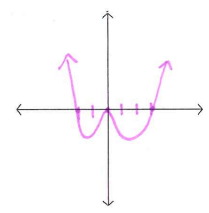
300
21) Constant(s):

none or 0
300
28) State the degree of the polynomial:

6
300
33a) Use the Remainder Theorem to conclude if the given x-values are roots of the given function:
a) x = -4
Yes, it is a root because there is no remainder!
300
26) Factor: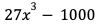
(3x-10)(9x^2+30x+100)
300
32) End Behavior:
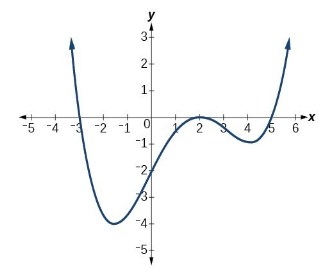
as x->-oo,f(x)->oo
as x->oo, f(x)->oo
400
21) Name:

7th degree trinomial
400
32) Real Roots (w/ multiplicities):
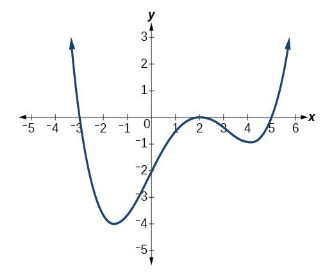
x = -3 with odd mult.
x = 2 with even mult.
x = 5 with odd mult.
400
33b) Use the Remainder Theorem to conclude if the given x-values are roots of the given function:
b) x = 3
No, it is not a root because there is a remainder.
400
27) Factor: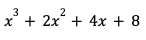
(x^2+4)(x+2)
400
32) Local minima:
Local maxima:
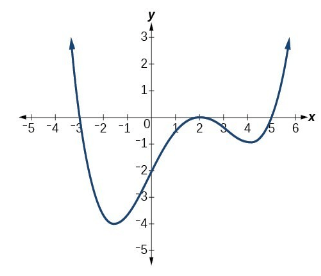
Local minima: -4 and -1
Local maxima: 0
500
21) End behavior:

as x->-oo, f(x)->-oo
as x->oo, f(x)->oo
500
28) Find all roots (real and imaginary), list any multiplicities larger than 1.

x = -5 with mult. 2
x=1+-isqrt2
x=+-2sqrt3
500
34) Find g(-2) using the Remainder Theorem for:

g(-2) = 21
500
What is the formula for factoring the sum of cubes?
a^3+b^3=(a+b)(a^2-ab+b^2)
500
32) Decreasing:
Increasing:
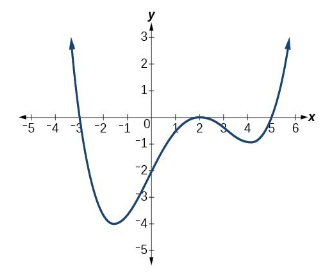
Decreasing: (-oo,-1.5)and(2,4)
Increasing: (-1.5,2)and(4,oo)