1D Kinematics
Graphs of motion
2D motion
Energy
Conservation of Energy
100
Which object has nonzero acceleration: one moving at constant velocity or one whose velocity is decreasing
The one with decreasing velocity
100
The physical quantity represented by the slope of a position–time graph
velocity
100
The horizontal acceleration of a projectile (ignoring air resistance)
zero
100
The condition under which gravitational potential energy increases (within/ on earth).
Increased height
100
The dominant form of energy just before a dropped object hits the ground. If no other information is given,
kinetic energy
200
The acceleration of a car traveling at constant speed in a circle.
non zero
200
The motion represented by a horizontal line on a velocity–time graph
constant velocity
200
The vertical velocity of a projectile at the highest point of its motion
zero
200
The quantities that kinetic energy depends on
mass and velocity
200
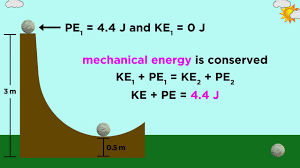
The behavior of total mechanical energy in a system with no nonconservative forces
It is conserved.
300
The relative arrival time of two objects of different masses dropped from the same height (no air resistance).
They hit at the same time.
300
The meaning of a positive slope on a velocity–time graph
Positive acceleration
300
The relative landing times of a ball launched horizontally and one dropped from the same height
The hit at the same time.
300
How kinetic energy changes when velocity is doubled
It quadruples
300
The consideration that determines the final speed of an object sliding down a frictionless ramp
height.
400
Two balls are thrown vertically upward from the same height with different speeds. Ball A is thrown faster than Ball B.
Which statement is correct about their accelerations while in the air (ignoring air resistance)?
A) Ball A has greater acceleration because it moves faster
B) Ball B has greater acceleration because it reaches a lower height
C) Both have the same constant acceleration
D) Acceleration depends on how long each ball is in the air
C) They both have the same constant acceleration
400
The physical quantity represented by the area under a velocity–time graph
displacement
400
A projectile is launched at an angle. Consider two points:
- Point A: just after launch
- Point B: at the top of the trajectory
How do the magnitudes of the acceleration and velocity compare at A and B?
A) Acceleration is smaller at B
B) Acceleration is the same at A and B; velocity is smaller at B
C) Both acceleration and velocity are smaller at B
D) Velocity is zero at B and acceleration is zero
B) Acceleration is the same at A and B; velocity is smaller at B
400
Two objects have the same mass. One moves at speed v, the other at speed 2v.
What is the ratio of their kinetic energies?
A) 1:2
B) 1:3
C) 1:4
D) 2:1
C) 1:4
400
Two frictionless tracks start at the same height and end at the same height.
Track A is straight; Track B is curved.
Which object has greater speed at the bottom?
A) Object on Track A
B) Object on Track B
C) Both have the same speed
D) Cannot be determined
C) Both have the same speed
500
An object moves along a straight line. Its velocity changes from −5 m/s-5 \,\text{m/s}−5m/s to +5 m/s+5 \,\text{m/s}+5m/s.
Which statement must be true?
A) The acceleration was positive during the entire motion
B) The object passed through zero velocity
C) The acceleration was zero at some point
D) The object changed direction without stopping
B) The object passed through zero velocity
500
How velocity–time graphs compare for two objects with the same acceleration but different initial velocities
Parallel lines
500
How time of flight changes if a projectile’s horizontal velocity is doubled (same launch height)
It does not change.
500
A ball is thrown upward. Consider two points:
- Point A: halfway up
- Point B: at maximum height
How do the kinetic energies compare?
A) KE at A > KE at B
B) KE at A = KE at B
C) KE at A < KE at B
D) KE is zero at both points
A) KE at A > KE at B
500
Two identical balls are released from rest from the same height.
- Ball A falls straight down
- Ball B slides down a frictionless ramp
Which has greater kinetic energy at the bottom?
A) Ball A
B) Ball B
C) Both have the same kinetic energy
D) Cannot be determined
C) Both have the same kinetic energy