Spine/Thorax bones
Spine muscles
Muscles of neck and TJ
Pelvis and Skull bones
Random
100
Which vertebrae has an odontoid process?
C2 - Axis
100
Which abdominal runs from the ribs to the pubic crest and is called the "six pack"?
Rectus abdominis
100
Which scalenes insert into the 1st rib?
Anterior and middle scalene
100
What is the circle area called? 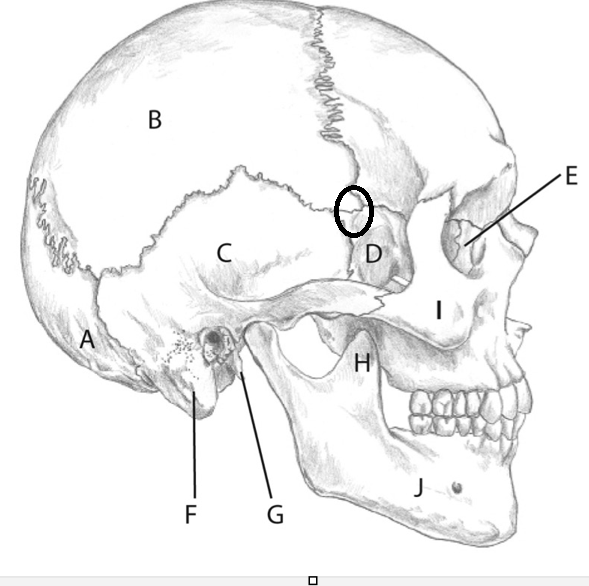
Pterion-Where the frontal, temporal, parietal and sphenoid meet
100
Which triangle do you find the brachial plexus?
a) anterior
b) posterior
c) abdominal
d) equilateral
B-posterior triangle
200
Name the parts of the vertebral disc?
Nucleus pulposus and annulus fibrosis
200
Identify the muscle on the right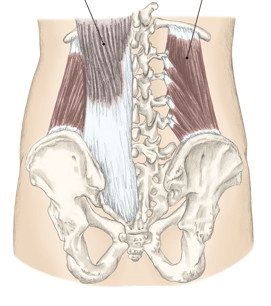
Quadratus lumborum
200
What is this muscle called? and what nerve innervates it?
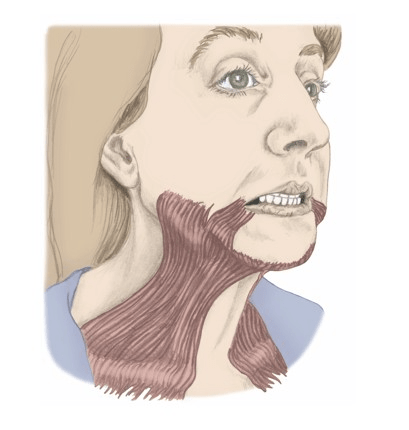
Platysma and Facial VII
200
Name two bones that make up the pelvis and vertebral column?
Sacrum and Coccyx
200
Your SI joint is made up of which to bones?
And true of false: males have a a wider iliac crest and a greater distance between ischial tuberosities
Sacrum and ilium
False-females do
300
Match the following:
1) cervical a) 12 vertebrae
2) thoracic b) 5 vertebrae
3) Lumbar c) 3-5 vertebrae
4) Coccyx d) 7 vertebrae
1) cervical d) 7 vertebrae
2) thoracic a) 12 vertebrae
3) Lumbar b) 5 vertebrae
4) Coccyx c) 3-5 vertebrae
300
There is a connective tissue that goes from your EOP all the way to the C7 Spinous process. What is this CT called?
Ligamentum Nuchae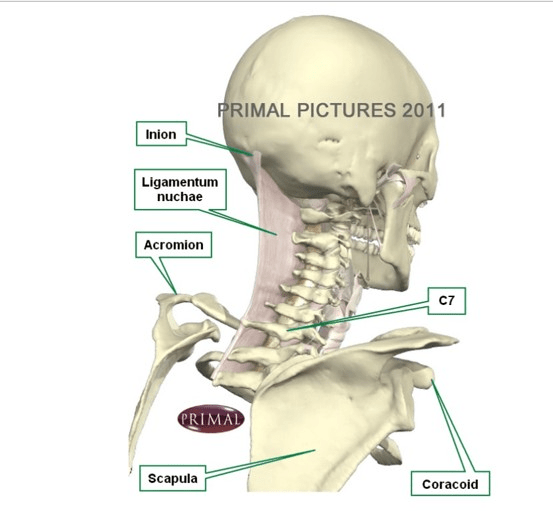
300
For the masseter which action shortens and which action lengthens the muscle?
Elevation mandible
depression mandible
Elevation mandible=shorten masseter
Depression of mandible=lengthen masseter
300
Name the parts of the pelvis: 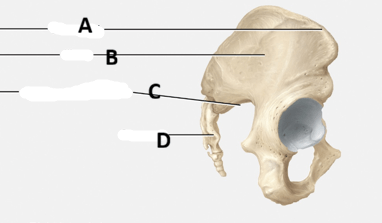
A=iliac crest
B=Ilium
C=Sciatic notch
D=Sacrum
300
What innervates the diaphragm?
Phrenic nerve-C3, C4, C5 keep the diaphragm alive
400
Which curvature applies to cervical, thoracic and lumbar area? (Kyphosis or Lordosis)
Cervical-lordosis, thoracic-kyphosis and lumbar-lordosis
400
Name the Erector Spinae Muscle and then tell their combined action?
Spinalis
Longissimus
Iliocostalis
Combined action-extension of spine and laterally flex to same side
400
Which muscles are these?
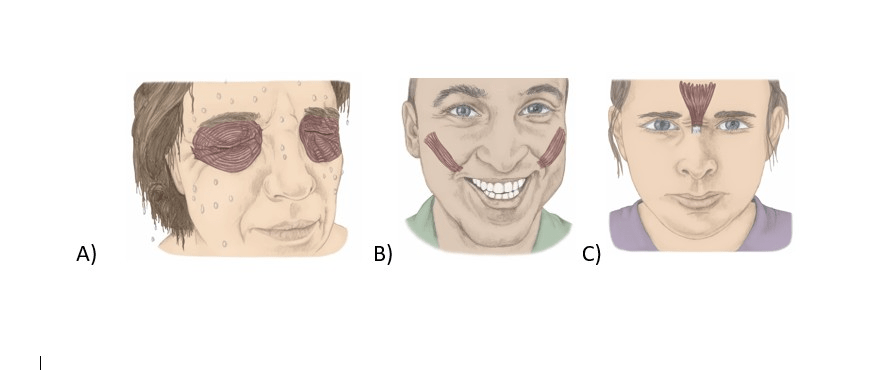
A) orbicularis oculi
b) Zygomaticus Major
C) Procerus
400
Identify A, B, C, D
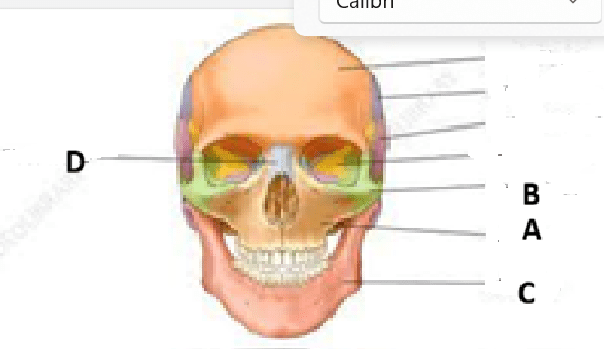
A=Maxilla
B=Zygomatic process
C=Mandible
D=Nasal Bone
400
Matching:
1) Transverse Abdominis
2) Diaphragm
3) Internal intercostal
4) External Oblique
a)Phrenic Nerve
b) Decrease thoracic cavity by drawing ribs inferiorly
c) involved in forced exhalation
d) Most superficial of the obliques. Important for rotation to the opposite side and lateral flexion.
1) C-involved in forced exhalation
2) A-phrenic nerve
3) B-Decrease thoracic cavity by drawing ribs inferiorly
4) External Oblique-Most superficial of the obliques. Important for rotation to the opposite side and lateral flexion.
500
Match the following with their landmarks?
1) T-2
2) L-4
3) T-7
4) C-7
a) The most prominent and visible bump at the base of the lower neck.
b) Inferior angle of the scapula
c) Imaginary horizontal line connecting the highest points of both iliac crests
d) Superior angle of the scapula
1) T-2 (D)Superior angle of the scapula
2) L-4- (C) Imaginary horizontal line connecting the highest points of both iliac crests
3) T-7-(b) Inferior angle of the scapula
4) C-7-a) The most prominent and visible bump at the base of the lower neck.
500
Match the following suboccipital muscles?
1) Rectus Capitis Posterior Major
2) Oblique Capitis Superior
3) Rectus Capitis Posterior Minor
4) Oblique Capitis Inferior
a) Insertion Between the nuchal lines of the occiput
b) Inferior nuchal line of the occiput
c) Insertion-Transverse process of the atlas (C-1)
d) Origin Spinous process of the axis (C-2)
1) Rectus Capitis Posterior Major-(d) Origin Spinous process of the axis (C-2)
2) Oblique Capitis Superior-(a)Between the nuchal lines of the occiput
3) Rectus Capitis Posterior Minor-(b) Inferior nuchal line of the occiput
4) Oblique Capitis Inferior-(c) Insertion-Transverse process of the atlas (C-1)
500
Origin TP of C3-C6 and insertion inferior surface of occiput is for which muscle?
a) longus capitis
b) longus colli
c) Temporalis
d) Lateral Pteryoid
A-longus capitus-Origin TP of C3-C6 and insertion inferior surface of occiput is for which muscle?
500
Label A, B, C, D
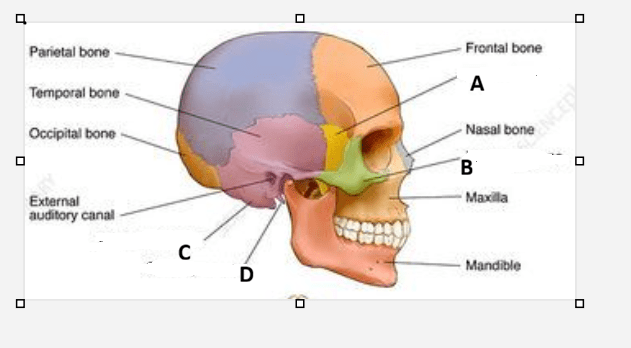
A=sphenoid
B=zygomatic arch
C=mastoid process
D=styloid process
500
The serratus posterior superior and inferior muscles affect the movement of what area of the body?
A) Cervical ara
b) sternum
C) ribs
D) clavicle
C-ribs