Connective Tissue Coverings
Skeletal Muscle Fiber Structure
The Sarcomere
Energy Metabolism
What Type of Muscle Tissue am I?
Excitation-Contraction Coupling
100
This CT layer covers each individual muscle fiber.
Endomysium
100
This is the name for the cytoplasm of a muscle fiber.
Sarcoplasm
100
The sarcomere is the repeating functional unit of skeletal muscle contraction. It is composed of thick and thin filaments made of these 2 proteins.
Thin filament = actin
Thick filament = myosin
100
The energy currency of the cell
ATP
100
I have multiple nuclei, striations, and a long cylindrical shape. I function to produce voluntary movement, produce heat, and protect organs.
Skeletal Muscle
100
This is the fluid filled gap between the axon terminal of a motor neuron, and the muscle fiber it innervates. Neurotransmitters are released in this space.
Synaptic cleft
200
This CT layer covers each individual muscle and is deep to the fascia.
Epimysium
200
This fiber-like organelle is made up of repeating subunits of myosin and actin.
Myofibril
200
This portion of the sarcomere is where thick and thin filaments overlap, and is also called the "dark band" 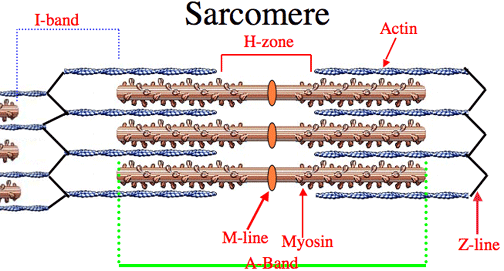
A Band
200
Sally is running a 10 mile race.This is the most likely pathway her muscles are using for ATP regeneration.
Aerobic respiration
200
I am uninucleate, have striations, and intercalated discs. I function to pump blood through blood vessels.
Cardiac Muscle
200
This is the neurotransmitter that stimulates muscle contraction.
Acetylcholine
300
This is the connective tissue that attaches muscles to bones.
Tendon
300
This organelle stores and releases the calcium ions involved in muscle contraction.
Sarcoplasmic reticulum
300
A contractile unit
What is a sarcomere?
300
Where does aerobic respiration take place in the muscle cell?
Mitochondria
300
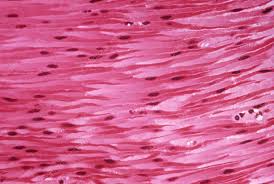
I am the muscle tissue shown here
Smooth Muscle
300
Calcium released from the sarcoplasmic reticulum floods the muscle fiber and binds to this protein in order to expose the active sites on actin filaments.
Bonus: what is the name of the other accessory protein that actually moves out of the way to espose active sites?
Troponin
Bonus: tropomyosin
400
This CT layer covers each fascicle.
Perimysium
400
This specialized structure controls what enters and exists the muscle fiber. It has projections, called T-tubules, that extend deep into the muscle fiber.
Sarcolemma
400
Which number represents the I band?
7 - The light band where there are only thin actin filaments.
400
What is the waste product which is produced when anaerobic respiration takes place in your muscle cells?
lactic acid
400
Smooth muscle produces this wavelike motion that propels food down the G.I. tract.
Peristalsis
400
This temporary structure is formed between myosin heads and actin. It is the formation of this structure, and the power stroke of myosin, that causes sarcomere shortening (AKA contraction).
Cross-bridge
500
Name one of the two main functions of the connective tissue wrappings of muscles.
1. Separate and organize parts of skeletal muscle
2. provide entry and exit point blood vessels & nerves
500
This the neurotransmitter which is released from a motor neuron which crosses the synaptic space to bind to a receptor in the sarcolemma which will initiate an impulse that travels to the T-tubule.
Acetylcholine
500
When a muscle fiber contracts the sarcomere does this as thin filaments are pulled over thick filaments within the structure.
Shortens
500
This is the number of ATP molecules generated from one glucose molecule during aerobic respiration (cellular respiration).
36-38 ATP
500
I am the muscle tissue seen here.
Cardiac muscle
500
After a contraction, the muscle fiber will relax in the presence of ATP. Calcium will be transported back to the sarcoplasmic reticulum, sodium concentration will be brought back to normal levels ending the action potential, and this enzyme will destroy all the acetylcholine left in the synaptic cleft to ensure stimulation of the muscle fiber has ended.
Acetylcholinesterase