Intramuscular
Subcutaneous
Capillary
Venipuncture
After Puncture
100
Intramuscular injection angle
90o

100
Subcutaneous injection angle
45 to 90 degree
100
What are capillaries?
Capillaries are the smallest blood vessels in your vascular system
100
What 7 items do you need for a venipuncture?
Tourniquets, Needle, Vacutainer tube, Vacutainer tube holder, Alcohol, Gauze, Band-aid
100
How many times do you invert blood tubes?
If the blood has to be mixed with an additive (gently invert the tube 4 to 10 times depending on the specimen tube being used)
200
Where can you give an intramuscular injection?
The four sites for an intramuscular injection are the shoulder, hip, thigh, and buttock.
200
Where can you give a subcutaneous injection?
Back of upper arms, Outer side of upper thighs, Belly area. Below your ribs and above your hip bones, at least 2 inches (5 centimeters) away from your belly button.
200
Where should the capillary puncture on a finger take place?
The puncture should be made across the fingerprint, not parallel to it. The puncture must be performed on the side of the fingertip where tissue depth is sufficient to prevent bone injury.
200
What angle should the needle be for venipuncture?
30 degrees or less
200
Do capillary injections have an order of draw?
Yes
- Capillary blood gas (CBG)
- EDTA tube.
- Other additive tubes.
- Nonadditive tubes.
- Filter paper for DBS collections.
300
What would you do if you had to give a patient multiple intramuscular injections?
Spread out the injections. Use both arms and if you have to give multiple injections in the same arm, it should be separated as far as possible (preferably at least 1” apart).
300
True or False: You can administer a subcutaneous injection on yourself
True
300
On an infant where would you do a capillary puncture?
On the heel
300
Why is order of draw necessary?
To protect against a tube's additive from carrying over into the next tube and affecting test results.
300
What is the purpose of inverting tubes?
All tubes (except red top tubes which contain no additives) must be gently inverted 5 to 8 times immediately after filling, to ensure proper mixing of blood and anticoagulant, or other additives.
400
Needle size for intramuscular injections
Needle length is usually 1"–1½", 22–25 gauge, but a longer or shorter needle may be needed depending on the patient's weight.
400
Needle size for subcutaneous injections
23–25 gauge, 5/8" needle.
400
Why do you wipe away the first drop of blood in a capillary puncture?
The first drop of blood may contain tissue fluids or contaminants from the skin, which could affect the accuracy of the test results.
400
Where can you draw blood?
Back of hand, inside elbow, forearm, foot
400
What injection site do you not put a band-aid?
Intradermal injection
500
Why are IM injections absorbed quicker than SQ injections?
The IM injection route deposits medication into deep muscle tissue, which has a rich blood supply, allowing medication to be absorbed faster than it would be by the subcutaneous route.
500
Why are SQ injections absorbed slower than SQ injections?
As subcutaneous tissue has few blood vessels, the injected drug is diffused very slowly at a sustained rate of absorption. Therefore, it is highly effective in administering vaccines, growth hormones, and insulin, which require continuous delivery at a low dose rate.
500
Why can't you do a capillary puncture on the thumb and pinky finger?
The thumb has a pulse and is likely to bleed excessively. The pinky finger does not have enough tissue to prevent hitting the bone with the lancet.
500
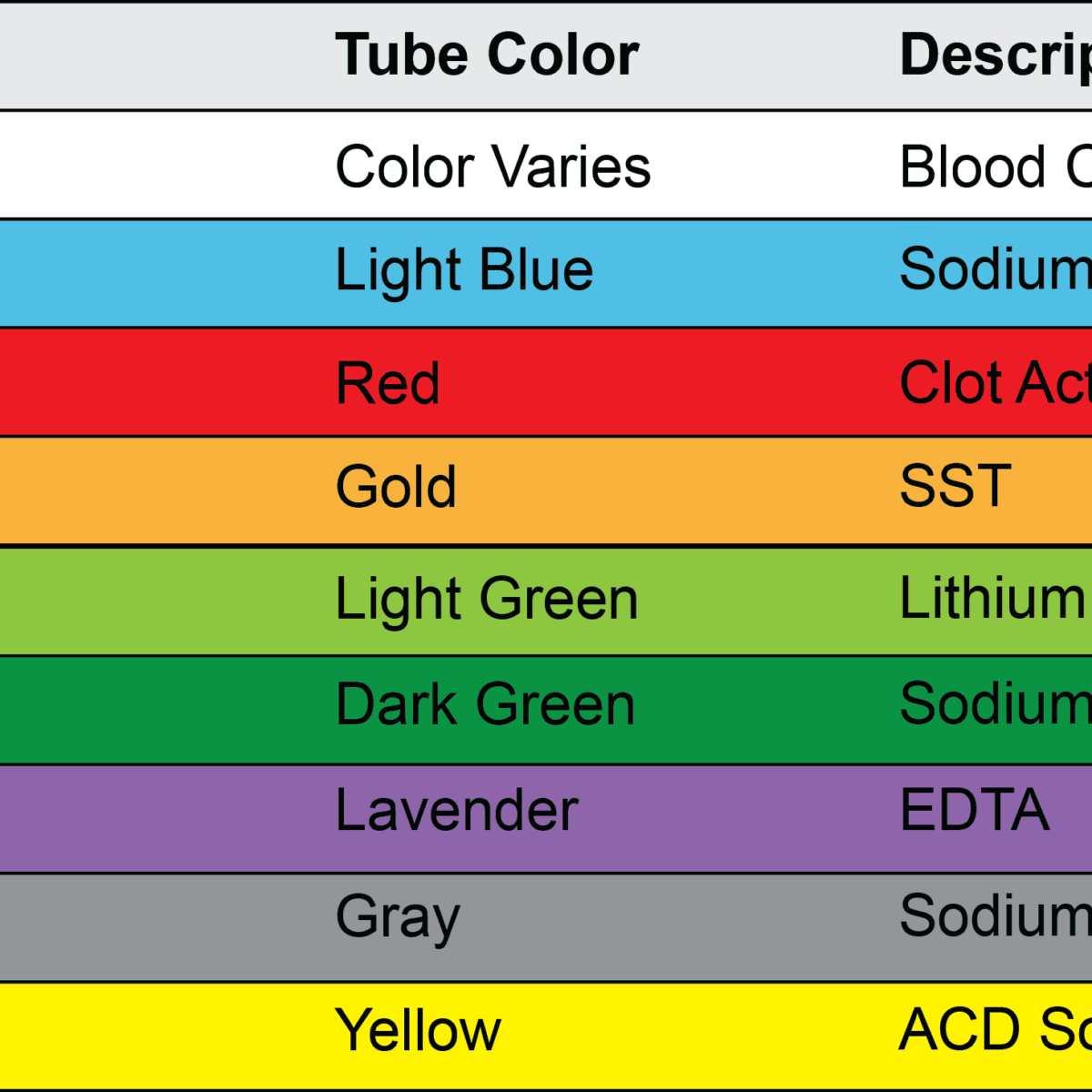
What is the correct Order of Draw?
Blood Cultures, Light Blue, Red, Gold, Light Green, Dark Green, Lavender, Gray, Yellow
500
What do you do with your blood sample after a blood draw?
It depends on the sample. Some need to be kept cool (refrigerated), kept at room temperature, kept on ice, avoid light, put in the centrifuged, etc. Always check before you draw and always label your samples.