Net Ionic Equations
The Mole
Ratios and Calculations
Rates of Reactions
Potporri
Final Jeopardy
100
Ba(OH)2.... Mg(OH)2... NaOH
The molecule that is insoluble in water.
What is Mg(OH)2?
100
The number of particles in 1 mole.
What is 6.02 x 10²³?
1 mole = 6.02 x 10²³
100
The amu in 1 molecule of CO2.
What is 44?
CO2 = 12 + 16 + 16 = 44 amu
100
As temperature increases the rate of a reaction does this.
What is increases?
As temperature increases the molecules move faster and collide harder... resulting in more collisions where bonds are broken.
100
What amu stands for.
Atomic Mass Units
200
The term given to ions that are aqueous in the products and reactants... they are not involved in the chemical reaction.
What are spectator ions?
200
The number of grams in 1 mole of water.
What is 18?
1 molecule H2O = 18 amu
1 mole H2O = 18 grams
200
_____N2 + _____O2 → _____NO2
The coefficients of the balanced chemical equation.
What is 1, 2, 2?
1N2 + 2O2 → 2NO2
200
The reason that a higher concentration increases the rate of a reaction.
What is more frequent collisions?
Molecules must collide in order for a reaction to take place.
200
The mole is often called ___________ number, named after the scientist who worked on the idea.
What is Avogadro's?
300
CaCO3... Mg(OH)2... HCl
The molecule that will dissociate in water.
The molecule that is soluble.
What is HCl?
All acids dissociate in solution.
300
The element in the Periodic Table that was used to calculate the value for the mole.
The entire Periodic Table is relative to this element.
What is 12C?
300
The number of grams in 1 mole of CO2.
What is 44?
1 molecule CO2 = 44 amu
1 mole CO2 = 44 g
300
The three parts of collision theory.
What is
1: molecules must collide
2: with enough energy to break bonds
3: and in the correct orientation?
300
True or False:
There are 6.02x10²³ molecules in 18 amu of H2O.
What is false?
1 molecule H2O = 18 amu
1 mole H2O = 18 g
1 mole H2O = 6.02x10²³ molecules
300
The total mass of the reactants needed to make 2 moles of CaO.
_____Ca + _____O2 → 2 CaO
What is 112 g?
_____Ca + _____O2 → 2 CaO
__2__Ca + __1__O2 → 2 CaO
1 atom Ca = 40 amu 1 mole Ca = 40 g
2 mole Ca = 80 g
1 mlcl O2 = 32 amu 1 mole O2 = 32 g
80 g + 32 g = 112 g
400
Na2CO3 (aq) + CaCl2 (aq) → CaCO3 (s) + 2NaCl (aq)
The spectator ions in the above equation.
What are Na+ and Cl-?
Ca2+ (aq)+ CO32- (aq) → CaCO3 (s)
Na+ and Cl- are not involved in this reaction.
400
1 mole H2.... 1 mole O2... 1 mole H2O
Which one has the greatest number of molecules?
What is none of them?
1 mole H2 = 6.02x10²³ molecules
1 mole O2 = 6.02x10²³ molecules
1 mole H2O = 6.02x10²³ molecules
400
The number of molecules in 3 moles of sodium chloride.
What is 18x1023 molecules?
1 mole = 6.02x10²³ molecules
3 moles = 3 x 6x1023 = 18x1023 molecules
400
The section of this graph showing the fastest rate.
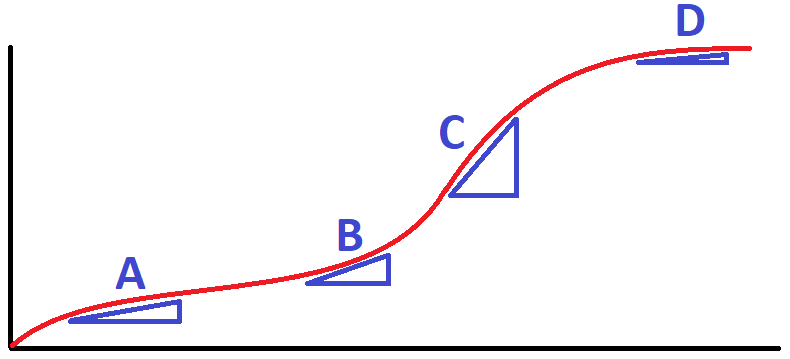
What is section C?
A fast rate has a steep slope.
400
When this chemical is mixed with hydrochloric acid, sulfur is produced that will make the X disappear.
What is sodium thiosulfate?
Na2S2O3
500
The net ionic equation:
AgNO3 ( ) + NaCl ( ) → AgCl ( ) + NaNO3 ( )
What is Ag+ (aq) + Cl- (aq) → AgCl (s)?
AgNO3 (aq) + NaCl (aq) → AgCl (s) + NaNO3 (aq)
Ag+ NO3- Na+ Cl- → AgCl (s) Na+ NO3-
Na+ and NO3- are spectators.
500
1 mole H2.... 1 mole O2... 1 mole H2O
Which one has the greatest number of grams?
What is oxygen?
1 molecule H2 = 2 amu 1 mole H2 = 2 grams
1 molecule O2 = 32 amu 1 mole O2 = 32 grams
1 mlcl H2O = 18 amu 1 mole H2O = 18 grams
500
_____g H2 + _____g F2 → _____g HF
The balanced mass equation of the following reaction:
1H2 + 1F2 → 2HF
What is 2, 38, and 40?
500
The reason(s) why one beaker has a faster reaction than the others.
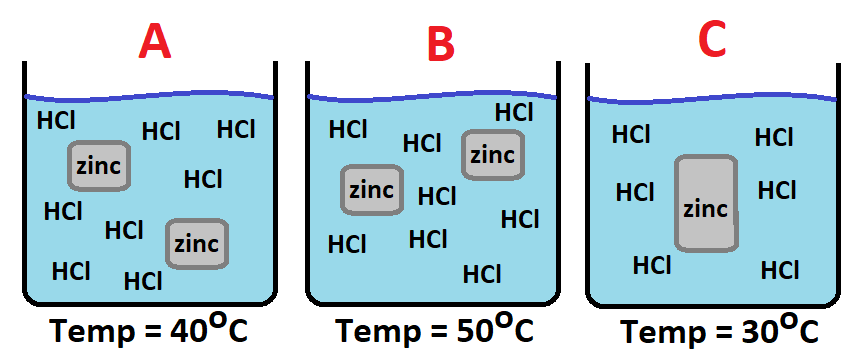
Beaker B has the fastest reaction because it has the highest temperature, resulting in more frequent and more energetic collisions.
Beaker B also has a high concentration of acid and a large surface area of zinc.
500
The rate of this reaction for the first 6 seconds.
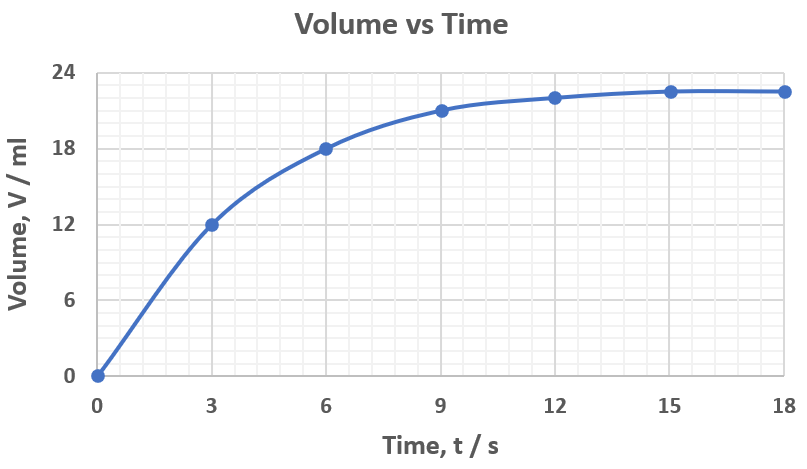
What is 3 ml/s?
slope = rate = rise/run = 18ml/6s = 3 ml/s