Structure & Function
Resting & Action Potentials
Synapses
Summation
Neurotransmitters and Drugs
100
Name the part that receives signals from other neurons.
Dendrites
100
What is the approximate resting membrane potential?
–70 mV
100
What's released from vesicles at the synapse?
Neurotransmitter
100
What does EPSP stand for?
Excitatory postsynaptic potential
100
Name a neurotransmitter involved in mood regulation.
Serotonin or dopamine
200
What structure sends the action potential to the next cell?
Axon terminal
200
Which ion is more concentrated outside the cell at rest?
Sodium (Na⁺)
200
What is the small gap between neurons called?
Synaptic cleft
200
What does IPSP stand for?
Inhibitory postsynaptic potential
200
What neurotransmitter is blocked by curare?
Acetylcholine (ACh)
300
This structure decides whether an action potential fires at all.
Axon hillock
300
Explain the "all-or-nothing" principle
Once a stimulus reaches threshold, the neuron fires a full action potential every time, the size of the spike doesn't change with a stronger stimulus.
300
What ion triggers vesicle fusion at the axon terminal?
Calcium (Ca²⁺)
300
If a neuron gets 3 EPSPs from 3 different dendrites at once, what's this called?
Spatial summation
300
How does Prozac affect serotonin in the synapse?
It blocks the reuptake of serotonin, leaving more of it in the synaptic cleft longer.
400
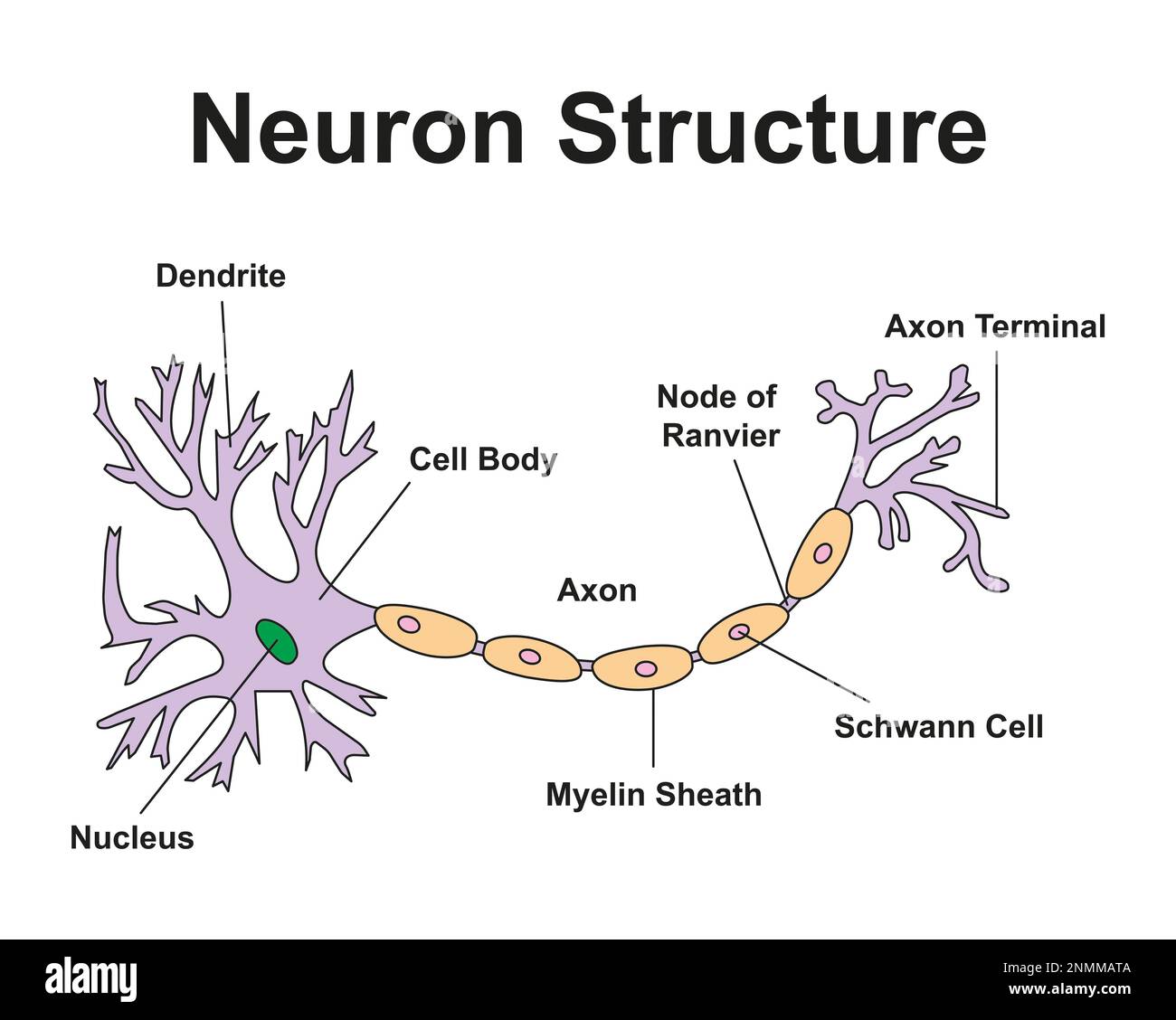
Draw and label a neuron in 30 seconds.
dendrites, cell body/nucleus, axon hillock, axon, myelin sheath, nodes of Ranvier, axon terminals
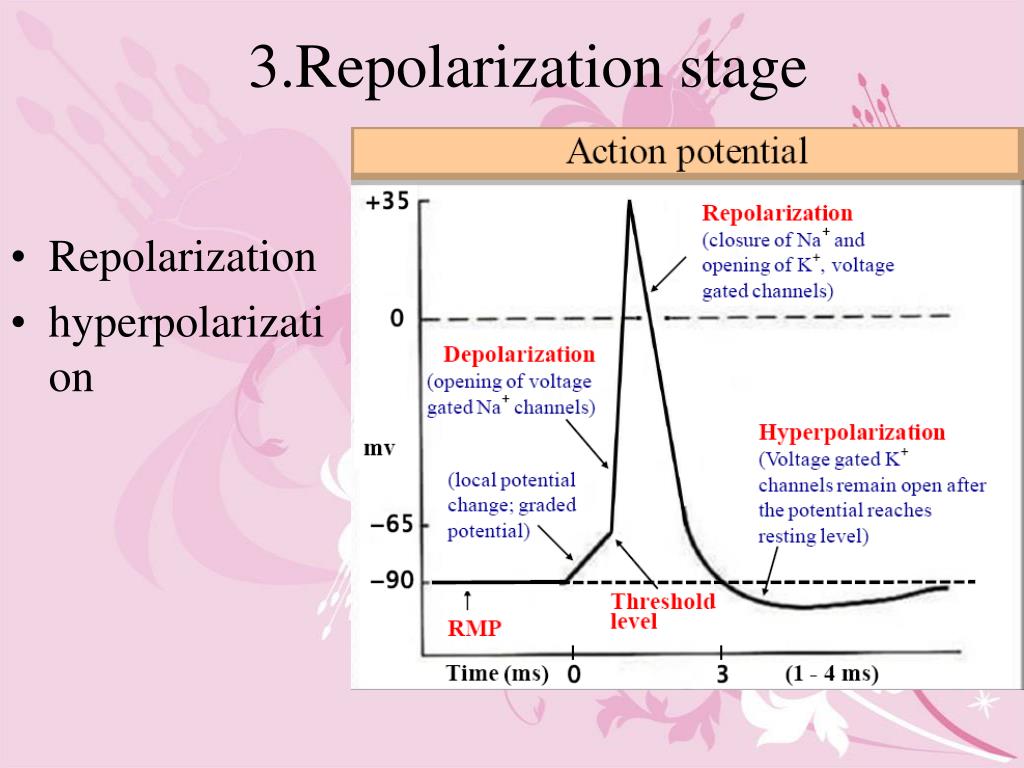
400
Sketch the action potential graph and label depolarization, repolarization, and hyperpolarization.
400
Put these steps in order: vesicle fusion, Ca²⁺ influx, receptor binding, NT release, diffusion across cleft.
Ca²⁺ influx → vesicle fusion → NT release → diffusion across cleft → receptor binding
400
Sketch what temporal summation looks like on a voltage graph.
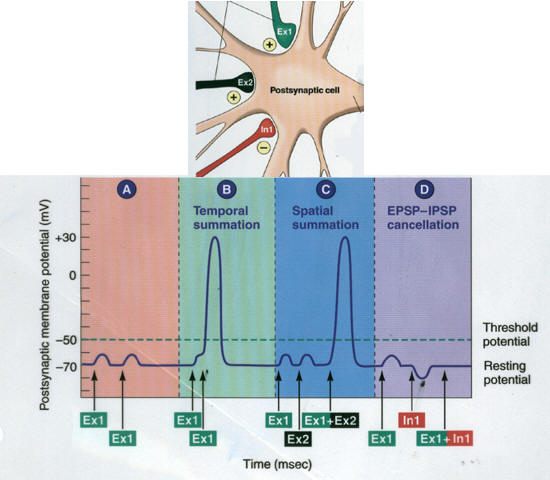
400
Match: cocaine, PCP, alcohol to their neurotransmitter targets.
Cocaine = blocks dopamine reuptake; PCP = blocks glutamate (NMDA) receptors; Alcohol = enhances GABA activity
500
Explain why myelin speeds up conduction.
Myelin insulates the axon so the signal "jumps" between the exposed nodes of Ranvier (saltatory conduction) instead of traveling continuously down the whole membrane, which is much faster.
500
Explain why the sodium-potassium pump moves ions in a 3:2 ratio and how that affects charge.
It pumps 3 Na⁺ out for every 2 K⁺ in, so more positive charge leaves than enters, this makes the inside of the cell more negative and helps maintain the resting potential.
500
Explain what happens to leftover neurotransmitter and why it matters.
It's either broken down by enzymes or taken back up by the presynaptic neuron (reuptake); this clears the synapse so the signal doesn't keep firing indefinitely
500
A neuron gets 2 EPSPs (+5mV each) and 1 IPSP (–5mV), starting at resting potential of –70mV, with threshold at –50mV. Does it fire?
–70 + 5 + 5 – 5 = –65mV. No, it does not reach the –50mV threshold.
500
Explain the general mechanism of how one abused drug affects synaptic transmission.
Example: Cocaine blocks the dopamine transporter responsible for reuptake, so dopamine accumulates in the synapse and keeps overstimulating the postsynaptic neuron.