Motor Models/Motor Learning
Spasticity/Rigidity
Hypotonia/Ataxia
UE
Balance
Pusher Syndrome
Sensory and Perceptual
UE Painful Shoulder
100
Tapping and Icing to get motor responce
What is the Reflexive Theory?
100
Resistance to movement on both sides of the joint.
Rigidity
100
This is an objective method of measuring progress for seated balance when someone cannot sit unsupported.
What is time?
100
This is an EB intervention you could use early on after stroke to increase repetitions of reaching.
What is UE robotics?
100
This system is important for knowing where your joint is in space.
What is the sensory system?
100
Pusher Syndrome is considered a mismatch between these two systems.
What are the visual and postural vertical systems?
100
If a patient draws this from memory. This is what type of neglect?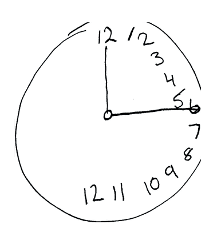
What is representational neglect?
100
This is the most common direction of subluxation after stroke.
What is inferior?
200
Motivation is Key to learning
What is the Optimal Theory of Motor learningl?
200
This modality can be added to agonist or antagonist to decrease spasticity.
What is Estim?
200
According to the evidence for ataxia this intervention could make error greater when removed?
What is using distal weights?
200
This is the requirement for patients when using CIMT or mCIMT.
What is active wrist and finger extension?
200
This is the first balance response in standing with a small pertubation.
What is an Ankle Reaction?
200
Someone who has pusher syndrome often pushes toward this side.
What is toward the weak side?
200
This picture identifies what type of neglect?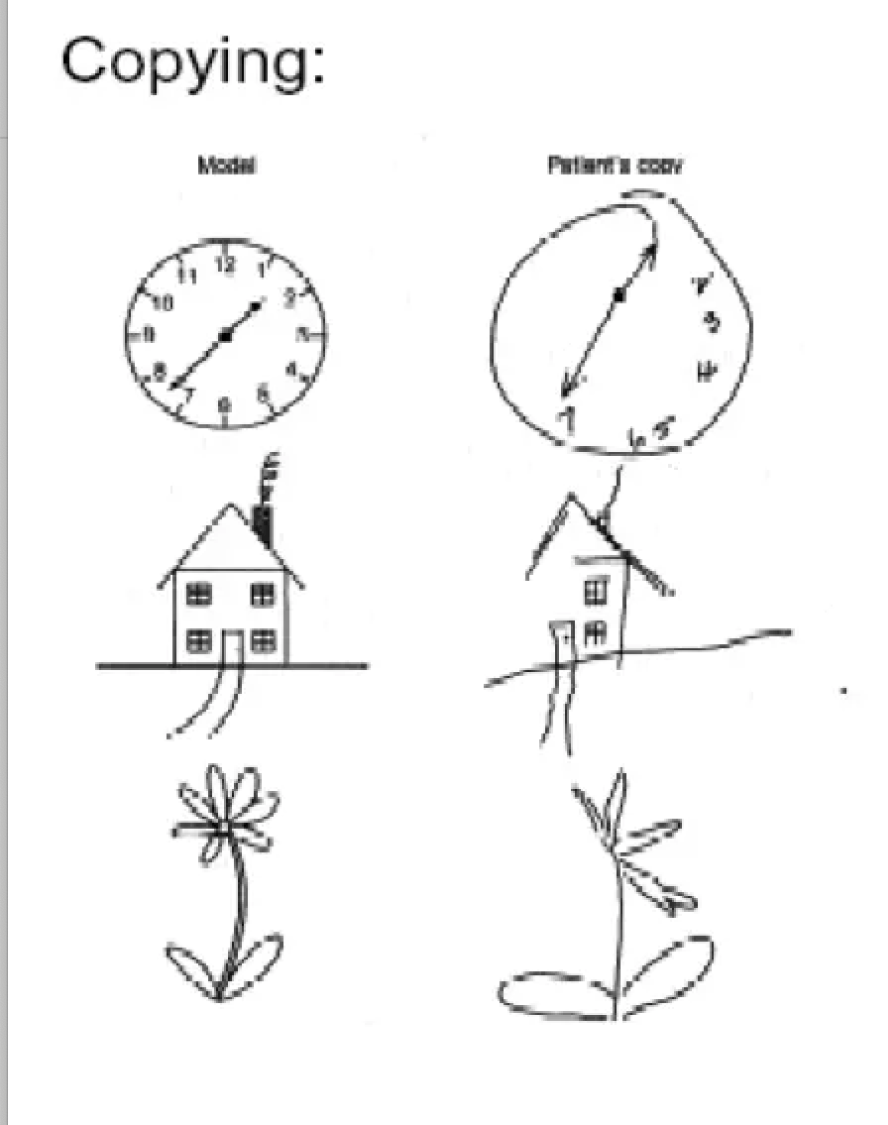
What is visual neglect?
200
This can be used early after stroke to support the shoulder and prevent subluxation.
What is shoulder strapping?
300
ROM, Stability, controlled mobility, skill
What is Roods?
300
This medication is best for focal spasticity.
What is Botox?
300
According to the TWIST algorithm this is the cut off for the trunk control test to predict walking at 6 weeks.
What is greater or equal to 40?
300
According to the PREP algorithm, this SAFE score at 72 hours indicates a complete recovery.
What is 8?
300
This is an automatic reaction to help a person maintain balance when their center of mass is displaced.
What is an equilibrium reaction?
300
This scale that is most sensitive to change in pushing behavior.
What is the Burke Lateralpulsion Scale?
300
This is a scale that looks at both pen and paper testing and behavioral testing for neglect.
What is the Behavior Inattention Test (BIT)?
300
This is a muscle that is commonly spastic that can contribute to trunk lateral bending and shoulder IR, ADD spastic pattern.
What is the latissimus dorsi?
400
Allowing Compensatory Strategies early is what Neuroplasitic Principle?
What is Interference?
400
This is a secondary consequence associated with Spasticity.
What is contracture?
400
Which is missing for stability techniques: Place and Hold, Rhythmic stabilization and ...
What is alternating isometrics?
400
According to Chedoke McMasters, this is the cut-off score to focus therapy on compensatory strategies.
What is <4?
400
These 3 types of training can improve functional ambulation.
What is balance exercises with strength and resistance training, standing practice, or balance exercises with biofeedback?
400
This is the first step when treating someone with pushing syndrome.
What is overleaning them to the strong side to diminish the push.
400
These are the two interventions that are most supported AND feasible in the clinic for neglect.
What are sensory stimulation and visual scanning?
400
This is an exercise that should NOT BE done in rehab with stroke patients with shoulder pain.
What are pulleys?
500
Schmitts Stage of Learning to introduce dual tasks.
What is Autonomous Stage?
500
This is what you would do if someone has HO in the Hip while you are casting the knee.
What is continue with casting?
500
Of the two ataxia scales, this is the most efficient one.
What is the Sara Scale for Ataxia?
500
According to the literature, these are the 5 R's necessary for effective task-specific training of the upper limb.
What are relevant, repeat, random, reward, raise/reinforce?
500
A patient has the following deficits in the left LE:
Strength grossly 2/5
Sensation intact
BERG balance 25
Normal Vestibular exam
ROM Normal
What would be the best intervention to improve this patient's balance?
What is strength training?
500
This is the first step in treatment when treating someone with backwards disequilibrium.
What is standing with their heels and back against the wall.
500
When testing sensation in a stroke patient this is the first test to perform to determine if more testing is necessary.
What is sharp/dull discrimination?
500
This is the most common cause of shoulder PAIN.
What is impingement.