Fetal Assessments and Testing
Pregnancy
Pregnancy Complications
All about mom
Misc
100
What are the 5 components of a Biophysical Profile?
Fetal HR
Fetal Movement
Fetal Breathing
Amniotic Fluid Levels
Fetal Tone
100
A nurse is assisting in performing an assessment on a client who suspects that she is pregnant and is checking the client for probable signs of pregnancy.
Positive pregnancy test, ballottment, Braxton-Hicks, Goodell Sign, Chadwick sign, Enlarging uterus
100
A nurse is monitoring a pregnant client with pregnancy induced hypertension who is at risk for preeclampsia. The nurse checks the client for which specific signs of preeclampsia?
HA, vision changes, epigastric pain, elevated BP, edema, proteinuria
100
A woman is at her prenatal visit and the doctor measures her fundal height at 22cm. How many weeks gestation would we expect her to be?
22 weeks
100
What tasks can a certified Nurse Midwife perform?
Antepartum care, contraceptive care, postpartum, preconception, pregnancy care, low risk patient care
200
A client is given an NST. The client is asking about how the results are determined. How should the nurse respond?
Reactive: 2 accelerations that are 15x15 in a 20-minute period.
Nonreactive: no acceleration or 1 acceleration in a 40-minute time period
200
The chief functions of progesterone is the:
Prepares the uterine lining, relaxes smooth muscle, and maintains the pregnancy
200
Rho (D) immune globulin (RhoGAM) is prescribed for a woman following delivery of a newborn infant and the nurse provides information to the woman about the purpose of the medication. What would the nurse tell the patient?
Administration of Rho(D) immune globulin prevents the woman from developing antibodies against Rh-positive blood by providing passive antibody protection against the Rh antigen.
200
A pregnanct client asks about the dark line that she has noticed going down the center of her abdomen. How shoud the nurse respond?
This is a normal finding called the Linea nigra. It should fade after pregnancy. This is common along with striae gravidarum
200
What are some signs that your patient may be a victim of human trafficking?
Late prenatal care, different levels of bruising, false ID or not knowing personal info, support person won't leave their side, avoiding eye contact, wont answer for themselves
300
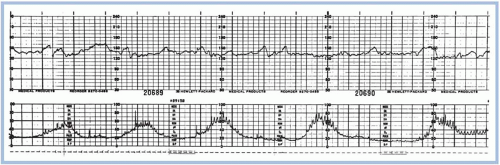
How would you interpret this NST?
Reactive
300
What are the chief functions of the placenta?
Oxygen and nutrient exchange, removal of metabolic waste, antibody transfer
300
A pregnant client is receiving magnesium sulfate for the management of preeclampsia. A nurse determines the client is experiencing toxicity from the medication if she notes what assessments?
Signs of toxicity relate to the central nervous system depressant effects of the medication and include respiratory depression, loss of deep tendon reflexes, and a sudden drop in the fetal heart rate and maternal heart rate and blood pressure.
300
What would be the expected weight gain for a client who has a pregpregnancy weight that is considered a normal BMI?
25-35lbs
300
Put the following fetal development milestones in order of when they occur:
Organs developed
Lungs are mature
Fetal movement felt by mom
Heart starts beating
Gender can be determined by ultrasound
Surfactant production begins
Heartbeat detected on doppler
Heart starts beating
Organs developed
Heartbeat detected on doppler
Gender can be determined by ultrasound
Fetal movement felt by mom
Surfactant production begins
Lungs are mature
400
A patient has undergone an amniocentesis for evaluation of fetal well-being. Which intervention would be included in the nurse’s plan of care after the procedure? Select all that apply.
A. Perform ultrasound to determine fetal positioning.
B. Observe the patient for possible uterine contractions.
C. Administer RhoGAM to the patient if she is Rh-negative.
D. Perform a mini catheterization to obtain a urine specimen to assess for bleeding.
B & C
400
A pregnant client is making her first antepartum visit. She has a 2-year-old son born at 40 weeks, a 5-year-old daughter born at 38 weeks, and 7-year-old twin daughters born at 35 weeks. She had a spontaneous abortion 3 years ago at 10 weeks. What is the client's GTPAL?
G5 T2 P1 A1 L4
400
What would the nurse assess in a client experiencing abruptio placenta?
A client with abruptio placentae may exhibit concealed or dark red bleeding, possibly reporting sudden intense localized uterine pain. The uterus is typically firm to board-like, and the fetal presenting part may be engaged.
400
What are some important vitamins and minerals that women should get during pregnancy and why?
Calcium-bone support
Folic acid- prevents neural tubal defects
Iron- for red blood cell production, prevents anemia
Vitamin D- calcium absorption, bone formation
400
What are the names of the 3 shunts in fetal circulation and what do the do?
Ductus Venosus: Shunts oxygenated blood away from the liver and allows it to go to the vena cava
Foreman Ovale: Flap between the atriums that allows oxygenated blood to bypass the lungs
Ductus Arteriosis: Allows the small amount of blood that is in the pulmonary artery passes through this to enter the descending aorta
500

How would you interpret this CST?
Negative
500
A pregnant woman’s last menstrual period began on April 8, 2020, and ended on April 13. Using Naegele’s rule her estimated date of birth would be:
January 15, 2021
500
A women comes in with a suspected ectopic pregnancy. What manifestations would she be exhibiting?
Missed period, positive pregnancy test, unilateral abd pain, spotting, pain that radiates to the scapula, signs of hypovolemic shock
500
What are some tips we can give to a patient who has hyperemesis to help with nausea and vomiting?
Eat bland carbs, eact smaller meals throughout the day, avoid greasy foods, use ginger or peppermint for nausea, avoid triggers, acupressure bands, temperature neutral foods,
500
What are the function of amniotic fluid?
Cushioning, temperature regulation, allows for symmetrical development, prevents fetal parts from adhering to the sac, allows for movement