Perfusion
Heart Failure
Atherosclerosis/CAD/MI
Clotting
Miscellaneous
100
Requirements for adequate perfusion.
What are
1) a working heart able to pump with enough strength and volume into arterial system to create a MAP of 70-100. (2 x diastolic) + systolic / 3
2) working arteries that dilate and contract and able to carry oxygenated blood away from heart. (afterload)
3) working veins able to dilate and contract and carry deoxygenated blood back to heart (preload)
100
Function of the heart.
What is to carry oxygen and nutrients to all cells of the body.
100
Most common cause of coronary artery disease.
What is atherosclerosis (plaque).
CAD is umbrella term for disease that cause narrowing of coronary arteries leading to poor perfusion.
100
Initial problem to start the clotting cascade.
What is a vascular injury.
100
The difference between cardiac output and stroke volume.
What is the amount of blood ejected with one minutes (cardiac output) and the amount of blood ejected with each heart beat (Stroke volume).
200
Normal Cardiac output
What is how much blood is being pumped out of the heart in one minute, which is approximately 4-6 liters.
Cardiac output is calculated with 2 variables, HR & SV.
1) HR, which is number of beats in one minutes
and
2) Stroke volume, which is the amount of blood with each beat.
CO = SV x HR
So using 5 liters (5000 mL) of blood in 1 minutes and a heart rate of 60 beats per minute, the body would have to pump approximately 71 mL of blood with each beat to pump 5 liters in a minute.
The total blood volume in a body is usually 5-6 liters. So, your body circulates your entire blood volume in one minute.
200
Difference between left sided and right sided heart failure.
What is
Left-sided heart failure results in lung problems
Right-sided heart failure results in body swelling
200
Modifiable Risk factors for atherosclerosis.
What are
Hypertension - Damages arterial walls → promotes atherosclerosis
Hyperlipidemia - ↑ LDL, ↓ HDL, ↑ triglycerides
Smoking / vaping - Causes endothelial damage and vasoconstriction
Diabetes mellitus - Accelerates atherosclerosis (diabetes = CAD risk equivalent)
Obesity (especially central/abdominal)
Sedentary lifestyle
Unhealthy diet - High saturated fat, trans fat, sodium, sugar
Chronic stress - ↑ catecholamines → ↑ BP, HR, inflammation
200
Difference between a thrombus and an embolus.
What is thrombus is clot developing at site of injury. Embolus is a clot that has torn away from a thrombus and traveled to another location.
200
The difference between pre-load and afterload.
What is the amount of blood being returned to the heart from the venous system where the ventricles are at their maximum volume (Preload)
Afterload is the amount of blood being pumped out of the ventricles in opposition of vascular resistance.
300
Four general types of tissue perfusion.
What are
1) Tissue perfusion
2) Myocardial perfusion
3) Central perfusion
4) Cerebral perfusion
300
Symptoms of poor cardiac output.
What are
cool hands (poor tissue perfusion)
decreased urine output (poor organ perfusion)
decreased blood pressure (poor myocardial perfusion)
confusion (poor cerebral perfusion)
fatigue
short of breath
300
Complications of Myocardial Infarct.
What are
dysrhythmias, heart failure, cardiogenic shock,
300
Risk factors for developing a DVT.
What are obesity, sedentary, recent orthopedic surgery, smoking
300
Symptoms of dysrhythmias.
What are
dizziness (neuro)
short of breath (respiratory)
chest pain (cardiac)
400
Problems that affect perfusion.
What are
1. heart failure
2. low blood pressure
3. something interfering with blood flow through circulation.
"Anything that narrows vessels, blocks flow, or weakens the pump impairs perfusion."
400
How symptoms of heart failure and low cardiac output differ.
What are
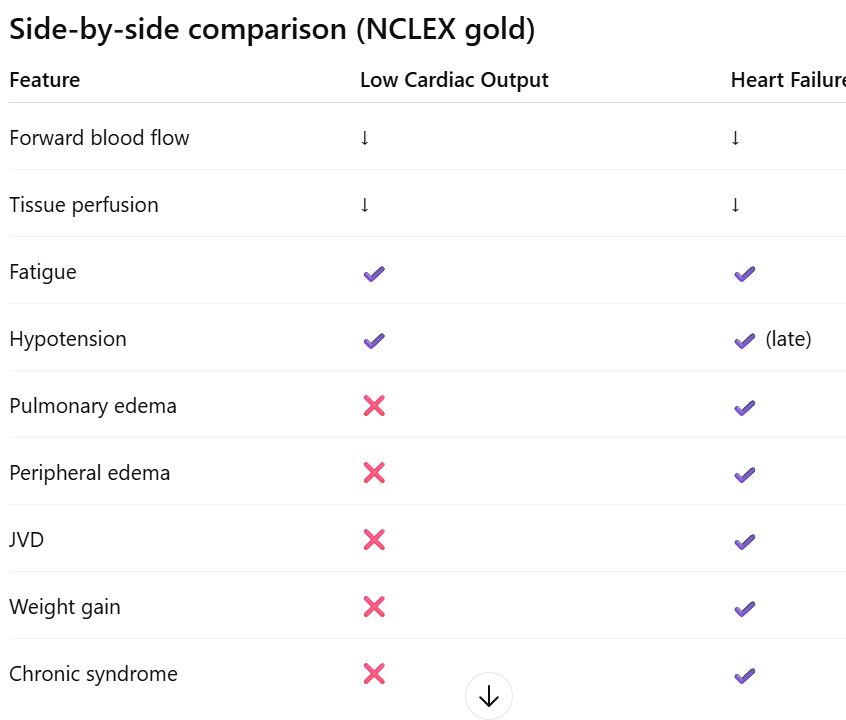
Low cardiac output = a hemodynamic problem (the heart isn’t pumping enough blood forward).
Heart failure = a clinical syndrome that often causes low cardiac output, plus fluid backup and neurohormonal changes.
Many symptoms look the same, but heart failure has extra features that low cardiac output alone does not.
Heart failure includes low cardiac output, PLUS fluid congestion from blood backing up.
Symptoms from fluid overload
Pulmonary edema → dyspnea, crackles
Orthopnea, paroxysmal nocturnal dyspnea
Peripheral edema
Jugular venous distention
Rapid weight gain
Key idea:
Blood can’t move forward → pressure builds → fluid leaks into tissues.
400
The difference between angina and an MI.
What is blood supply is not completely cut off in angina and is a temporary condition. Blood supply is completely cut off in an MI.
400
Steps in clotting processs.
What are
1. vasoconstriction at site of injury.
2. injury exposes collagen and platelets produce substance to cause them to stick together (aggregation).
3. Platelet plug formed.
4. Fibrin (protein fibers) stabilize platelet plug.
400
Two large categories of dysrhythmias.
What are tachycardia (faster than normal rate), and bradycardia (slower than normal rate).
500
Risk factors for altered perfusion.
What are
MI, DVT, CVA, Sepsis, Kidney failure, trauma, HTN, PVD, Diabetes
500
Treatment for heart failure.
What are
Medications (diuretics, ACE inhibitors, beta blockers, inotropics)
Lifestyle changes (exercise, weight loss, smoking cessation)
Pacemakers
500
Reason hypertension causes atherosclerosis.
What is that it causes damage to blood vessel endothelial cells allows lipids to attach to walls narrowing lumen of blood vessel.
500
The process (cascade of events) involved in breaking down a clot.
What is fibrinolysis.
500
This dysrhythmia can lead to no cardiac output and sudden cardiac death
What is ventricular fibrillation