Nuclear Basics
Nuclear Equations
Half-Life
Fusion vs Fission
The Mole
Conversion Challenge
100
This number identifies an element because it tells how many protons are in its nucleus.
What is atomic number?
100
These two numbers must balance on both sides of a nuclear equation.
What are mass number and atomic number?
100
This term means the time required for half the radioactive nuclei in a sample to decay.
What is half-life?
100
In this nuclear process, a heavy nucleus splits into smaller nuclei and releases energy.
What is nuclear fission?
100
This is the number of molecules in 1.00 mol of water.
What is 6.022 x 10²³ molecules?
100
To convert grams of a compound into molecules, use these two conversion steps in order.
What are grams → moles → molecules?
What are molar mass & Avogadro's number?
200
This type of radiation consists of two protons and two neutrons.
What is an alpha particle?
200
When radium-226 emits an alpha particle, this daughter isotope forms.
What is radon-222?
200
An 80 g sample goes through three half-lives. This much remains.
What is 10 g?
200
In a nuclear power plant, fission heats water to produce steam. The steam spins this device, which drives a generator.
What is a turbine?
200
This is the molar mass of NaCl.
What is 58.44 g/mol?
200
How many bromine atoms are in 15.98 g of liquid bromine?
What is 1.204 x 10²³ bromine atoms?
300
This type of radiation is the most penetrating form of radiation.
What is gamma radiation?
300
This nuclide is generally more stable than the parent nuclide.
What is the daughter nuclide?
300
A sample decreases from 100 g to 12.5 g. If its half-life is 4 hours, how much time has passed?
What is 12 hours?
300
These components absorb neutrons to control the rate of a fission chain reaction in a reactor.
What are control rods?
300
A 36.0 g sample of H₂O contains this many moles of H₂O.
What is 2.00 mol?
300
This is the number of oxygen atoms in 25.0 g of CaCO₃.
What is 4.51 x 10²³ oxygen atoms?
400
Stable nuclei of many lighter elements have approximately this ratio of protons to neutrons.
What is 1:1?
400
Iodine-131 becomes xenon-131. Identify the emitted particle.
What is a beta particle (electron)?
400
A radioactive sample starts with 2.56 x 10⁶ atoms. How many atoms have decayed after eight half-lives?
What is 2.55 x 10⁶ atoms?
400
Complete this fusion equation:
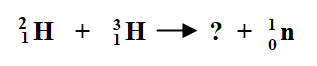
What is He-4?
400
This is the mass of 0.750 mol of Ca(OH)₂.
What is 55.6 g?
400
A 13.5 g sample of an unknown element contains 3.01 x 10²³ atoms. What is the element?
What is aluminum (Al)?
500
These two forces compete within a nucleus: one pulls nearby nucleons together, while the other pushes protons apart.
What are the strong nuclear force and electrostatic repulsion?
500
Uranium-238 undergoes two successive alpha decays. Identify the resulting isotope.
What is radium-230?
500
A sample begins with 14.0 g of carbon-14. Its half-life is 5,730 years. How many carbon-14 atoms remain after 11,460 years? Use 14.0 g C-14 = 1 mol C-14.
What is 1.51 x 10²³ carbon-14 atoms?
500
Identify the missing daughter nuclide in this fission equation:
What is Kr-92?
500
This is the number of oxygen atoms in 0.250 mol of CO₂.
What is 3.011 x 10²³ oxygen atoms?
500
A 26.2 g sample of iodine-131 has a half-life of 8.0 days. How many iodine-131 atoms remain after 24.0 days? Use a molar mass of 131 g/mol.
What is 1.51 x 10²² atoms?