Nucleotide Know-How
Copy That!
Divide & Conquer
Protein Production Line
Connect the Bases
100
Every nucleotide is built from these three components.
What are a phosphate group, pentose sugar and nitrogenous base?
100
DNA replication produces copies with this relationship to the original base sequence.
What are identical base sequences?
100
This process physically splits the cytoplasm of one parent cell between its daughter cells.
What is cytokinesis?
100
This process uses DNA as a template to produce an RNA molecule.
What is transcription?
100
If the DNA template sequence is TAC GGA, transcription produces this RNA sequence.
What is AUG CCU?
200

In this simplified nucleotide, this pentagon-shaped component sits between the phosphate and the base.
What is the pentose sugar?
200
This enzyme plays molecular unzipper, unwinding DNA and breaking hydrogen bonds between the strands.
What is helicase?
200
After DNA replication, each chromosome consists of two of these identical DNA-containing structures, held together until anaphase.
What are chromatids?
200
During translation, this RNA molecule carries an amino acid and uses its anticodon to pair with mRNA.
What is tRNA?
200
This chromosome has already replicated. Each chromatid consists of one of these molecules.
What is a DNA molecule?
300
DNA has thymine and deoxyribose. This other nucleic acid instead contains uracil and ribose.
What is RNA?
300
DNA replication gets this name because each new molecule contains one original strand and one newly produced strand.
What is semi-conservative replication?
300
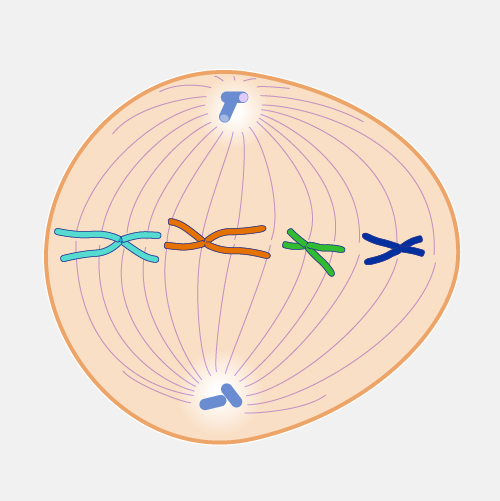
In this micrograph, the chromosomes are condensed and arranged across the middle of the cell. Name the mitotic phase.
What is metaphase?
300
 In this translation diagram, the three highlighted bases on the mRNA make up this unit of the genetic code.
What is a codon?
300
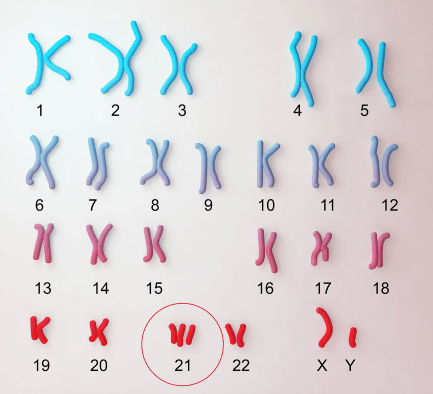 This chromosome display contains three copies of chromosome 21. This condition can result from non-disjunction during meiosis.
What is Down syndrome?
400
 The dotted lines shown joining A to T and G to C represent this type of attraction.
What are hydrogen bonds?
400
 Look at this gel. The crime-scene sample has bands at the same positions as one suspect. This technique separated the DNA fragments shown here.
What is gel electrophoresis?
400
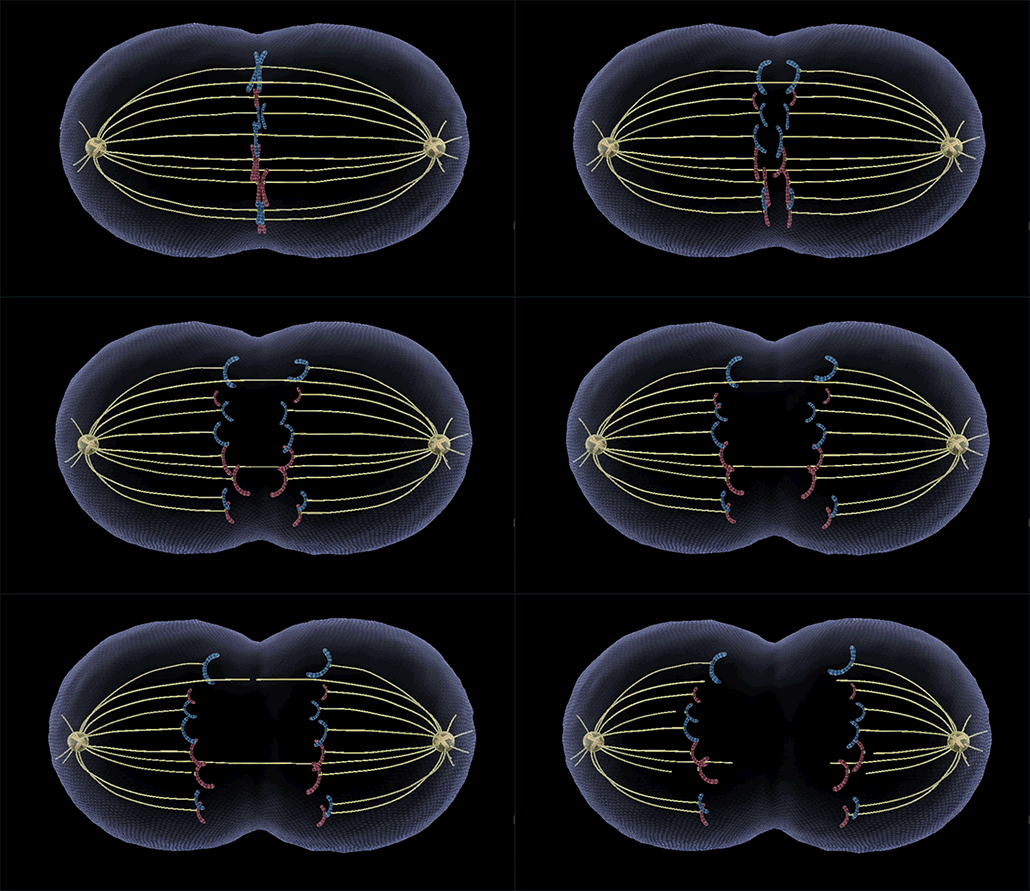 At the moment when the chromatids separate and begin moving towards opposite poles, the cell has entered this phase.
What is anaphase?
400

What is methionine-glycine-phenylalanine-glutamine?
400
A diploid cell has 8 chromosomes. Immediately after DNA replication, but before mitosis begins, it contains this many chromosomes and this many elongated DNA molecules.
What are 8 chromosomes and 16 DNA molecules?
500
A DNA sequence contains 6 positions, and each position can contain any one of four bases.
4^6
therefore gives this many possible six-base sequences.
What is 4096?
500
In PCR, repeated heating separates the DNA strands. Cooling then allows these short DNA sequences to bind to the target region so that Taq polymerase can begin copying it.
What are primers?
500
 This diagram shows two processes in meiosis: bivalents facing different directions, and homologous chromosomes exchanging sections. Together they increase this feature of the resulting cells.
What is genetic diversity?
500
A point mutation changes an mRNA triplet from UCU to UCC, but both specify serine. This feature of the genetic code explains why the mutation does not change the amino acid.
What is degeneracy?
500
During translation, arrange these events in the correct order:
[a peptide bond forms]
[the ribosome moves one triplet along the mRNA]
[a complementary tRNA binds]
[the uncharged tRNA leaves]
What is: complementary tRNA binds → peptide bond forms → ribosome moves along the mRNA → uncharged tRNA leaves?