Competency 1
Competency 2 - Cancer
Competency 3 - Neuro
Competency 4 - Respiratory
Competency 5 - Cardiac
100
Which assessment finding is most consistent with shock?
A. Warm dry skin and hypertension
B. Bradycardia and increased urine output
C. Hypotension, tachycardia, and cool skin
D. Flushed skin and hypertension
C. Hypotension, tachycardia, and cool skin
100
Which client statement indicates understanding of cancer prevention?
A. "Smoking does not affect cancer risk."
B. "Regular screenings can help detect some cancers early."
C. "Sun protection has no effect on skin cancer risk."
D. "Cancer prevention is not possible."
B. "Regular screenings can help detect some cancers early."
100
A nurse witnesses a client having a seizure. Which action is appropriate?
A. Insert a tongue blade into the mouth to keep from choking on tongue.
B. Restrain the client's extremities to keep from causing injury.
C. Lower to floor or padded surface to prevent head injury.
D. Swipe finger in oral cavity to assess for airway blockage.
C. Lower to floor or padded surface to prevent head injury.
100
Which intervention is most effective in reducing the risk of ventilator-associated pneumonia?
A. Keeping the client flat
B. Oral hygiene and head-of-bed elevation
C. Increasing room temperature
D. Restricting suctioning
B. Oral hygiene and head-of-bed elevation
100
Which client has the greatest risk for developing coronary artery disease?
A. 25-year-old runner with normal BMI
B. 55-year-old smoker with diabetes and hypertension
C. 30-year-old with seasonal allergies
D. 40-year-old who exercises daily
B. 55-year-old smoker with diabetes and hypertension
200
The NCLEX-PN primarily evaluates a graduate's ability to:
A. Function safely as an entry-level practical nurse
B. Practice as an advanced practice nurse
C. Manage a hospital budget
D. Perform physician responsibilities
A. Function safely as an entry-level practical nurse
200
A client undergoes surgery for colon cancer. Which postoperative nursing assessment has the highest priority?
A. Pain
B. Urine output
C. Surgical site
D. Oxygen saturation
D. Oxygen saturation
200
Which statement by a client with epilepsy indicates understanding of discharge teaching?
A. "I can stop my medication when I feel better."
B. "I should wear a medical identification bracelet."
C. "Missing a dose or two will not affect seizure control."
D. "Sleep deprivation helps prevent seizures."
B. "I should wear a medical identification bracelet."
200
A nurse is assessing a client with suspected respiratory failure. Which assessment finding is most concerning?
A. Respiratory rate of 22 breaths/minute
B. Oxygen saturation of 94% on room air
C. New confusion and restlessness
D. Mild productive cough
C. New confusion and restlessness
200
Following cardiac catheterization via femoral access, which finding requires immediate intervention?
A. Bruise at insertion site
B. Distal pulse absent in affected leg
C. Blood pressure 128/76 mm Hg
D. Tenderness at insertion site
B. Distal pulse absent in affected leg
300
A widowed client reports loneliness after moving into assisted living. Which response by the nurse is most therapeutic?
A. "You need to stay busy."
B. "Many older adults experience adjustment challenges after major life changes."
C. "Try not to think about it."
D. "You should be grateful for your housing."
B. "Many older adults experience adjustment challenges after major life changes."
300
A client asks the nurse about the difference between benign and malignant tumors. Which response is most accurate?
A. Benign tumors metastasize rapidly throughout the body.
B. Malignant tumors invade surrounding tissues and may metastasize.
C. Benign tumors are always life-threatening.
D. Malignant tumors are encapsulated and remain localized.
B. Malignant tumors invade surrounding tissues and may metastasize.
300
A client experiencing a stroke arrives at the emergency department. Which symptom should the nurse recognize as a common stroke manifestation?
A. Sudden unilateral weakness
B. Bilateral hearing loss C
. Gradual weight gain
D. Chronic cough
A. Sudden unilateral weakness
300
A client develops sudden dyspnea, tachycardia, and pleuritic chest pain two days after a total hip replacement. Which condition should the nurse suspect first?
A. Sarcoidosis
B. Acute bronchitis
C. Pulmonary embolism
D. Pneumothorax
C. Pulmonary embolism
300
A client experiencing chest pain receives sublingual nitroglycerin. Which assessment should the nurse prioritize?
A. Blood pressure
B. Heart rate
C. Liver function
D. Bowel sounds
A. Blood pressure
400
A client sustains a thermal burn to the forearm. Which nursing action is appropriate immediately after removing the client from the heat source?
A. Apply ice directly to the burn.
B. Cool the area with cool water.
C. Apply butter to the burn.
D. Break any blisters present.
B. Cool the area with cool water.
400
A client receiving external radiation therapy asks how to care for the treatment site. Which instruction is appropriate?
A. Scrub the area antibiotic cleanser.
B. Apply heating pads to the site.
C. Use mild soap and protect the skin from sun exposure.
D. Apply ice to the site.
C. Use mild soap and protect the skin from sun exposure.
400
A nurse is assessing a client with increased intracranial pressure (ICP). Which finding requires immediate intervention?
A. Mild headache
B. Glasgow Coma Scale score of 14
C. Projectile vomiting
D. Heart rate of 82 beats/minute
C. Projectile vomiting
400
An 82-year-old client reports increasing shortness of breath with exertion. Which age-related respiratory change most contributes to decreased gas exchange in older adults?
A. Increased alveolar surface area
B. Increased chest wall compliance
C. Loss of alveolar elasticity and decreased lung recoil
D. Increased ciliary function
C. Loss of alveolar elasticity and decreased lung recoil
400
A nurse notes the following telemetry strip and identifies the rhythm as which of the following?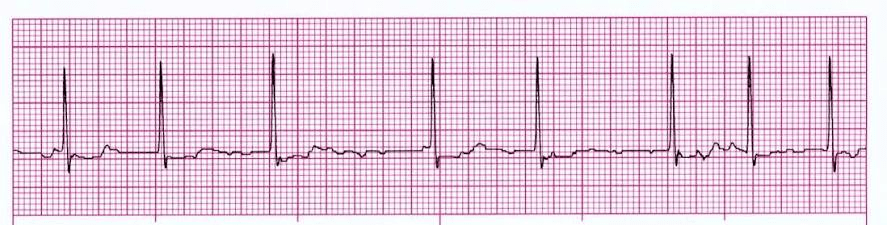
A. Atrial flutter
B. Atrial fibrillation
C. Sinus tachycardia
D. Sinus bradycardia
B. Atrial fibrillation
500
The nurse is teaching an older adult newly diagnosed with diabetes. Which teaching approach is best?
A. Speak rapidly and provide all information at once.
B. Use large-print materials and allow extra time for questions.
C. Provide instructions only to family members.
D. Avoid written materials.
B. Use large-print materials and allow extra time for questions.
500
A client receiving chemotherapy has a white blood cell count of 1,800/mm³. Which nursing action is most appropriate?
A. Place fresh flowers in the room.
B. Encourage crowds to visit.
C. Monitor carefully for signs of infection.
D. Discontinue hand hygiene precautions.
C. Monitor carefully for signs of infection.
500
Which finding is expected in a client with Parkinson's disease?
A. Resting tremor
B. Hyperactive movements
C. Increased muscle flexibility
D. Sudden paralysis
A. Resting tremor
500
A client with ARDS has worsening hypoxemia despite receiving oxygen via nonrebreather mask. Which intervention should the nurse anticipate?
A. Immediate discharge
B. Mechanical ventilation with positive end-expiratory pressure (PEEP)
C. Incentive spirometry only
D. Fluid overload therapy
B. Mechanical ventilation with positive end-expiratory pressure (PEEP)
500
A client is diagnosed with atrial fibrillation. Which complication is the nurse most concerned about?
A. Shock
B. Respiratory failure
C. Pericardial effusion
D. Cerebrovascular attack
D. Cerebrovascular attack