Lub Dub
I Heart You
Oh No ... Patho!
Sugar High
Tic Tac Toe
100
A patient with a history rheumatic heart disease knows that she is at risk for bacterial endocarditis when undergoing invasive procedures. Prior to a scheduled cystoscopy, the nurse should ensure that the patient knows the importance of taking which of the following drugs? A)Enoxaparin (Lovenox) B)Metoprolol (Lopressor) C)Azathioprine (Imuran) D)Amoxicillin (Amoxil)
D)Amoxicillin (Amoxil) Although rare, bacterial endocarditis may be life-threatening. A key strategy is primary prevention in high-risk patients (i.e., those with rheumatic heart disease, mitral valve prolapse, or prosthetic heart valves). Antibiotic prophylaxis is recommended for high-risk patients immediately before and sometimes after certain procedures. Amoxicillin is the drug of choice. None of the other listed drugs is an antibiotic.
100
A patient is admitted to the critical care unit (CCU) with a diagnosis of cardiomyopathy. When reviewing the patient's most recent laboratory results, the nurse should prioritize assessment of which of the following? A)Sodium B)AST, ALT, and bilirubin C)White blood cell differential D)BUN
A)Sodium Sodium is the major electrolyte involved with cardiomyopathy. Cardiomyopathy often leads to heart failure which develops, in part, from fluid overload. Fluid overload is often associated with elevated sodium levels. Consequently, sodium levels are followed more closely than other important laboratory values, including BUN, leukocytes, and liver function tests.
100
The healthcare provider is caring for a patient who has diabetes and is also diagnosed with hypertension. Which of the following medications on the patient’s medication administration record will cause the most concern?
Please choose from one of the following options.
•Angiotensin receptor blocker
•ACE inhibitor
•Calcium channel clocker
•Beta-blocker
What is beta-blockers.
•Hypoglycemia is an acute complication that may be experienced by patients who are diabetic.
•Beta-blockers reduce blood pressure by blocking actions of the sympathetic nervous system, which is activated when a patient becomes hypoglycemic. •Blocking of adrenergic beta receptors will also block many of the symptoms of hypoglycemia, hindering the patient’s ability to recognize early signs of hypoglycemia.
100
A patient diagnosed with type 2 diabetes mellitus is admitted to the medical unit with pneumonia. The patient’s oral antidiabetic medication has been discontinued and the patient is now receiving insulin for glucose control. Which of the following statements best explains the rationale for this change in medication?
Please choose from one of the following options.
A Stress-related states such as infections increase risk of hyperglycemia
B Infection has compromised beta cell function so the patient will need insulin from now on
C Insulin administration will help prevent hypoglycemia during the illness
D Acute illnesses like pneumonia will cause increased insulin resistance
What is stress-related states such as infections increase risk of hyperglycemia.
• Infections such as pneumonia stimulate a stress response in the body.
• Stress hormones include glucocorticoids and epinephrine.
• Glucocorticoids and epinephrine increase blood glucose levels. Type 2 diabetics may temporarily require insulin during acute illnesses and hospitalizations, but they often return to their normal medication regimen after they recover.
100
What are the normal blood gas lab ranges for the following?
pH
paCO2
HCO3
Must get all correct for points
pH 7.35 -7.45
paCo2 45-35
HCO3 22-26
200
A patient is admitted to the emergency department after sustaining abdominal injuries and a broken femur from a motor vehicle accident. The patient is pale, diaphoretic, and is not talking coherently. Vital signs upon admission are temperature 98 F, heart rate 130 beats/minute, respiratory rate 34 breaths/minute, blood pressure 50/40. The healthcare provider suspects which type of shock?
Please choose from one of the following options.
• Cardiogenic
• Hypovolemic
• Neurogenic
• Distributive
What is hypovolemic.
•Look at the vital signs and the other assessment data to help narrow down the options.
•The patient’s history of trauma can narrow down the options further.
•A history of abdominal injury points to hypovolemic shock secondary to hemorrhage.
200
A nurse is caring for a patient who has a lab finding of serum potassium (K+) of 5.4 mEq/L. The nurse should assess for which of the following clinical manifestations? • EKG changes • Constipation • Polyuria • Hypotension
What are EKG changes. (peaked T waves) •Other symptoms of hyperkalemia: fatigue, weakness, N/V, chest pain, palpitations •Constipation, polyuria and hypotension are clinical manifestations of hypokalemia
200
Mean arterial pressure is a good indicator of tissue perfusion. If a patient has a BP of 100/60, what is their MAP & what does it tell you about their perfusion? (Must answer both correctly)
What is 73 and adequate tissue perfusion.
•MAP= (2xD) + S
•120 + 100 = 220 / 3 = 73
•MAP should be >65
200
Which of the following is NOT a typical finding in HHNS?
A. Blood pH <7.35
B. Dehydration
C. Mental status changes
D. Osmotic diuresis
A. Blood pH <7.35
200
name the acid base disturbance
pH 7.50
paCO2 47
HCO3 27
What is metabolic alkalosis
partially compensated
300
A patient who is in hypovolemic shock has the following clinical signs: Heart rate 120 beats/minute, blood pressure 80/55 and urine output 20mL/h. After administering an IV fluid bolus, which of these signs if noted by the healthcare provider is the best indication of improved perfusion?
Please choose from one of the following options.
• Right atrial pressure increases
• Systolic blood pressure increases to 85
• Urine output increases to 30cc/hr
• Heart rate drops to 100 beats/minute
What is Urine output increases to 30.
•Perfusion involves blood and oxygen delivery to the tissues.
•All of these options indicate improvement in the patient’s status, but which one points to tissue perfusion?
•The best indication of tissue perfusion is increased urine output.
300
What intervention may a patient have done to attempt/correct a rapid Atrial Fibrillation? Select all that apply (must have all to be correct) • An AICD/ICD • Cardioversion • Diltiazem (Cardizem) IV • A cardiac ablation
What is cardioversion, diltiazem (cardizem) IV and a cardiac ablation •Cardioversion is a synchronized defibrillation that restarts the cardiac cylcle diltiazem is a calcium channel blocker used to reduced the strength of the muscles cell contraction. •A cardiac ablation destroys the electrical pathways in the AV node. Patients will also need a pacemaker placed when this is done. An AICD/ICD is used to treat ventricular dysrhythmias
300
Translocation is a term used to describe the general movement of fluid and chemicals within body fluids. In every client’s body, fluid and electrolyte balance is maintained through the process of translocation. What specific process allows water to pass through a membrane from a dilute to a more concentrated area?
Osmosis
Filtration
Evaporation
Active transport
What is Osmosis.
•Remember egg video on osmosis
Lower concentration to higher concentration
•Diffusion:
- Small PARTICLES move freely.
- Larger particles (proteins and blood cells) do not pass through intact membranes.
- Difference between the two areas is the concentration gradient
•Facilitated diffusion
-involves a “carrier molecule”; glucose into cell
still moving from higher to lower
•Active Transport – lower concentration to higher concentration – requires Adenosine Triphosphate – ATP = energy
300
Which of the following patients is MOST LIKELY experiencing Hyperglycemic Hyperosmolar Nonketotic Syndrome based on their symptoms?
A. A 72 year old with a health history of diabetes who has a blood glucose of 300 mg/dL and is complaining of thirst and frequent urination.
B. A 66 year old with type I diabetes that has ketones present in their urine.
C. A 69 year old admitted with an infection of the right foot with a health history of diabetes that reports missing several doses of Metformin and has a blood glucose of 600 mg/dL.
D. A 6 year old that is presenting with polyuria, polydipsia, abdominal pain, and vomiting.
C. A 69 year old admitted with an infection of the right foot with a health history of diabetes that reports missing several doses of Metformin and has a blood glucose of 600 mg/dL.
Hallmark of HHNS is an EXTREME high blood glucose (>600 mg/dL), is precipitated by infection, and is more common in type 2 diabetics. The 69 year old is a type 2 diabetic due to the clue that the option states the patient has missed doses of Metformin (which is an oral type 2 diabetic medication). DKA presents with elevated blood glucose >300 mg/dL and ketones which HHNS does not.
300
A patient with a longstanding diagnosis of generalized anxiety disorder presents to the emergency room. The triage nurse notes upon assessment that the patient is hyperventilating. The triage nurse is aware that hyperventilation is the most common cause of which acid–base imbalance? A)Respiratory acidosis B)Respiratory alkalosis C)Increased PaCO2 D)CNS disturbances
B)Respiratory alkalosis The most common cause of acute respiratory alkalosis is hyperventilation. Extreme anxiety can lead to hyperventilation. Acute respiratory acidosis occurs in emergency situations, such as pulmonary edema, and is exhibited by hypoventilation and decreased PaCO2. CNS disturbances are found in extreme hyponatremia and fluid overload. If you increase your respiratory rate (hyperventilation) you "blow off" CO2 (acid) therefore decreasing your CO2 acid—giving you ALKLAOSIS If you decrease your respiratory rate (hypoventilation) you retain CO2 (acid) therefore increasing your CO2 (acid)—giving you ACIDOSIS
400
A patient with hypertrophic cardiomyopathy (HCM) has been admitted to the medical unit. During the nurse's admission interview, the patient states that she takes over-the-counter “water pills” on a regular basis. How should the nurse best respond to the fact that the patient has been taking diuretics?
Encourage the patient to drink at least 2 liters of fluid daily.
B) Increase the patient's oral sodium intake.
C) Inform the care provider because diuretics are contraindicated.
D) Ensure that the patient's fluid balance is monitored vigilantly.
C) Inform the care provider because diuretics are contraindicated.
Diuretics are contraindicated in patients with HCM, so the primary care provider should be made aware. Adjusting the patient's sodium or fluid intake or fluid monitoring does not address this important contraindication.
400
A patient in the ICU has developed acute disseminated intravascular coagulation. When reviewing the patient’s laboratory results, the healthcare provider will expect which of the following results? Select all that apply. • Reduced prothrombin time (PT) • Elevated fibrin degradation products • Reduced plasma Factor VIII • Normal activated partial thromboplastin time (aPTT) • Reduced platelet count
What is elevated fibrin degradation products, reduced plasma Factor VIII and reduced platelet count. •There is widespread formation of fibrin clots in the medium and small vessels throughout the body in disseminated intravascular coagulation. •Because of the increased clotting, platelets and coagulation factors are rapidly depleted. Both the PT and aPTT will be prolonged. •There will also be increased fibrinolysis throughout the body as the many clots are dissolved, resulting in elevated fibrin degradation products.
400
When ischemia involves the kidneys, such as in response to hemorrhagic shock, kidneys produce less urine due to lack of blood flow.
This lack of perfusion stimulates WHAT to increase the blood pressure?
What is the renin-angiotensin-aldosterone system.
•Results in an increase in BP because of the effects it has on both angiotension II (vasoconstricts blood vessels)
•and the increase it has on aldosterone secretion (retains Na+ then H2O, causing peripheral edema)
400
True or False: Hypertonic fluids, such as 3% saline, are the first line of treatment to correct dehydration in HHNS.
True
False
False: Isotonic (0.9% NS) solutions are usually the first-line treatment or the physician may order a hypotonic solution such 0.45% NS to replenish the dehydrated cell. ....this depends on the severity of dehydration. A 5% Dextrose 0.45% NS may be added when the glucose has reached 300 mg/dL, but is not first-line treatment. However, 3% Saline is never used.
400
Daily Double!!!!!!!!
Name this acid/base disturbance
pH 7.43
CO2 28
HCO3 18
What is respiratory alkalosis
fully compensated
500
DAILY DOUBLE!!!!!!!!!!!!! Identify this dysrhythmia...
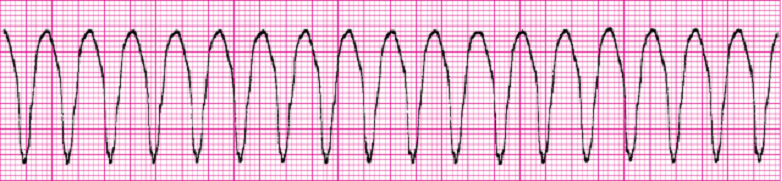
What is a VT or Ventricular Tachycardia
500
A nurse educator is reviewing expected findings in a patient who has right-sided valvular heart disease with a group of nurses. Which of the following should be included in the discussion? (Select all that apply - need all to be correct) • Dyspnea • Patient report of fatigue • Bradycardia • Pleural friction rub • Peripheral edema
What is dyspnea, fatigue, peripheral edema •a normal or rapid pulse and irregular rhythm would be a sign of left sided valvular disease •A pleural friction rub is a symptom of pleurisy or pna
500
Why is sodium important in the treatment of DKA? (Think about the process that hyperglycemia causes in the cells)
What is... •Hyperglycemia causes osmotic diuresis of water, electrolytes and ketones. •Na and K+ are lost via urine. •Serum Na+ may drop from loss of Na+ via urine OR, may rise due to excretion of large volumes of water. •Once insulin therapy is started, the serum K+ typically falls as it drives K+ into the cells. •Life threatening hypokalemia can occur! •Na+ and K+ serum levels are volatile in DKA.
500
A patient is admitted with Diabetic Ketoacidosis. The physician orders intravenous fluids of 0.9% Normal Saline and 10 units of intravenous regular insulin IV bolus and then to start an insulin drip per protocol. The patient’s labs are the following: pH 7.25, Glucose 455, potassium 2.5. Which of the following is the most appropriate nursing intervention to perform next?
A. Start the IV fluids and administer the insulin bolus and drip as ordered
B. Hold the insulin and notify the doctor of the potassium level of 2.5
C. Hold IV fluids and administer insulin as ordered
D. Recheck the glucose level
B. Hold the insulin and notify the doctor of the potassium level of 2.5
Remember when insulin is given it helps take potassium back into the cell which will cause potassium blood levels to fall. Insulin therapy is to be started only if the patient's potassium level is 3.3 or greater.
500
You are an emergency-room nurse caring for a trauma patient. Your patient has the following arterial blood gas results: pH 7.47, PaCO2 33, HCO3 23 mEq/L. How would you interpret these results?
respiratory alkalosis
uncompensated
TestValueNormalsAnalysis pH:7.477.35-7.45Alkalotic (high): Overall state is (still) an alkalosis PaCO2:33 mmHg35-45 mmHgAlkalotic (low): CO2 tension is low (respiratory alkalosis) [HCO3-]:23 mEq/L22-26 mEq/LNormal: HCO3- concentration is normal The pH and CO2 levels are both alkalotic, so the primary mechanism is a respiratory alkalosis. The HCO3- is normal, so there is no indication of metabolic compensation.