Colligative properties
Equilibrium
Thermodynamics
Kinetics
100
Which solution has the highest freezing point: 0.1 m NaCl, 0.1 M CaCl₂, or 0.1 M glucose?
NaCl
100
For an exothermic reaction, how does increasing the temperature affect the equilibrium?
Their concentrations don’t change during the reaction; they are considered constant.
100
100: What is the sign of ΔS when a solid dissolves in water?
Positive — increased disorder.
100
What plot gives a straight line for a first-order reaction?
ln[A] vs. time
200
100: What is the sign of ΔS when a solid dissolves in water?
Positive — increased disorder.
200
You have 13 fish. All but 8 died. How many fish are left.
8
200
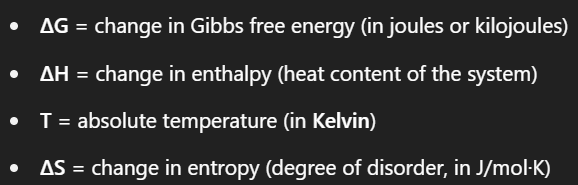
Explain why an exothermic reaction can be non-spontaneous.
If ΔS is very negative and T is high, ΔG can still be positive.
300
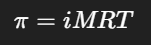
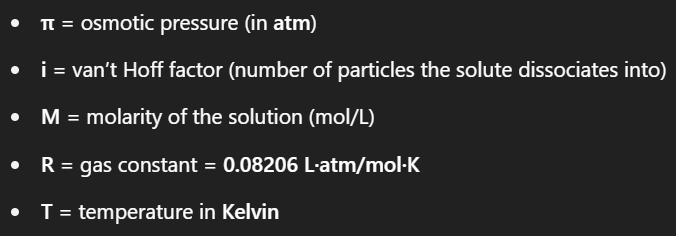
What is osmotic pressure, and how does it relate to colligative properties?
Osmotic pressure is the pressure needed to stop solvent flow through a semipermeable membrane. It increases with the number of solute particles — a colligative property.
300
What happens to the solubility of AgCl when NaCl is added to the solution?
Solubility decreases due to the common ion effect (Cl⁻ is added, shifting equilibrium left).
300
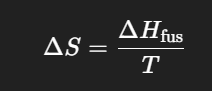
What is the change in entropy of the system when 1 mol of ice melts melts at 0°C (273 K)?
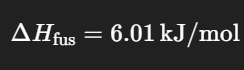
Give your answer in J/mol*K
22.0 J/mol*K
300
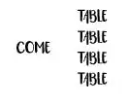
Comfortable
400
If you double the concentration of a weak acid, does the pH at the half-equivalence point change?
Answer: No; still equals pKa
400
Will a precipitate form if [Ba²⁺] = 1.0 × 10⁻³ M and [SO₄²⁻] = 1.0 × 10⁻⁴ M? (Ksp of BaSO₄ = 1.1 × 10⁻¹⁰)
Q = (1.0 × 10⁻³)(1.0 × 10⁻⁴) = 1.0 × 10⁻⁷ > Ksp ⇒ Yes, a precipitate forms
400
How many Seconds are in 1 minute
60 seconds

400

3D movie
500
What's greater than God? More evil than the devil? The poor have it, the rich need it. If you eat it you'll die.
Nothing
500
Why does adding a strong acid increase the solubility of salts containing basic anions (like CO₃²⁻)?
Answer: The acid reacts with the anion, removing it and shifting equilibrium to dissolve more solid
500
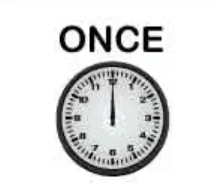
Once upon a time
500

Tuna Fish
600

Breakfast
700
XQQQQQQME
Excuse me
700
The rate constant doubles when temperature increases from 298 K to 308 K.
If the reaction is 0 order, how much time in seconds does it take to go from 0.46 M of reactant to 0.1M when the frequency factor is 2 at this new temperature.
1.7 x 10^8