Position
Velocity
Acceleration
Graphs & Tables
100
What is the significance of position equation of a function?
This tells us where the particle is at different values of t (time)
100
What is velocity?
This is the change of the position function over time.
The velocity of a particle is the rate at which its position changes with respect to time, expressed as both its speed and its direction of motion.
v=dx/dt
100
What is acceleration?
This is the change of velocity over time.
100
A particle P moves on the number line. The graph s=f(t) shows the position of P as a function of time t.
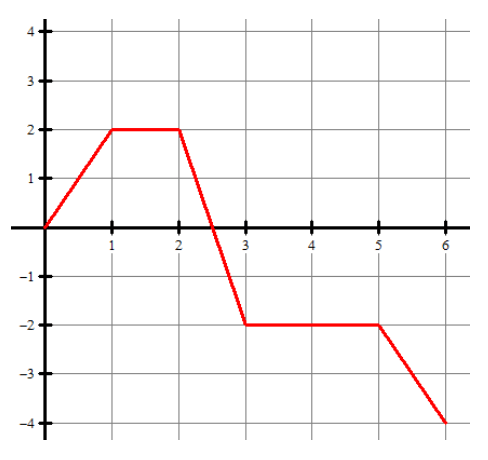
a. When is P moving to the left?
b. When is P moving to the right?
c. When is P at rest?
P moving to the left (2, 3) and (5, 6)
P moving to the right (0, 1)
P at rest (1, 2) and (3, 5)
200
What is
x(t)?
This is the position function.
200
What happens when
v(t)>0
on a horizontal line (where is the particle moving)
To the right (or in the positive direction).
200
What is
x'(t)?
This is what v(t) is equal to.
200
The figure shows the velocity
v=(ds)/dt=f(t)
of a body moving along a coordinate line in meters per second.
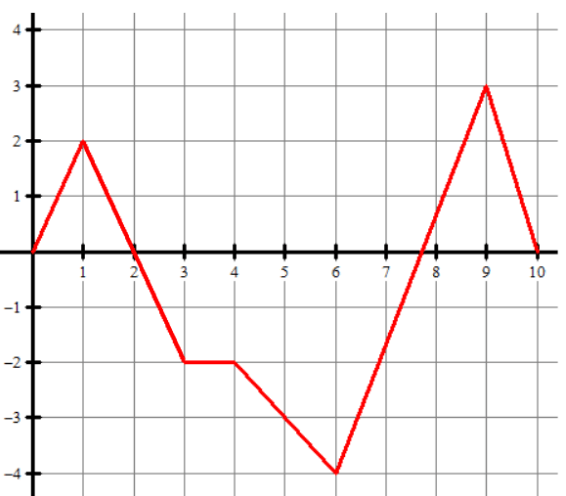
a. When does the body reverse direction?
b. When is the body moving at a constant speed?
c. What is the body’s maximum speed?
a. The body reverse direction t=2 and t=7.8 (velocity changes signs)
b. The body moving at a constant speed (3,4) (velocity is zero)
c. The body’s maximum speed 4m/sec
300
Find and explain the meaning
x(t)=t^2-2t-3
when
t=4
x(4)=5
The particle is 5 unit to the right of the origin after 4 minutes
300
What is x"(t) or v'(t)?
a(t)
300
What is the acceleration function of
x(t)=2t^4+4t^3+t^2
.
24t^2+24t+2
300
The data in the table gives selected values for the velocity, in meters per minute, of a particle moving along the x-axis. The velocity v is a differentiable function of time t.

At t = 0, is the particle moving to the right or left? Justify.
Left because the velocity is negative.
v(0)<0
400
This is the position of
x(t)=2t^3+4t^2+t
, when
t=2
The particle is 34 feet to the right of the origin after 2 minutes
x(2)=34
400
What is the velocity function of
x(t)=t^4 – 2t^3 – 6t^2 + 9t.
v(t) = 4t^3 – 6t^2 – 12t + 9
400
A particle moves along a line so that its position at any time
t>=0
is given by the function
s(t)=1/3t^3-3t^2+8t-5
where s is measured in meters and t is measured in seconds.
Find the acceleration of the particle at any time t.
a(t)=2t-6
400
The data in the table gives selected values for the velocity, in meters per minute, of a particle moving along the x-axis. The velocity v is a differentiable function of time t.

Use the data from the table to approximate v′(10). Explain the meaning of v'(10) in terms of the particle motion.
At 10 minutes, the particle's velocity is decreasing by 0.5 m/min^2
(v(12)-v(8))/(12-8)
v'(10)=-0.5
500
A particle moves along a line so that its position at any time
t>=0
is given by the function
s(t)=1/3t^3-3t^2+8t-5
where s is measured in meters and t is measured in seconds.
What is the displacement of the particle for the first 3 seconds?
s(3)-s(0)=6 meters
500
A particle moves along a line so that its position at any time
t>=0
is given by the function
s(t)=1/3t^3-3t^2+8t-5
where s is measured in meters and t is measured in seconds.
When is the particle at rest?
t=2 and t=4 seconds
500
A ball is dropped off a 1200 ft cliff. The height of the ball over time is modeled by the function
h(t)=1200-16t^2
where h is the height of the ball and 𝑡 is time in seconds.
Find
h''(3)
. Explain what it means.
h''(3)=32
At 3 seconds, the rate the ball is falling is increasing by 32 feet / second per second.
500
The graph represents the velocity, in feet per second, of a particle moving along the x-axis over the time interval from 𝑡 = 0 to 𝑡 = 9 seconds.
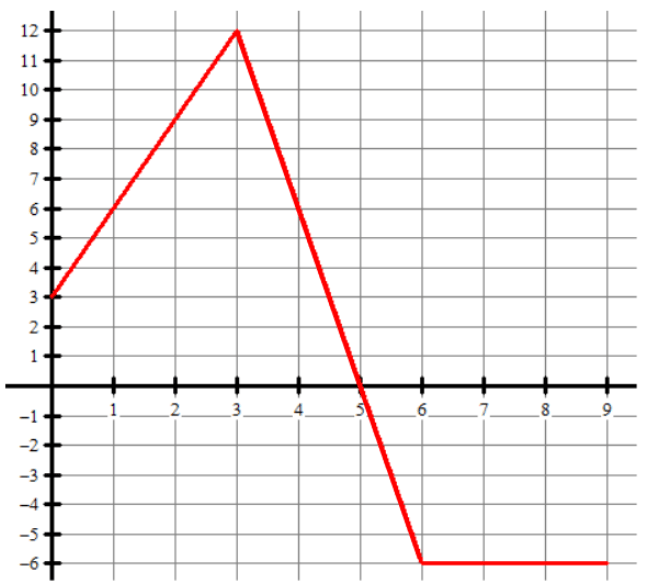
What is the average acceleration of the particle over the interval 2 ≤ t ≤4?
a(t)=(v(4)-v(2))/(4-2)
-1.5(ft)/sec^2