Patterns of The Earth & Sky
Vocabulary
Key Concepts
Bonus
100
The side of Earth facing ________ experiences daytime.
the Sun
100
We can use a globe as a ______ of Earth to visual day and night in real time.
Model
100
Earth pulls objects ______ toward the ground with the force of gravity, so ______ is away from the ground, anywhere on Earth.
Down; up
100
Earth spins on its axis. One complete ________ takes about 24 hours.
Rotation
200
In which image is the person on earth experiencing nighttime - Image A or Image B? In your explanation, be sure to support your claim with scientific reasoning.
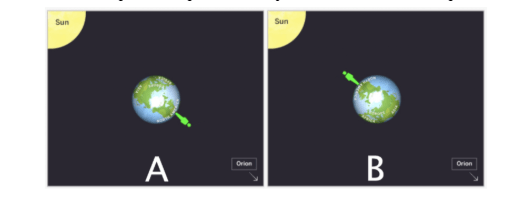
The person in image A is experiencing nighttime because the Earth has rotated and their side of the Earth is no longer facing the sun. (Image A with a reasonable explanation will be considered correct.)
200
A period of time that is 24 hours long and includes daytime and night time.
Day
200
Are stars still present in the sky during the daytime? Explain your answer.
Yes. Stars are still present during the daytime but the Sun's light is so bright that it makes the light from the other stars difficult to see. (Yes & a reasonable explanation will be considered correct.)
200
What constellation would we see in the night sky between November 11–December 27?
Orion
300
The dot on the earth shows where a student lives, what must happen in order for it to become nighttime where the student lives?
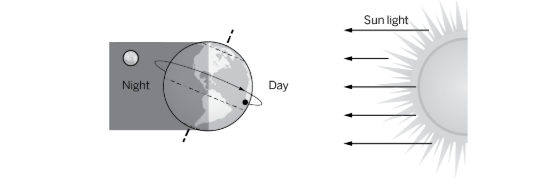
Earth must rotate on its axis.
300
Something we observe to be similar over and over again.
Pattern
300
Describe the two ways the Earth moves.
The Earth spins around and it orbits the sun.
300
Earth travels in an orbit around the Sun. One complete _________ takes about one year.
Revolution
400
A diagram of the sun's position while the students are at recess at noon is shown below. How long does it take for the sun to be back in the same position at noon each day?
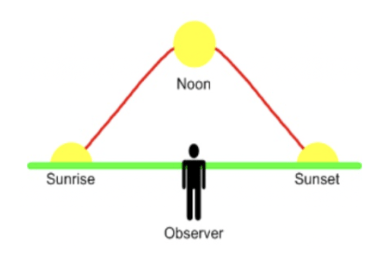
24 hours
400
The pull between Earth and other objects, which acts even without touching.
Gravity
400
A student wanted to model for the class how people on Earth can see the Sun during the daytime and the stars at night. Which demonstration best shows what the student wants to model?
A) The student can point a flashlight at a basketball and turn it off and on in a repeated pattern.
B)The student can point a lit flashlight at a basketball and walk around the basketball while still pointing at the basketball.
C)The student can place a lit flashlight on a desk, mark a basketball with an x, then spin the basketball on her finger.
D)The student can place a lit flashlight on a desk and walk around the flashlight with the basketball.
400
What happens when one object travels in a curved or circular path around another object.
Orbit
500
Which part of the sky is visible from Earth during March?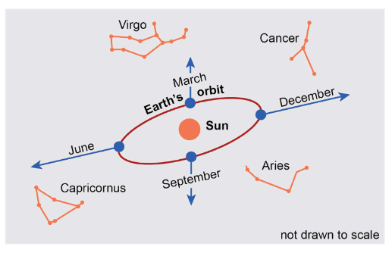
Virgo
500
An arrangement of stars as seen from Earth
Constellation
500
Orbiting occurs in space. If orbiting were able to happen on Earth, which of the following would not be an example of an object in "orbit"?
A) A dog chasing its own tail in circles.
B) A child riding a merry-go-round.
C) A car driving down a neighborhood street.
D) The secondhand moving on an analog clock.
500
What constellation would we see in the night sky between August 11–September 26?
Pegasus