Ortho 1
Ortho 2
Are you aware?
NAT 1
NAT 2
100
The Kocher Criteria is used to distinguish septic arthritis from transient synovitis in a pediatric patient with an inflamed hip. Identify the four criteria.
1. Non-weight bearing
2. Temperature >38.5 °C
3. ESR>40 mm/hr
4. WBC > 12,000 cells/mm3
100
The most common cause of chronic lateral knee pain in pediatric patients. Generally presents without swelling or knee instability.
- Iliotibial band (ITB) syndrome
- maximal tenderness found over ITB as it courses over the later femoral epicondyle
BONUS: What is the most common cause of anterior knee pain?
100
Do you remember from journal club...
TRUE or FALSE
The PERC-peds rule for bedside exclusion of pulmonary embolism without radiation in children (BEEPER) involved the development of a clinic tool to safely rule out pulmonary embolism. This study's sensitivity and NPV were both very high (99%) making it a reliable rule-out tool.
True
- High sensitivity and NPV make this a reliable rule-out tool
- This tool has a low specificity making in less effective for ruling in PE
100
Which intraoral injury in infants is strongly suggestive of child abuse?
Torn frenulum
100
Which pediatric age group is at the highest risk of serious and fatal abuse?
Children < 1 year
200
Nursemaid’s Elbow is also known as subluxation of the radial head. What is the ligament that is actually displaced in this condition?
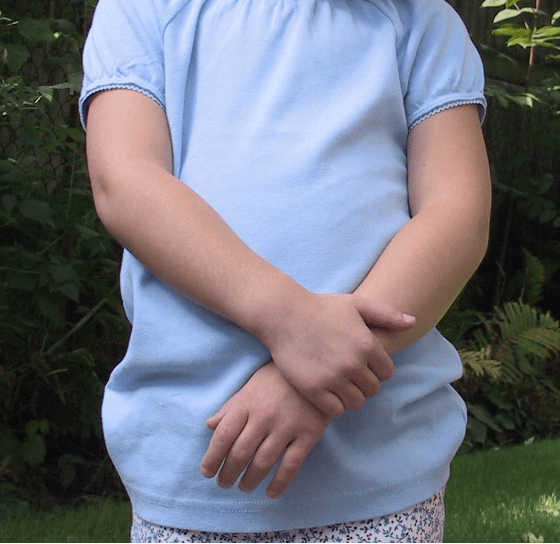
Annular Ligament
200
The Monteggia fracture is defined by which findings?
1. Angulaged midshaft ulna fracture
2. Radial head dislocation
200
Where do we admit patients that present to our facility with underlying metabolic conditions?
University of Michigan - we do not have metabolic coverage
200
Which two fracture types are highly specific for inflicted injury in infants?
1. Posterior rib fractures - reflect forceful chest compression
2. Metaphyseal lesions - reflect traction across growth plates
200
Abdominal trauma is an uncommon form of child abuse but is the second leading cause of mortality in victims of physical abuse. Which two organs are most commonly injured?
Liver and spleen
300
Identify this fracture.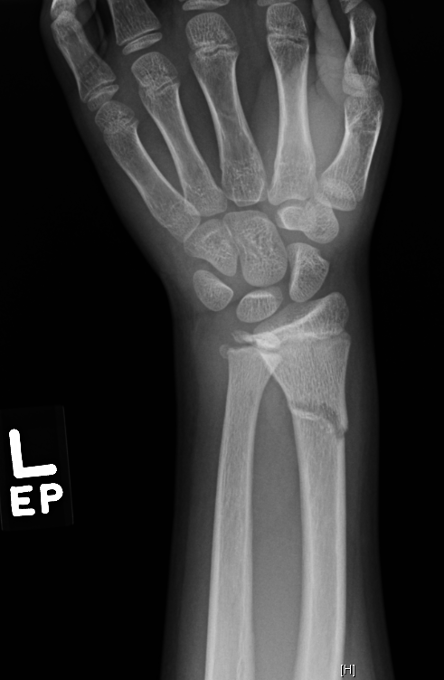
Galaezzi Fracture
300
MCP joint dislocations are the most common dislocation among the pediatric hand injuries. What digit is most commonly involved?
Thumb
300
Which two days of the year does Dr. Cortis believe she cares for the most orthopedic patients?
1. First day of school - kindergardeners on the the monkey bars alone for the first time presenting with supracondylar fractures (August/September)
2. First day football players are allowed to tackle (August)
300
Identify 3 factors can predispose children to neglect or abuse.
1. Child factors - Physical, developmental, emotional or behavioral delays, disabilities, chronic illness, preterm births
2. Caregiver factors - low coping skills, substance abuse, young parental age, poor knowledge of child development/unrealistic expectations, negative perception of normal child behaviors, low self-esteem, personal history of abuse
3. Environmental factors - poverty, low parental education leels, social isolation, single-parent homes, a non-biologically related male living in the home, family/intimate parter violence
300
What are the two most common presenting signs of physical abuse in pediatric patients?
1. Bruising
2. Skeletal fractures
400
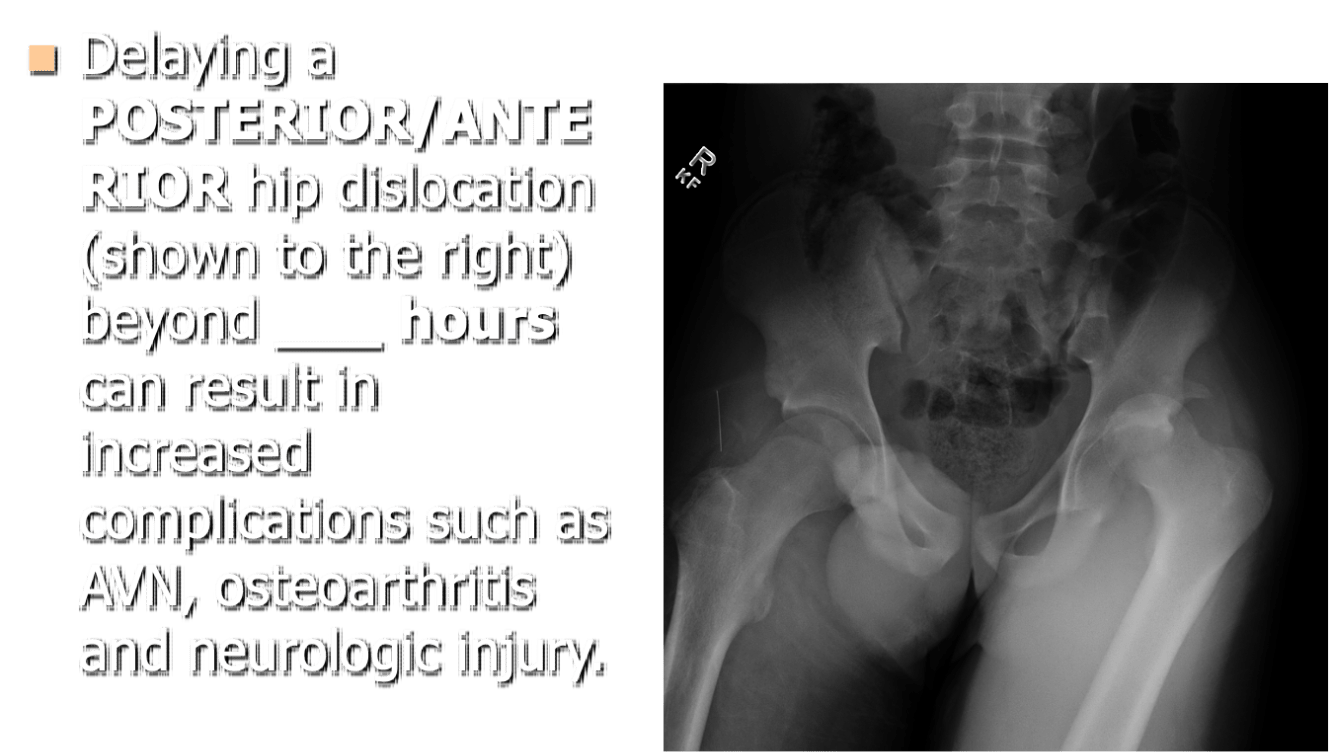
- Posterior
- 6 hours
400
This type of fracture comprise a special type of injury, with a Salter-Harris I or II fracture of the distal phalanx associated with exposure of the proximal aspect of the nail and damaged germinal matrix. This is a rare fracture with a high risk of infection and nonunion. Management includes removal of the nail and repairing any lacerations.
Seymour fracture
400
Dr. Delaroche is rolling out a new study starting on Oct. 1 related to asthma care and management. What kind of health care workers are engaging with patients who have asthma and their families?
Community health workers
400
Identify three disorders that can mimic physical abuse in children.
1. Congenital dermal melanocytosis (formerly mongolian spots)
2. Phytophotodermatitis
3. Cultural practices (cupping/coining)
4. Bone fragility disorders (osteogenesis imperfecta, rickets, osteopenia of prematurity)
400
What are ACEs?
- Adverse childhood experiences
- Potentially traumatic events that occur in childhood
- Classified in 3 categories: abuse, neglect and household dysfunction
500
Torticollis and rotary subluxation both involve spasm of the sternocleidomastoid muscle (SCM). In torticollis the spasm of the SCM is on the _______ side as the chin points. In rotarty subluxation the spasm of the SCM is on the _______ side as the chin points.
Torticollis: opposite side
Rotary subluxation: same side
500
Which of the carpal bone has the highest incidence of injury?
Scaphoid
500
When you don't have a Braslow tape, the ETT size can anchor almost everything else. Fill in the number:
- ETT depth(cm) at the lip=ETT size x __
- NG/OG tube (Fr) estimated EET size x __
- Foley/urinary catheter (Fr) estimated ETT size x __
- Chest tube (Fr) estimated ETT size x __
- ETT depth(cm) at the lip=ETT size x 3
- NG/OG tube (Fr) estimated EET size x 2
- Foley/urinary catheter (Fr) estimated ETT size x 2
- Chest tube (Fr) estimated ETT size x 4
500
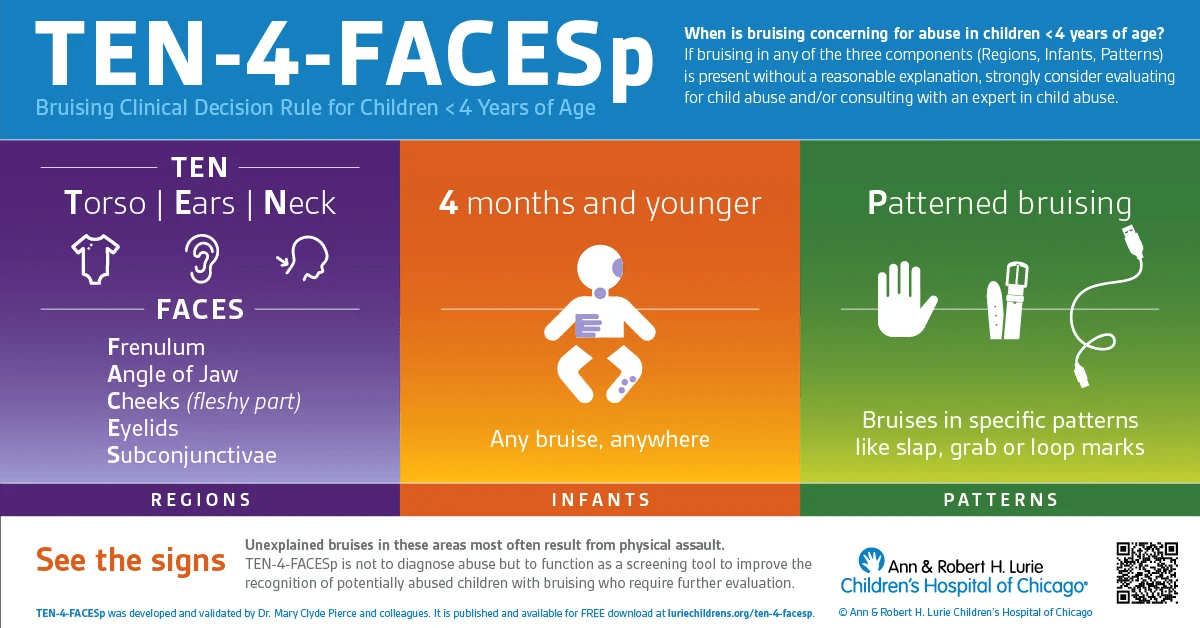
TEN-4-FACESp is a bruising clinical decision tool for children under the age of 4years. Please explain/define the components of this tool:
- TEN
- 4
- FACES
- p
500
Please get out your cell phone