Groups
Vocabulary
Who? What?
Bonding Basics
Cool Chem
100
Elements in the same ___________ would share many of the same chemical and physical characteristics.
What is the same group (or vertical column)?
100
Horizontal rows on the periodic table are know as these.
What are periods?
100
This scientist helped to create the periodic table.
Who is Dmitri Mendeleev?
100
This is what we call the electrons on the outermost shell of an atom. They are available for bonding.
What are valence electrons?
100
This characteristic of metal describes its ability to be pulled into a thin wire.
What is ductility (or ductile)?
200
This group make up the majority of the periodic table and are good conductor or heat and electricity.
What are metals?
200
This quality describes metals because they can be hammered or flattened into thin sheets.
What is malleability (or malleable)?
200
Henry Moseley reorganized the periodic table, arranging the elements by this quality.
What is atomic number (# of protons in the nucleus of an atom)? It used to be ordered by atomic weight.
200
Looking at the dot diagram for aluminum below, would it be stable or unstable? Why?
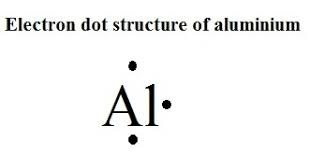
Aluminum would be unstable. It has unpaired valence electrons.
200
Metals are shiny and reflect light, so this term is used to describe them.
What is lustrous (or luster)?
300
This group exhibits some traits associated with metals and some traits associated with nonmetals.
What is a metalloid?
300
This group of gases can be found at the far right of the periodic table. They are known as inert and do not typically react with other elements.
What are the noble gases?
300
This element is a nonmetal, although it is found on the left side of the periodic table, and it is the most common element in the universe.
What is hydrogen?
300
Which electrons are held most strongly by the positively charged nucleus-those close to the nucleus or farther away?
The electrons closest to the nucleus are most strongly attracted.
300
If an element is brittle and dull in appearance (low luster), would it probably be a metal or a nonmetal?
It would be a nonmetal.
400
This group of metals known for their strength and have high melting points. They are less reactive than some other metals.
What are the transition metals?
400
When atoms form chemical bonds and are joined together as a unit, this has been formed.
What is a molecule?
400
The compound produced by this type of bonding often forms water-soluble crystals with a high melting point. The compound is comprised of nonmetal ions and metal ions.
What is ionic bonding?
400
This type of bonding happens when elements share electrons.
What is covalent bonding?
400
This would be where the electrons with the highest energy levels would be found.
What is farthest from the nucleus?
500
The most reactive metals are in this group and are found on the far left of the periodic table.
What are the alkali metals on the far left of the periodic table?
500
This describes a molecule, like water, with a positive part and a negative part.
What is polar?
500
These four elements are most plentiful in the human body.
What are oxygen, carbon, hydrogen, and nitrogen?
500
This type of bonding happens when an atom gives one or more electron to another atom. The atom that gave up the electron(s) will be a positive ion, while the atom that accepted the electron(s) will be a negative ion. They will then be attracted to one another.
What is ionic bonding?
500
When a nonmetal atom bonds with another nonmetal atom, this type of bonding has occurred.
What is covalent bonding?