Density & Physical Properties
Periodic Table Trends
Atomic Structure
Scientific Inquiry & Experiments
Nature of Science
100
- : If you cut a block of pure iron in half, what happens to its density and thermal conductivity?
- They stay exactly the same.
100
- What do elements located in the same vertical column (group) share in common?
Similar chemical properties (reactivity).
100
- Which two subatomic particles are located together inside the central nucleus of an atom?
Protons and neutrons.
100
- : In an experiment testing how salt affects the freezing temperature of water, what type of variable is the amount of salt added?
- Test variable (independent variable).
100
- What happens to a scientific theory when new empirical evidence contradicts part of it?
A) It is immediately discarded and replaced with a new law.
B) It is modified and updated to include the new evidence.
C) It is kept exactly the same because theories never change.
D) It becomes a hypothesis until more testing is completed.
B) It is modified and updated to include the new evidence.
200
- Liquid A has a density of
 and Liquid B has a density of
  . Which liquid forms the top layer when poured into a graduated cylinder?
Liquid B (because it is less dense).
200
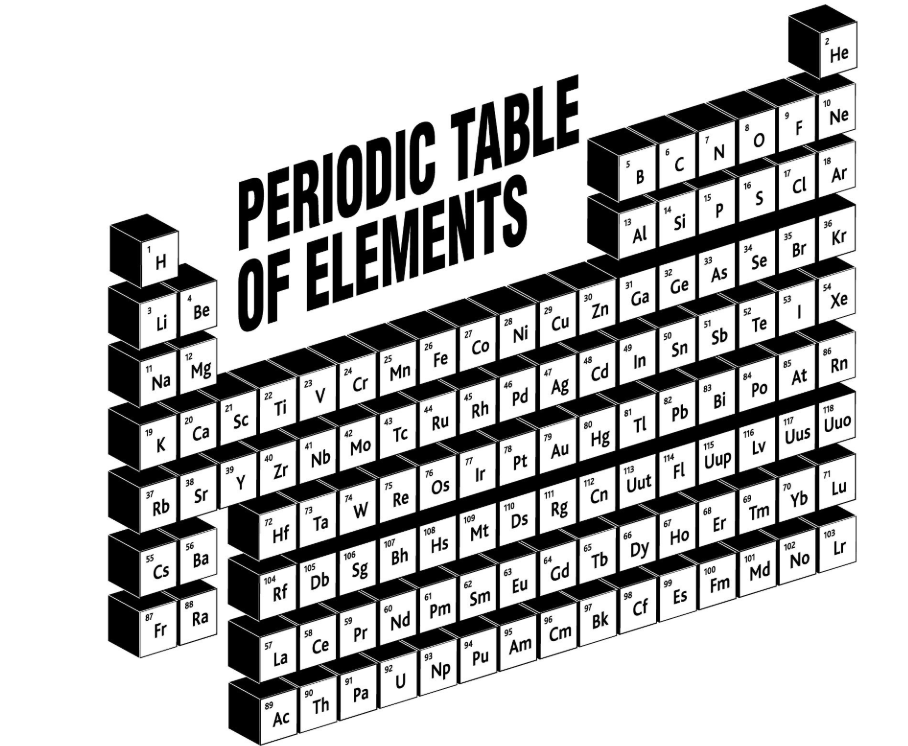 Which element behaves most similarly in chemical reactions to Sulfur (
 )?
)? - Is it Silicon (
 ), Argon (
 ), or
), or - Selenium (
 )?
)?
- Answer: Selenium (
 ).
).
- Answer: Selenium (
200
- Where is the negatively charged electron located in an atom?
- Orbiting outside the nucleus within an electron cloud. ( Shell, Valance)
200
- In Pauline's experiment, Container #1 contained
 of salt. What role does Container #1 play in the setup?
The Control Group (standard for comparison).
200
- If a living organism was discovered that contained zero cells, what change would Cell Theory undergo?
A) Cell Theory would be completely discarded and forgotten.
B) Cell Theory would be modified to incorporate the new discovery.
C) Cell Theory would automatically turn into a Scientific Law.
D) Cell Theory would remain unchanged because theories cannot be updated.
- B) Cell Theory would be modified to incorporate the new discovery.
300
- Two spheres both have a mass of
 . Sphere A has a density of
  and Sphere B has a density of
  . Which sphere has a larger volume?
Sphere B (using  ).
).
300
- To which group on the far right of the periodic table do Helium (
 ) and Argon (
 ) belong?
The Noble Gases (Group 18).
300
- If a basketball represents the mass of a neutron, which small object best represents the relative size of an electron: a soccer ball, a beach ball, or a pea?
A pea.
300
- : What is the term for the variable that a scientist measures to observe the results of an experiment?
Outcome variable (dependent variable).
300
- Why are major scientific theories like Evolution or Atomic Theory unlikely to be discarded completely?
A) They are backed by extensive evidence gathered by multiple scientists over time.
B) They have been proven as mathematical laws and can never be changed.
C) They were written so long ago that scientists are not allowed to edit them.
D) They are simple guesses that do not require any actual data or testing.
A) They are backed by extensive evidence gathered by multiple scientists over time.
400
- : What physical property is demonstrated when table salt dissolves in water?
: Solubility.
400
- : True or False: Elements in Group 13 are completely identical to each other in every physical and chemical way.
Bonus - How are they similar if you chose True or different if you chose False
- False (they share similar chemical reactivity, but have different masses and atomic numbers).
400
- Which dense central region accounts for almost all of an atom's total mass?
The nucleus.
400
- : Complete this hypothesis: "If you increase the amount of salt dissolved in water, then the freezing point temperature will _____."
Decrease (lower).
400
- What type of statement does a scientific theory provide about natural phenomena?
A) An untested prediction written before gathering any data or observations.
B) A statement that describes what happens without giving an underlying reason.
C) A broad, evidence-backed explanation detailing how or why processes happen in nature.
D) A temporary hypothesis that automatically becomes a scientific law over time.
- C) A broad, evidence-backed explanation detailing how or why processes happen in nature.
500
- Two metal blocks take up the exact same amount of space. Block 1 weighs
 and Block 2 weighs
  . Since Block 2 has twice as much mass packed into the same volume, how many times denser is Block 2 than Block 1?
It is double (2 times greater).
500
- Which subatomic particle determines an element's placement on the periodic table and increases by 1 across each period?
Protons (atomic number).
500
- What best describes how scientists develop scientific theories? ( think about how atoms have changed and why)
- A. scientist develop explanations that permanent and don't ever change
- B. Scientist provide evidence and allow for acceptance to change
- C. Scientist make laws that will never change
- D. Scientist come up with ideas and can change science without evidence.
- B. Scientist provide evidence and allow for acceptance to change
500
- : What is the term for keeping liquid volume and container type identical across all test setups?
Controlling variables (constants).
500
What fundamental aspect of scientific knowledge is shown by the shift from the "Plum Pudding" model to Bohr's model to the electron cloud model?
A) Scientific knowledge is open to revision and modification as new evidence is discovered.
B) Earlier scientific models were completely useless and based on false data.
C) Scientific theories automatically turn into scientific laws after three updates.
D) Atomic structure changes physically every time scientists create a new model.
A) Scientific knowledge is open to revision and modification as new evidence is discovered.
600
- An unknown cube has a mass of
 and dimensions of
  . What is its density?
:  (since
  and
and 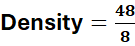 ).
).
600
- Which category of elements makes up the majority of the periodic table and is characterized by high conductivity and luster?
Metals.
600
- : An atom has an atomic number of 15 and a mass number of 31. How many neutrons are in its nucleus?
16 neutrons ( ).
).
600
- A scientist must perform multiple trials of the exact same experiment to ensure the results are _____________ (1) and to reduce _____________ (2).
Word Bank: reliable | errors | evidence | variables
- Reliable and Errors
600
- A scientific _____________ (1) describes _____________ (2) happens, while a scientific theory explains _____________ (3) it happens.
Word Bank:
Why | what | why | hypothesis | law | when
law
what
why