Types of Elements
Atomic Radius
Ionization Energy
Electronegativity
Element ID
100
This type of element makes up most of the period table
Metals
100
Label the following from smallest to largest:
K, Li, Na, Cs
Li, Na, K, Cs
100
List the elements in order form lowest (smallest) IE to highest (biggest) IE.
Ne, Li, O, C
Li, C, O, Ne
100
Which has the larger EN?
F, Br, He, K
F
100
This element is a liquid at room temperature, is conductive, and is shiny
Hg (Mercury)
200
This type of element is a poor conductor and brittle when solid.
Nonmetal
200
Label the following from largest to smallest:
N, B, C, Be
Be, C, N, O
200
List the elements in order form highest (biggest) IE to lowest (smallest) IE.
Br, F, I, Cl
F, Cl, Br, I
200
Which has the smaller EN?
O, Li, Rb, Fe
Rb
200
This element is a solid at room temperature, has one valence electron, and contains 3 energy levels.
Na (Sodium)
400
This is the name of the elements that are part of the staircase
Metalloids
400
Which is bigger?
Br or Br -
Br -
400
This best explains the reason for the trend of ionization energy as you go down a group (vertical).
As you go down a group, there are more energy levels (shells) which means the electrons are farther away from the nucleus, decreasing the coulombic attraction between the nucleus and valence electrons, making them easier to remove.
400
List the elements in order form lowest (smallest) EN to highest (biggest) EN.
As, Br, K, Ca
K, Ca, As, Br
400
This element is a gas at room temperature, is highly reactive, and has 3 energy levels
Cl (Chlorine)
800
This is the name of the family/group that are fairly reactive due to having two valence electrons
Alkaline Earth Metals
800
This explains why cations have smaller radii than their neutral atoms.
Cations lose electrons, which means they lose an energy level, causing the cations to become smaller.
OR
Cations lose electrons, reducing the repulsive forces between electrons, causing the cations to become smaller.
800
This best explains the reason for the trends of ionization energy across a period (horizontal)
There are more protons in the nucleus as you go from left to right across a period, giving the nucleus a greater coulombic attraction to the electrons, making them harder to remove.
800
List the elements in order form highest (biggest) EN to lowest (smallest) EN.
Ba, Mg, Be, Ca
Be, Mg, Ca, Ba
800
This element is smaller than calcium more electronegative than sodium, and has a lower IE than aluminum.
Mg (Magnesium)
1000
This is the name of the family/group that are soft, highly reactive with water and air, and have low densities.
Alkali Metals
1000
This best explains the reason for the trend of atomic radius as you go down a group (vertical).
As you go down a group, there are more energy levels (shells) which means the electrons are farther away from the nucleus, increasing the size.
1000
What group is does this element belong to based on IE values?
1st: 499 kJ/mol
2nd: 624 kJ/mol
3rd: 1422 kJ/mol
4th: 1790 kJ/mol
Alkaline Earth Metals
OR
Group 2
1000
This best explains the reason for the trend of electronegativity as you go down a group (vertical).
As you go down a group, there are more energy levels (shells) which means the valence electrons of other atoms are farther away from the nucleus, decreasing the pull on those electrons.
1000
This element is smaller than silicon, less electronegative than sulfur, and has a higher IE than bismuth (Bi).
P (Phosphorus)
2000
These elements are tasteless, odorless, colorless, and inert (nonreactive).
Noble Gases
2000
This best explains the reason for the trends of atomic radius across a period (horizontal)
There are more protons in the nucleus as you go from left to right across a period, giving the nucleus a greater coulombic attraction to the electrons, drawing them closer and making the atoms smaller.
2000
This is the name of the family/group represented by #3 on the chart
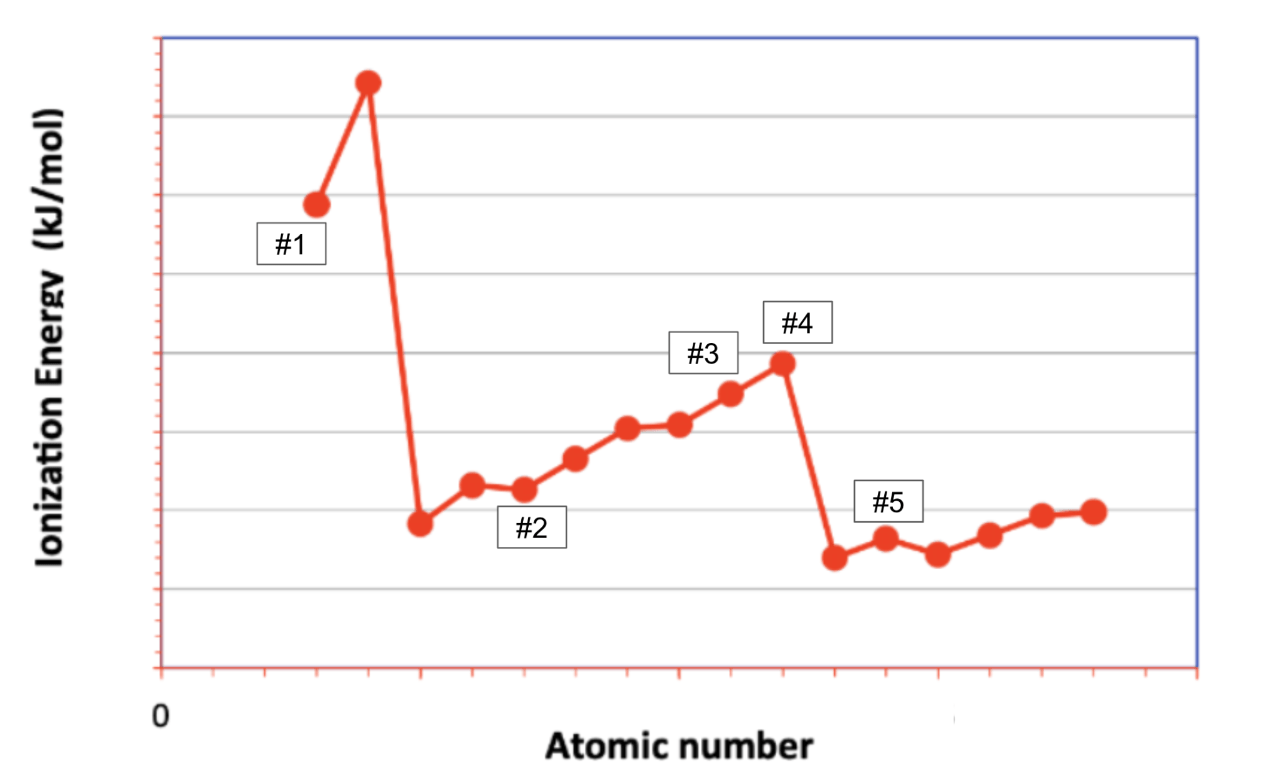
Halogens
2000
This best explains the reason for the trends of electronegativity across a period (horizontal)
There are more protons in the nucleus as you go from left to right across a period, giving the nucleus a greater coulombic attraction to the electrons of the other atom, increasing the pull on the electrons.
2000
This element is fairly reactive, smaller than strontium but larger than sodium, less electronegative than iron, and has a lower IE than chromium.
Calcium