Mixed Bag
Who Knows?
Could Be Anything
You Tell Me
Surprise Surprise
100
A 68-year-old patient with diabetic neuropathy and CKD stage 3 is prescribed gabapentin (Neurontin) 300 mg TID. Two days later, staff find the patient confused and excessively sedated. Which factor is MOST likely contributing to this presentation?
1. The drug is causing paradoxical CNS stimulation
2. Gabapentin accumulates in renal impairment due to reduced clearance
3. The patient developed tolerance within 48 hours
4. Gabapentin interacts with insulin to cause hypoglycemia
2. Gabapentin accumulates in renal impairment due to reduced clearance
Why? Gabapentin is renally cleared and requires dose reduction in CKD. Accumulation leads to excessive CNS depression including sedation and confusion. Dose adjustment based on creatinine clearance is essential.
100
The nurse working on a L & D unit is reviewing the charts of 4 clients. For which of the following clients should the nurse anticipate an order for dinoprostone?
1) A 36.6 week pregnant client with gestational diabetes and an estimated fetal weight of 4,000 g (8 lb, 13 oz)
2) A 39.3 week pregnant client who is 1 cm dilated and experiencing mild, intermittent uterine contractions
3) A 38.1 week pregnant client with a biophysical profile (BPP) score of 2 displaying absent fetal tone and breathing movements and 1 acceleration
4) A 37 week pregnant client with a hx of previous c-section who is 2 cm dilated, experiencing uterine contractions, and desires a vaginal birth
2) A 39.3 week pregnant client who is 1 cm dilated and experiencing mild, intermittent uterine contractions

100
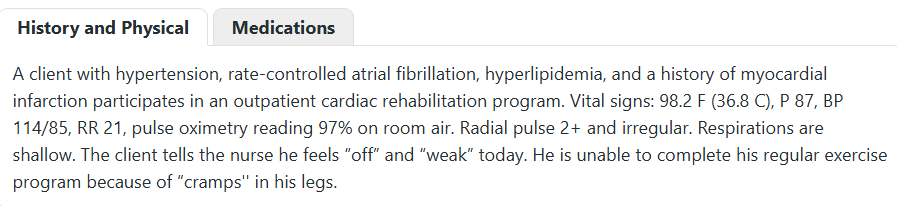
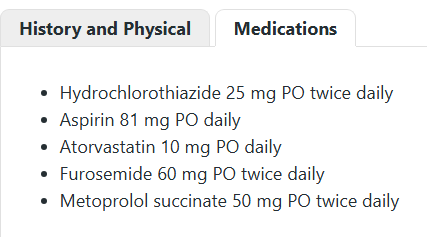
Which findings would require follow up? SATA:
1) Weakness
2) Leg cramps
3) Respiratory status
4) 2+ pulse
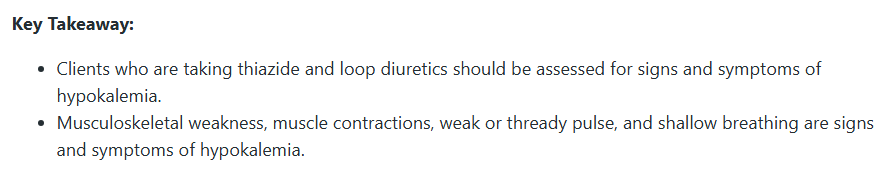
1, 2, 3
100
This ACE inhibitor leads to this annoying but non-dangerous adverse effect affecting up to 15% of patients.
Lisinopril (Prinivil/Zestril)
Why? ACE inhibitor-induced cough results from bradykinin accumulation and affects 10–15% of patients. It does not resolve as long as the ACE inhibitor is continued. ARBs do not inhibit ACE and are the standard alternative.
100
A parent calls asking about their 8-year-old child who has been on montelukast (Singulair) for 2 weeks and is having nightmares and appears more anxious. What should the nurse tell the parent?
1. This is normal — continue the medication
2. Sleep disturbances, anxiety, and behavior changes are a known black box warning; contact the provider
3. Increase the dose to improve tolerance
4. Give the medication in the morning instead of at night to eliminate this effect permanently
2
Montelukast carries an FDA black box warning for serious neuropsychiatric adverse effects including suicidal thoughts, agitation, and sleep disturbances. Parents and patients must be educated about this risk and instructed to contact the provider.
100
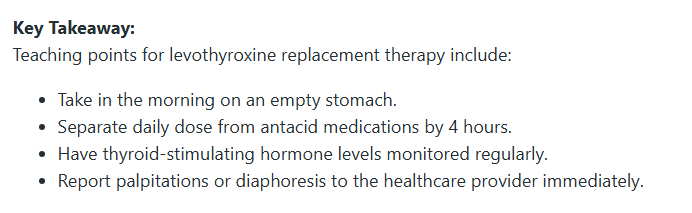
The nurse is teaching a client with newly-diagnosed hypothyroidism how to take PO levothyroxine. Which statements should the nurse include when teaching the client how to take this medication? SATA:
1) "Take this medication with a small meal to avoid nausea."
2) "Separate the daily dose from your antacid meds by 4 hours."
3) "You will require monitoring of your thyroid-stimulating hormone level."
4) "Take this in the evening at the same time every day so you don't forget."
5) "Report any palpitations or diaphoresis to the PCP immediately."
2, 3, 5
100
The nurse is caring for a client who is receiving a high dose of methimazole. When evaluating the client for a potentially life-threatening side effect related to the medication, it would be a priority for the nurse to report:
1) dizziness
2) sore throat
3) pulse of 58
4) 4/10 joint pain
2) sore throat

100
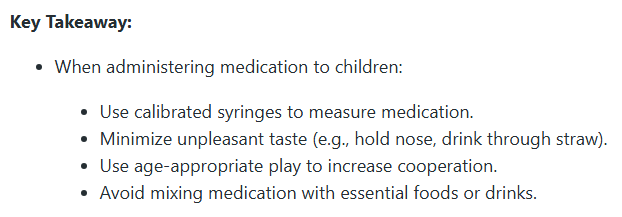
The experienced nurse is observing a newly licensed nurse prepare to administer 4 ml of liquid ibuprofen to a 4 year old client. Which of the following actions by the newly licensed nurse requires follow up?
1) Mix the liquid medication with milk
2) Measure the drug using a 5 ml oral syringe
3) Have the child drink medication with a straw
4) Pretend to give a doll medicine before giving the child medicine
1) Mix the liquid medication with milk
100
For this selective beta-1 blocker, hold the dose and notify the provider if the patient's heart rate falls below this number.
What is the medication and what is the heart rate threshold?
Metoprolol (Toprol/Lopressor) / 60
* The general parameter is to hold if HR < 60 unless otherwise ordered.
100
A patient on HCTZ (Microzide) presents with muscle cramps, fatigue, and a serum potassium of 3.1 mEq/L. The patient is also on digoxin. What is the nurse's priority concern?
1. The HCTZ should be held and potassium replaced; hypokalemia potentiates digoxin toxicity
2. Muscle cramps are expected with diuretics — continue current regimen
3. Hyperkalemia from digoxin may be causing the muscle cramps
4. The patient needs immediate dialysis
1. The HCTZ should be held and potassium replaced; hypokalemia potentiates digoxin toxicity
Why? Thiazide diuretics cause hypokalemia. Hypokalemia potentiates digoxin toxicity by increasing digoxin binding to cardiac Na+/K+ ATPase. This combination is life-threatening and requires urgent potassium replacement and provider notification.
100
The nurse is caring for a client on a continuous IV infusion of heparin for a PE. The client has a critical lab value showing a severely prolonged partial thromboplastin time (PTT) beyond the detectable limit. Which of the following actions should the nurse take next?
1) Stop the IV heparin infusion
2) Administer protamine sulfate
3) Draw blood to repeat the PTT test
4) Assess the client for bleeding or bruising
1) Stop the IV heparin infusion

100
The nurse is caring for a client diagnosed with schizophrenia who is prescribed olanzapine 10 mg PO daily. The nurse reviews the 1000 lab results. Which of the following findings is most concerning to the nurse?
1) BMI of 30.4
2) Hemoglobin A1C of 6.3%
3) Triglyceride level of 220
4) WBC count of 4,500
4) WBC count of 4,500

100
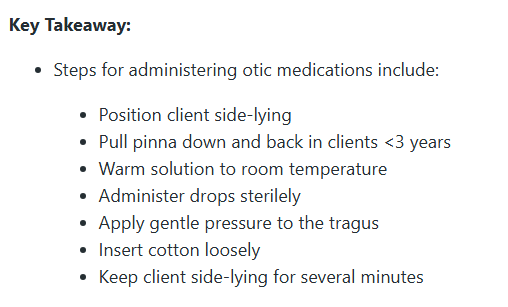
The nurse is preparing to administer antibiotic ear drops to a 2 year old client with acute otitis externa. Which of the following steps are appropriate? SATA:
1) Pulls the client's pinna down and back
2) Inserts the tip of the dropper inside the auditory canal
3) Applies gentle pressure to the tragus after instillation
4) Warms the medication to room temperature in a warm water bath
5) Pushes a piece of cotton inside the auditory canal after administration
6) Maintains client in a side-lying position for a few minutes after instillation
1, 3, 4, 6
100
This is the maximum daily safe dose of acetaminophen in healthy adults; patients on combination opioid analgesics must check OTC labels to avoid exceeding it.
4 g/day (4,000 mg/day) or 3g/day or (3,000 mg/day)
--> Acetaminophen is in both Norco and the OTC cold medication. Exceeding 4 g/day (3 g/day in patients with liver disease) causes hepatotoxicity. Nurses must educate patients to check all OTC labels for hidden acetaminophen.
100
A patient uses albuterol (ProAir) MDI more than 3–4 times per week. Today they are requesting a refill of their second canister this month. What should the nurse discuss with the provider?
1. Increase the dose of albuterol to achieve better control
2. Overuse of SABA suggests inadequate asthma control
3. Prescribe a second SABA for PRN use
4. Patient education on inhaler technique is sufficient
2. Overuse of SABA suggests inadequate asthma control; consider adding or adjusting controller therapy such as an ICS
Why? Frequent SABA use (>2 days/week) is a marker of uncontrolled asthma per NAEPP guidelines. Reliance on rescue bronchodilators without controller therapy increases exacerbation risk. Consider adding or adjusting controller therapy such as an ICS (Inhaled corticoid steroid)
100
The nurse is preparing to administer epoetin alfa to a client. Which of the following actions should the nurse take?
1) Hold the medication if the client reports bone pain
2) Check the client's hemoglobin before administration
3) Shake the medication vial gently before administration
4) Teach the client that the medication is given to increase platelets
2) Check the client's hemoglobin before administration

100
The nurse is preparing to administer intranasal desmopressin to a client with diabetes insipidus. It would be most important for the nurse to monitor the client for:
1) nasal congestion
2) altered mental status
3) decreased urine output
4) low serum sodium level
2) altered mental status

100
The charge nurse is supervising a staff member in the care of clients. Which of the following actions by staff member would require the charge nurse to intervene?
1) Prepares to administer naproxen to a client who is drowsy
2) Prepares to administer aspirin to a 16 year old client with a fever
3) Prepares to administer acetaminophen to a client with CKD
4) Prepares to administer morphine to a 7 year old client with a RR of 28
2) Prepares to administer aspirin to a 16 year old client with a fever

100
An INR of 5.8 with hematuria in a patient on this anticoagulant requires holding the drug and notifying the provider — reversal may involve this antidote.
Name the medication and the antidote
Warfarin (Coumadin) / Vitamin K
--> INR of 5.8 is critically elevated. Hematuria indicates significant bleeding. The dose must be held and the provider notified urgently. Vitamin K, FFP, or 4-factor PCC may be needed depending on bleeding severity.
100
A patient on long-term prednisone (Deltasone) is admitted for a fracture after a minor fall. Labs show blood glucose 220 mg/dL; the patient is not diabetic. Which nursing actions are appropriate?
1. Administer the scheduled prednisone dose and notify the provider of the glucose and fracture
2. Hold prednisone because it is causing hyperglycemia
3. Start a sliding scale insulin protocol as ordered and notify provider of steroid-induced hyperglycemia; do not abruptly stop prednisone
4. Both 1 and 3 are correct
4 - Both 1 and 3 are correct
Why? Long-term corticosteroids cause glucose elevation, osteoporosis, and adrenal suppression. Prednisone must NEVER be abruptly discontinued (risk of adrenal crisis). Hyperglycemia is expected and managed. Provider notification for both the fracture and glucose level is essential.
100
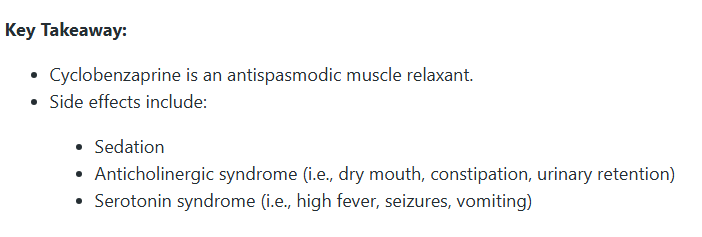
The nurse is providing medication teaching to a 65 year old client who has been prescribed cyclobenzaprine. Which client statements indicate understanding of the teaching provided? SATA:
1) "I should ask for a prescription of naloxone as needed."
2) "I can expect the medication to make my urine look darker."
3) "I should stop the cyclobenzaprine if I have a fast heartbeat."
4) "I should avoid alcohol until I'm finished with these medications."
5) "I'll have my partner drive me to my follow-up appointment in a few days."
3, 4, 5
100
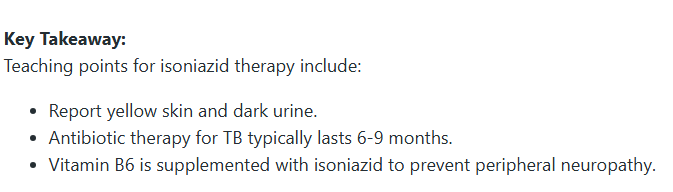
The nurse is providing instructions to a client who has a prescription for isoniazid for TB. Which of the following information should the nurse include?
1) Report yellow skin and dark urine
2) Supplement vitamin C while taking INH
3) A typical course of isoniazid for TB lasts 5-7 days
4) This medication may turn urine, tears, and sweat reddish-orange
1) Report yellow skin and dark urine
100
The nurse is administering rosuvastatin to a client with a diagnosis of CAD. Which of the following findings would cause the nurse to question administration?
1) Client reports flushing
2) Client reports muscle pain
3) Blood pressure of 94/66
4) Total cholesterol level of 185 (ref range: <200)
2) Client reports muscle pain

100
This antiemetic prolongs the QTc interval and should be used with extreme caution — or avoided — in patients already on QTc-prolonging drugs like methadone.
Ondansetron (Zofran)
Why? Ondansetron prolongs the QTc interval, particularly at higher doses. Combined with methadone (a potent QTc prolonger), the risk of torsades de pointes is significantly elevated.
100
A patient on quetiapine (Seroquel) for schizophrenia has gained 25 lbs in 3 months and has a new fasting glucose of 148 mg/dL. Which actions should the nurse take? (Select all that apply)
1. Notify the provider — metabolic syndrome is a serious adverse effect of atypical antipsychotics
2. Monitor fasting lipids, blood pressure, and waist circumference
3. Reassure the patient this is expected and not medically significant
4. Educate the patient about diet and exercise
5. Document findings and continue routine monitoring
1, 2, 4, 5
Why? Atypical antipsychotics including quetiapine are associated with metabolic syndrome: weight gain, hyperglycemia, dyslipidemia, and hypertension. This requires provider notification, metabolic monitoring, and lifestyle counseling. It is NOT insignificant.