Photosynthesis I
Photosynthesis II
Cellular Respiration I
Cellular Respiration II
Random
100
This products of photosynthesis
Glucose, oxygen
100
The two REACTANTS of photosynthesis.
water and carbon dioxide
100
The two REACTANTS of cellular respiration.
glucose and oxygen
100
The PRODUCTS of cellular respiration.
carbon dioxide, water, and energy (ATP)
100
Adenosine triphosphate (ATP) is primarily used in living organisms for what?
Energy
200
In the desert, many plants like succulents will only open their stomata at night. Why do they do this?
To prevent water loss
200
Where does photosynthesis occur?
Only in chloroplasts of plant cells
200
Glycolysis occurs in this part of the cell, where only a small amount of energy is released.
cytoplasm
200
The Krebs cycle and ETC occur in this organelle, where LARGE amounts of energy are produced.
mitochondria
200
What types of living organisms do cellular respiration and have mitochondria?
BOTH plants and animals do cellular respiration (along with fungi, many types of bacteria, etc.)
300
Carbon dioxide enters a land plant through these small openings or pores on the undersides of the leaves.
What are stomata?
300
This pigment absorbs light energy and uses it to power photosynthesis.
chlorophyll
300
What are the 3 steps of cellular respiration in order?
glycolysis, Kreb's Cycle, and ETC
300
What happens after glycolysis if oxygen is unavailable?
Cellular Respiration cannot happen, fermentation will happen instead
300
Determin whether each of these is an autotroph or a heterotroph:
- dog
- banana
- oak tree
heterotroph, autotroph, autotroph. I know this because the dog must eat to live while trees and other plants make their own food through photosynthesis.
400
You look at the underside of a plant leaf under a microscope. You observe that many of the stomata are open on the leaf. What would this indicate about the plants’ environment and what is it doing?
That the plant is probably in a cooler, shaded environment and that there is a lot of gas exchange occurring. (The plant is taking in CO2 to do photosynthesis and releasing the waste product, O2.)
400
How do plants gain mass?
carbon dioxide in the air -- over time the carbon gets incorporated into their bodies after photosynthesis turns the carbon into glucose molecules
400
How are photosynthesis and cellular respiration related?
The products of one process are the reactants for the other/ The equations are opposite one another
400
When your cells are not getting enough oxygen during rigorous exercise, your muscles burn when this process happens in your cells
Lactic acid fermentation
400
Why does heart rate and breathing rate go up while you exercise? (must provide detailed answer)
Your cells require more energy, so more cellular respiration must happen. Your heart is pumping faster to deliver O2 to your cells for this process and removing CO2. You breathe more to obtain more O2 and rid of excess CO2 that is made during cellular respiration.
500
Label this organelle and its parts. What types of cells are these found in?
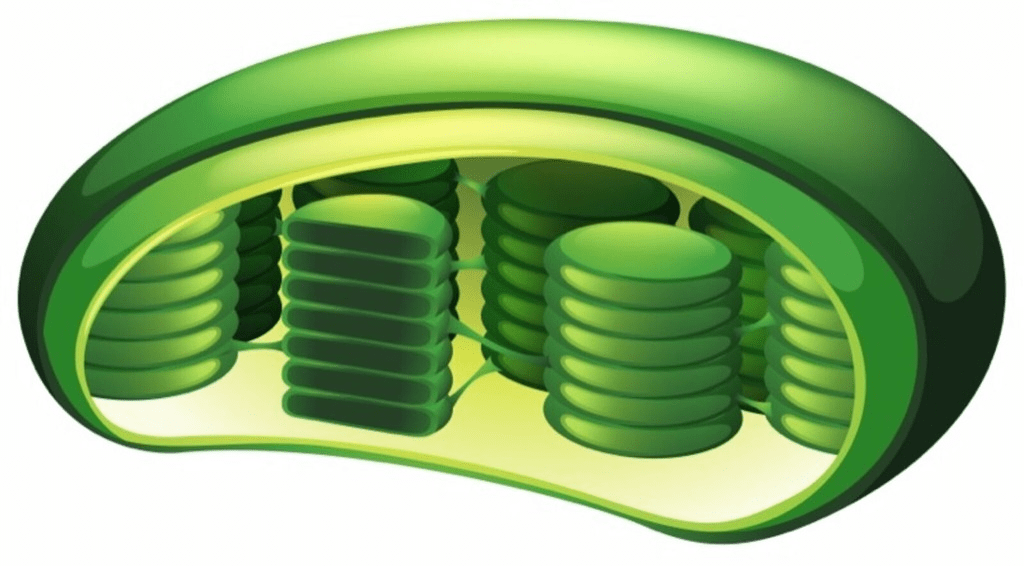
This is a chloroplast. Inside, the disc-shaped parts are thylakoids and they are surrounded by a liquid called stroma. Stacks of thylakoids are called grana.
You will find these only in plant cells and some bacteria that can do photosynthesis.
500
What cells control the opening and closing of stomata? How do they do this?
Guard cells-- They inflate and cause the opening to appear when there is plenty of water in the plant. They deflate and close the opening when not enough water is present so that the plant doesn't continue to lose too much water.
500
Which steps of cellular respiration are aerobic, and happen in the mitochondria?
only Kreb's Cycle and ETC
500
This kind of fermentation is important to bakers (yeast do this)
alcoholic fermentation
500
Cyanide halted WHICH part of cellular respiration in the Tylenol murders we discussed?
the ETC