Vocabulary
Phase Changes and Gas Laws
Atoms/Periodic Table
Bonding
Chemical Equations
Chemical Nomenclature
100
A _____ is a positively charged particle in the nucleus that determines the element's identity.
Proton
100
List the three phases of matter in order from least kinetic energy to most kinetic energy
Solid, Liquid, Gas
100
Give an example of an alkaline earth metal
Be, Mg, Ca, Sr, Ba, Ra
100
If atoms give and take away electrons, which type of bond is being studied?
Ionic
100
What is the order you should balance elements in when balancing equations?
metals
nonmetals
hydrogen
oxygen
100
Which type of bond tells us that prefixes are required when naming compounds?
Covalent Bond
200
Columns (up and down) within the periodic table are called _____
Families
200
Presented below is a shower thought. Pick a stance and defend your point:
If you are waiting on a waiter, aren't you the waiter?
HAPPY SUMMER!!! ENJOY THESE 200 POINTS FOR FREE!!!
200
Give an example of an element with 4 VE's
C, Si, Ge, Sn, Pb
200
What is the ultimate goal when atoms form a bond?
To reach 8 valence electrons, either by filling or emptying their outer shell.
200
Balance the following chemical equation:
__ BaCl2 + __ H2SO4 = __BaSO4 + __HCl
What are the reactants?
How many chlorine atoms are on the right side before balancing?
1, 1, 1, 2
BaCl2 + H2SO4
1 chlorine atom
200
What type of element requires roman numerals when naming?
Transition Metals
300
__________ tells us that when temperature increases, volume increases as well
Charles's Law
300
Answer the following questions from this graph:
- How long is this substance a solid?
- At what letter does the substance have the most kinetic energy?
- At what temperature is this substance finished melting?
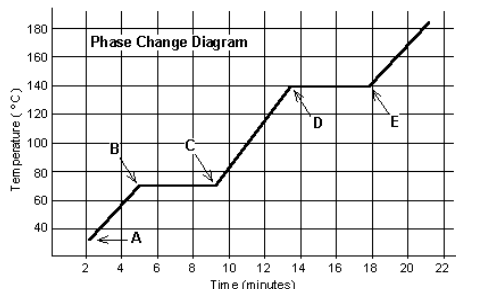
3 minutes
E
70 degrees Celsius
300
Why does most of the mass of an atom exist in the nucleus?
Protons and neutrons are x2000 larger than electrons, and both of those subatomic particles are located in the nucleus.
300
Draw the bond for the following elements: Mg and F
Then answer these questions:
- How many electrons does magnesium give up?
- How many fluroine atoms are in your final drawing?
- What is the charge on a single fluroine atom?
Mg gives up 2 electrons
2 Fl atoms are in the final drawing
Fl has a charge of -1
300
Balance the following chemical equation:
__ Fe + __Cu2O --> __Fe2O3 + __ Cu
What are the reactants?
How many copper atoms are on the left side after the equation is balanced?
2, 3, 1, 6
Fe + Cu2O
6 copper
300
Name this compound:
S2F4
Disulfur Tetrafluoride
400
_____ is the process where a solid changes directly into a gas without passing through the liquid phase.
Sublimation
400
If 22.5 L of nitrogen at 748 mm Hg are compressed to 725 mm Hg at constant temperature. What is the new volume?
Round your answer to the nearest tenths place
23.2 L
400
Rank the following elements from most ionization energy to least ionization energy:
Selenium (Se), Oxygen (O), Tellerium (Te), Sulfur (S)
O, S, Se, Te
400
Draw the bond for the following compound: P2
Then answer these questions:
- How many total electrons are needed in your drawing?
- How many double bonds are present in your drawing?
- How many free electrons does your drawing have?
10 electrons
TRICK QUESTION...it's a triple bond!!!
4 free electrons
400
Balance the following chemical equation:
__Mn(OH)2 + __ HPO3 --> __ Mn(PO3)2 + __ H2O
What are the products?
How many hydrogen are on the right side after balancing?
1, 2, 1, 2
Mn(PO3)2 + H2O
4 hydrogens
400
Write the formula for the following compound:
Magnesium Chloride
MgCl2
500
_____ are atoms of the same element that have the same number of protons but different numbers of neutrons.
Isotopes
500
A gas is heated from 263.0 K to 298.0 K and the volume is increased from 24.0 liters to 35.0 liters by moving a large piston within a cylinder. If the original pressure was 1.00 atm, what would the final pressure be?
Round your answer to the nearest hundredths
0.78 atm
500
Why does electronegativity increase as you move right across a period in the periodic table?
Why does electronegativity increase as you move right across a period in the periodic table?
500
Draw the bond for the following elements: Al and O
Then answer these questions:
- How many electrons does oxygen give up?
- How many oxygen atoms are in your final drawing?
- What is the charge on a single aluminum atom?
TRICK QUESTION...none
3 oxygen atoms are needed
Al has a charge of +3
500
Balance the following chemical equation:
__ Al4C3 + __ H2O --> __Al(OH)3 + __ CH4
What are the products?
How many hydrogen are present on the right side before balancing?
1, 12, 4, 3
Al(OH)3 + CH4
7 hydrogen
500
Write the formula for the following compound:
Sodium Carbonate
Na2CO3
600
_____ is the average kinetic energy of the particles that make up a substance.
Temperature
600
Maybelline Cousteau’s backup oxygen tank reads 900 mmHg while on her boat, where the temperature is 27 degrees celsius. When she dives down to the bottom of an unexplored methane lake on a recently-discovered moon of Neptune, the temperature will drop down to –183 degrees celsius. What will the pressure in her backup tank be in mm Hg at that temperature?
270 mm Hg
600
Fill in the 4 blanks with the correct numbers. You have 3 minutes
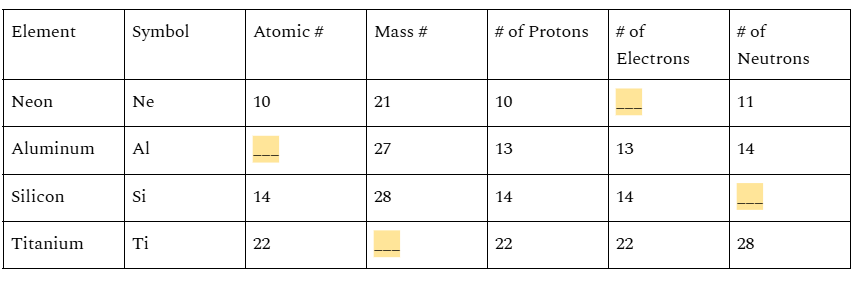
Blank 1= 10
Blank 2= 13
Blank 3= 14
Blank 4= 50
600
Draw the bond for the following compound: NOCl
Then answer these questions:
- Which element goes in the center of the drawing?
- How many double bonds are present in your drawing?
- Who is happy after initially placing your electrons but before the drawing is complete?
- Nitrogen is in the center
- 1 double bond is present
- Oxygen and Chlorine are satisfied before moving anything around
600
Balance the following chemical equation:
__ Fe2S3 + __ O2 = __ SO2 + __ Fe2O3
What are the reactants?
How many oyxgen are on the right side before balancing?
2, 9, 6, 2
Fe2S3 + O2
5 oxygens
600
Name the following compound:
Ni3(PO4)2
Nickel (II) Phosphate