States of Matter
Properties
Mixtures & Solutions
Physical & Chemical Changes
Matter
100
What are the three main states of matter?
Solids, liquids, and gases.
100
In physical science, what are properties?
A property is any characteristic that is used to describe matter such as its color, material, or shape.
We use these characteristics to identify matter and distinguish them from one another.
For instance, that's how we can tell the difference between gold and silver.
100
A ____________________
contains two or more substances
that are not chemically combined.
Mixture
100
What is a chemical change?
A change that occurs when the particles that make up two or more substances are rearranged to form a new substance.
100
What is matter?
Anything that has weight and takes up space
200
This state of matter has a
definite shape and volume
and has particles that are
tightly packed together
Solid
200
Pick an object in this room.
What are some of its properties that can be observed?
Provide at least three.
Color, shape, material. You can tell just by looking at the object.
200
If matter can easily dissolve into a liquid
it has high _________________.
Solubility
200
What are some of the signs
that a chemical change is occurring?
Makes smells
Releases light
Releases gases
Gives off or takes in heat
200
What is an matter made of?
Tiny particles
300
___________________ happens when water vapor changes directly into ice —such a snowflakes and frost.
Notably, this is the process where water changes directly to ice without first becoming a liquid.
It usually happens at the top of mountains where temperatures are low.
Deposition (the opposite of sublimation)
300
Pick an object in this room.
What is one of its properties that can be measured?
Provide a measurement for that object.
Length, width, height, volume, weight. You need to use tools, numbers, and math in order to measure something.
300
Which type of solution has too much solute and no more solute will dissolve?
Saturation is the point at which no more solute can dissolve in a solution. For example, when you add too much sugar to water, at some point the sugar won’t dissolve anymore.
300
In a ___________ change,
a new substance is made,
like when you burn a candle.
In a ________ change,
no new substance is made,
like when water turns to ice.
In a chemical change,
a new substance is made,
like when you burn a candle.
In a physical change,
no new substance is made,
like when water turns to ice.
300
Provide three examples of matter in this classroom.
Everything is matter!!!
400
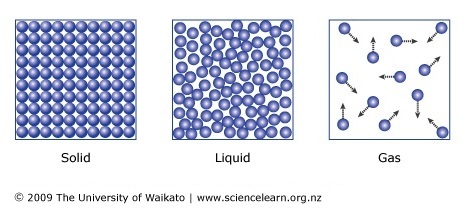
Come up to the board to draw a model that shows how the atoms behave in each of the three states of matter.
400
Which property of matter changes depending on the gravitational pull?
In other words, which property is affected by gravity?
Weight.
400
Imagine you are creating a solution. What is the solute in your experiment? What is the solvent in your experiment?
The solute is the substance that is dissolved in a solution. For example, sugar is a solute when mixed with water because it is dissolving in the water.
The solvent is the substance that does the dissolving in a solution. For example, water is the solvent when mixed with sugar because it is helping the sugar dissolve.
400
Provide an example of a chemical change and a physical change.
Nice :)
400
Provide an example of
each of the three states of matter
that cannot be found in this classroom.
Rad :)
500
Can states of matter change?
If yes, provide an example.
Yes they can!
500
How do you think
investigating properties of matter
might be useful in the real world?
It's important to tell the difference between substances that could be potentially harmful or unknown.
500
Sort between mixtures and solutions
using the examples provided.
Sweet! :)
500
Sort the following items between
physical and chemical changes.
Cool :)
500
What is the difference between an
atom and a molecule?
Atoms are tiny particles that are the basic building blocks of all matter.
Molecules, on the other hand, are made up of atoms that are held together by a chemical bond.