You've Got Some Nerve
IDEK
Gassy
Take My Breath Away
Under Pressure
100
During attempted awake intubation, the patient gags when the laryngoscope presses on the base of the tongue due to the following cranial nerve.
A. Trigeminal
B. Facial
C. Glossopharyngeal
D. Vagus
E. Hypoglossal
What is...
C. The Glossopharyngeal nerve?
100
Which statement about the Pin Index Safety System is MOST likely true?
a. It prevents turning on two vaporizers at the same time.
b. It prevents interchanging the connections for different gases from the wall outlet to the anesthesia machine.
c. It is designed to prevent administration of an hypoxic gas mixture.
d. It couples the nitrous oxide and oxygen flowmeters.
c. It is designed to prevent administration of a hypoxic gas mixture.
100
This is the way that the majority of carbon dioxide is transported in the blood.
*Extra points- name all the ways it is transported
What is...
Dissolved in plasma: 5-7%
Bound to hemoglobin: 10%
Bicarb buffer system: Majority (85%)
100
Nitrogen washout (end-tidal nitrogen) is used to approximate this lung value (i.e. a volume or capacity).
What is...Functional residual capacity?
100
*A PaO2 of 60mmHg corresponds to a saturation of:
What is 90%?
200
A patient is undergoing exploration of a stab wound to the left side of the neck. On awake laryngoscopy, the left vocal cord is in midposition and the right vocal cord is abducted during inspiration. Trauma to this structure on the LEFT is the most likely cause of these findings.
A. C7-8 nerve root
B. Stellate ganglion
C. Glossopharyngeal nerve
D. Superior laryngeal nerve
E. Vagus nerve
What is...
E. Vagus nerve?
200
*What does red indicate on color doppler on ultrasound? (i.e. flow direction, frequency)
Source moving TOWARD probe = HIGHER frequency
200
What is the second gas effect?
Rapid uptake of a high-concentration gas (like nitrous oxide) reduces alveolar volume and transiently increases the concentration of a concurrently administered second gas, accelerating its rise in alveolar partial pressure.
- Think of a bowl of trail mix:
70 peanuts (nitrous)
2 M&Ms (sevo)
If you suddenly remove most of the peanuts…
The M&Ms now make up a bigger percentage Ihigher concentration) of what’s left, even thought its the same amount of M&Ms.
200
National Institute for Occupational Safety and Health (NIOSH) recommends limiting the room concentration of nitrous oxide to ___
25ppm
200
Draw and label the lung volume and capacity chart.
Hint: label 6 items

A= TV
B=IRV
C=ERV
D=VC
E= RV
F=TLC
300
The following statement about the superior laryngeal nerve is TRUE.
A. It provides sensory innervation to the subglottic surface of the vocal cord
B. It provides sensory innervation to the inferior surface of the epiglottis
C. It is a branch of the glossopharyngeal nerve
D. It is blocked by injection of anesthetic near the lateral portion of the cricothyroid membrane
E. It is the most commonly injured nerve during thyroid surgery
What is...
B. It provides sensory innervation to the inferior surface of the epiglottis
300
*The point of maximum amplitude corresponds to this during an oscillometric blood pressure cuff measurement.
What is... MAP?
These devices directly measure MAP
300
A sevoflurane vaporizer is filled with isoflurane and the vaporizer dial is set at 1%. What will happen?
Overdose
More than 1% isoflurane will be delivered
300
How will an under-dampened arterial line affect blood pressure values?
UnderDamp overshoot SBP, underestimate DBP, MAP accurate

300
Your patient has recently had a vitrectomy for retinal detachment repair. Which of the following statements regarding nitrous and recent intraocular surgery is TRUE?
a. It is safe to use nitrous 10 minutes prior to intraocular gas
b. It is safe to use nitrous 7 days after the patient received a filtered room air bubble
c. It is safe to use nitrous 7 days after the patient received a sulfur hexafluoride bubble
d. It is safe to use nitrous 7 days after the patient received a perfluoropropane bubble
b. It is safe to use nitrous 7 days after the patient received a filtered room air bubble.
-D/c nitrous >15min before
-Air bubble lasts 7 days
-SF6 lasts 10d-1month
-C3F8 lasts 6-8weeks
400
*What property of helium makes it beneficial to a patient with postop stridor?
Its low density
-Heliox reduces work of breathing and decreases airway resistance by facilitating laminar flow (because turbulent flow is dependent on gas density.)
-Can treat upper airway obstruction, post-extubation stridor, COPD, asthma.
400
This muscle tenses the vocal cords.
What is...
The cricothyroid muscle?
*What nerve innervates it??
400
A 70-year-old man who underwent bilateral carotid endarterectomies two years ago is to undergo anesthesia and surgery. The denervation of the carotid bodies is likely to result in this.
A. chronic respiratory alkalosis
B. decreased ventilatory response to hypoxemia
C. increased ventilatory response to hypercarbia
D. labile hypertension
E. resting bradycardia
What is...
B. decreased ventilatory response to hypoxemia?
400
*The desflurane percentage delivered from a vaporizer at high altitude will be ___ to the desflurane delivered from a vaporizer at sea level.
A. Decreased
B. Same/unchanged
C. Increased
What is B, the same/unchanged?
500
Name the liters and PSI in a full nitrous oxide tank AND in an oxygen tank.
What is...
Nitrous: 750PSI; 1600L
Oxygen: 2200PSI; 700L
*Bonus* How many liters are left in a nitrous tank once the PSI drops below 750?
500
This is characteristic of the airway in a 2-month-old when compared with an adult airway.
A. Airway is narrowest at the cricoid cartilage
B. Epiglottis is broader
C. Laryngeal mucosa is more tightly adherent
D. Larynx is positioned lower in the neck
E. Vocal cords have a more cephalad anterior attachment
What is...
A. The airway is narrowest at the cricoid cartilage?
500
Which of the following is the most appropriate action after an anesthetic vaporizer (Tec4) is tipped?
a. Return to the manufacturer for recalibration
b. Flush the vaporizer with oxygen at 5 L/min for 24 hours
c. Store the vaporizer for 24 hours at room temperature
d. Set the vaporizer at high concentration and flush with oxygen at 10 L/min for 30 minutes
d. Set the vaporizer at high concentration and flush with oxygen at 10 L/min for 30 minutes
Tipping may flood the bypass area and lead to dangerously high anesthetic concentrations because liquid anesthetic is much more potent (1ml liquid sevo produces 184ml vapor!)
500
Write Out:
-Alveolar Gas Equation
-Arterial Oxygen Content Equation

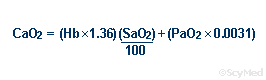
500
Name two molecules or drugs that are metabolized in the lungs.
Not a complete list....
Norepinephrine, serotonin, bradykinin, prostaglandins, leukotrienes
Drugs: Lidocaine, prilocaine, bupivacaine, mepivaciane, thiopental, propofol, fentanyl, sufent, alfent, methadone, morphine, codeine
600
You patient is coughing during awake intubation; you may have not adequately localized this/these nerve(s).
A. Glossopharyngeal
B. Hypoglossal
C. Recurrent laryngeal and glossopharyngeal
D. Recurrent laryngeal and superior laryngeal
E. Superior laryngeal and glossopharyngeal
What are the...
D. Recurrent laryngeal and superior laryngeal?
600
*Error will increase when using doppler to evaluate an artery under ultrasound when this is changed.
-Angle of transducer
-Probe frequency
-Color
What is...Angle. (If your angle is above 60 degrees, the probe cannot compensate as well and error increases)
600
Administration of 200 mEq of sodium bicarbonate during cardiopulmonary resuscitation is associated with this.
A. CSF alkalosis
B. hypercalcemia
C. hypercarbia
D. hyperkalemia
E. shift of the oxyhemoglobin dissociation curve to the right
What is...
C. hypercarbia?
600
Oxygen 300 ml/min is bubbled through a vaporizer containing an anesthetic with a vapor pressure of 100 mmHg, and this mixture is added to a fresh gas flow of 3 L/min. The delivered anesthetic concentration is
A. 0.8%
B. 1.0%
C. 1.2%
D. 1.6%
E. 2.0%
C. 1.2%
-SVP/atmP= x/(x + carrier ml), solve for x (which is anes in mL)
Saturated % = 100/760 = 0.1316 = 13%
Agent mL = 13% of 300 = 39 mL/min
Total flow = 3000 + 300 = 3300
Delivered % = 39/3300 = 0.0118 = 1.18%
Shortcut: 100/760 ≈ 1/8 ≈ 12.5%.
600
On Monday morning, you enter your room and see the "end case" button was not clicked. (Yup, you're in that OR with the missing button.)
Later, you are 30 minutes into an otherwise uneventful case. After incision, you turn up the deslufrane after your patient develops unexplained tachycardia. The pulse oximeter reads 100%, and the capnography waveform and ETCO₂ are normal.
Which of the following may be DECREASED in this patient?
A. Mixed Venous Oxygen Content
B. PaO2
C. Carboxyhemoglobin
D. SpO2
A. Mixed Venous Oxygen Content
Reaction between desflurane and desiccated CO₂ absorbent produces carbon monoxide. Falsely elevated PaO2 and SpO2.
Order of CO Production: Des>Iso>Sevo